Description
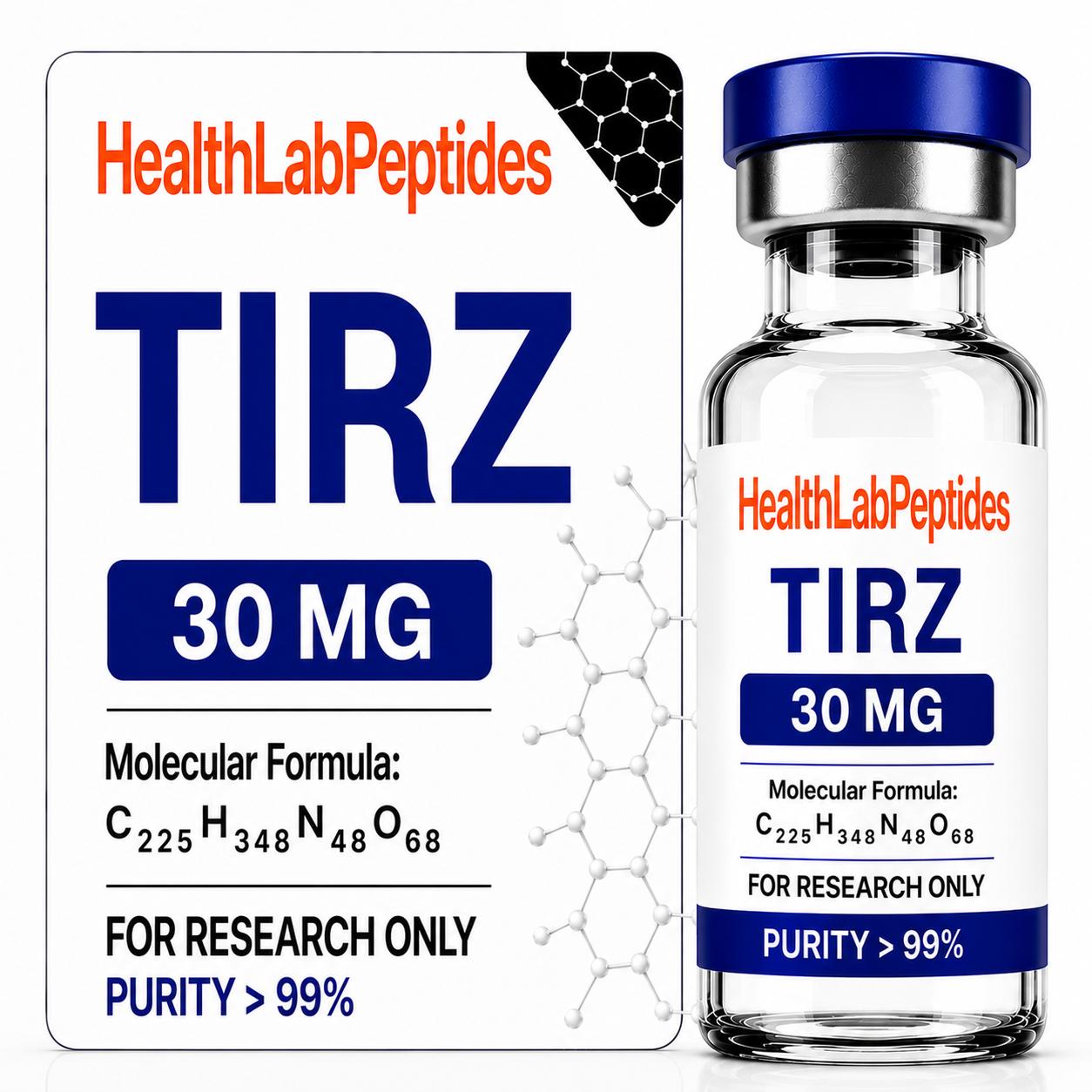
Research suggests that accurate interpretation of Tirz research material begins with molecular identity, analytical documentation, and a clear distinction between sequence confirmation, chromatographic purity, total material mass, and assay performance. HealthLab Peptides offers this Tirz Research Material — 30mg exclusively for legitimate laboratory, analytical, and in-vitro research.
Researchers comparing nominal material quantities, analytical recovery, or receptor-assay performance may also review Tirz Research Material — 20mg and Tirz Research Material — 40mg. These internal links are provided for laboratory catalog navigation; different vial quantities should not be assumed to establish analytical equivalence between lots.
Tirz 30mg molecular identity and chemical makeup
Tirz is the HealthLab catalog abbreviation for the underlying analytical identity tirzepatide. It is a synthetic, modified peptide containing 39 amino-acid residues. Its design is based on a GIP-related peptide sequence and incorporates two non-coded residues of 2-aminoisobutyric acid (Aib) at sequence positions 2 and 13. Aib is an alpha,alpha-disubstituted amino acid that can affect local peptide conformation and proteolytic susceptibility compared with a sequence composed only of standard proteinogenic amino acids.
| Analytical attribute | Technical description |
|---|---|
| Material designation | Tirz research material |
| Underlying identity | Tirzepatide |
| Peptide length | 39 amino-acid residues |
| Empirical formula | C₂₂₅H₃₄₈N₄₈O₆₈ |
| Average molecular mass | Approximately 4813.5 Da |
| Monoisotopic mass | Approximately 4810.52 Da |
| Non-coded residues | Aib at positions 2 and 13 |
| C-terminal chemistry | C-terminal amide |
| Side-chain modification | Lys20-linked 1,20-eicosanedioic acid through a defined linker |
| Declared vial quantity | 30mg |
Lys20 linker and C20 fatty-diacid modification
The lysine residue at position 20 carries a covalently attached 1,20-eicosanedioic acid moiety. The lipid portion is joined through a structured linker containing a gamma-glutamyl unit and two 8-amino-3,6-dioxaoctanoic-acid spacer units. This side-chain architecture adds substantial atoms and mass beyond the linear 39-residue peptide backbone. For that reason, identity assessment should consider the complete modified molecule rather than comparing only an unmodified amino-acid sequence.
The molecule also has a C-terminal amide rather than a free C-terminal carboxyl group. Terminal chemistry, the two Aib residues, and the Lys20 lipid-linker structure are all identity-defining features. A nominal intact mass can support identity, but sequence-informative fragmentation or peptide mapping may be needed when a laboratory must distinguish closely related variants or confirm modification placement.
Analytical characterization of Tirz research material
A complete Tirz research-material assessment may use several complementary analytical methods. LC-MS or high-resolution mass spectrometry can compare the observed intact molecular ion with the expected molecular mass. Charge-state assignment, adduct recognition, mass accuracy, and deconvolution settings should be documented because a modified peptide of this size commonly appears as multiple charged ions rather than one simple molecular peak.
Reverse-phase HPLC or UPLC can evaluate retention behavior and the relative area of the principal chromatographic peak. HPLC area percentage should not be described as total mass purity without qualification. Detector wavelength, integration threshold, baseline selection, co-elution, counterions, associated water, residual solvents, and non-UV-active material can all affect how chromatographic purity relates to the total contents of a vial.
Tandem mass spectrometry and peptide mapping can add sequence-position evidence. Important reporting elements include precursor charge state, collision conditions, fragment tolerance, sequence coverage, evidence surrounding the Aib-containing regions, and confirmation of the lipid-linker attachment region. Researchers should preserve raw spectra and processing parameters rather than relying only on a summary identification score.
Purity, quantity, water, and counterion are different measurements
The declared 30mg vial quantity is not the same measurement as HPLC peak-area purity. Quantitative laboratory work may need to consider peptide-equivalent content, moisture, counterion or salt contribution, residual volatiles, and analytical recovery. Lot documentation and the applicable Certificate of Analysis should be reviewed before method development, reference comparison, or a concentration-sensitive in-vitro experiment.
- Identity testing asks whether the material matches the intended modified peptide.
- Chromatographic purity estimates the relative detector response of resolved peaks under one method.
- Mass-based content addresses how much analyte-equivalent material is present on a stated basis.
- Moisture and counterion testing evaluates non-peptide contributions that may affect gravimetric calculations.
- Functional assay performance measures behavior in a defined in-vitro model and cannot replace identity testing.
In-vitro receptor-assay research context
In laboratory models, Tirz is commonly examined with assays involving GIPR and GLP-1R receptor systems. Appropriate in-vitro research may compare binding or engagement, cAMP signaling, beta-arrestin recruitment, receptor internalization, response kinetics, receptor-expression dependence, matrix recovery, or cross-platform normalization. These are model-specific measurements and should not be extended beyond the receptor construct, host cell, detection platform, and conditions actually tested.
For a detailed discussion of receptor-expression balance, reference controls, and matched assay design, see Tirz Dual-Receptor Research: Quantifying GIPR and GLP-1R Balance Across Matched Assays. Researchers can also review the complete HealthLab Peptides research-material catalog for other documented RUO analytical comparators.
Laboratory controls and documentation
- Review the lot-specific Certificate of Analysis and retain the lot identifier with the raw data.
- Verify intact identity and chromatographic behavior before using a functional assay as evidence.
- Use matrix blanks, vehicle controls, qualified reference material, recovery checks, and independent preparations.
- Document container type, contact time, temperature history, transfer count, instrument settings, integration rules, and software version.
- Distinguish technical repeat measurements from independently prepared experimental replicates.
- Use only within an appropriately equipped laboratory under qualified supervision and applicable institutional procedures.
- Purchasers are responsible for lawful acquisition, storage, handling, recordkeeping, and disposal.
Research Use Only (RUO). For legitimate laboratory, analytical, and in-vitro research only.
NOT FOR HUMAN OR VETERINARY USE, CONSUMPTION, INGESTION, INJECTION, IMPLANTATION, OR OTHER BODILY ADMINISTRATION.
This material is not a drug, food, dietary supplement, cosmetic, or medical product. HealthLab Peptides does not provide dosing, administration, reconstitution, injection, treatment, cycling, or personal-use instructions. It is not intended to diagnose, treat, cure, or prevent disease.