
**Meta Description:** Explore the scientific landscape of CJC-1295. This deep dive examines the research, mechanism of action, and scientific studies surrounding this growth hormone-releasing hormone analog, presented for informational purposes only.

CJC-1295 Research: A Scientific Overview of the Growth Hormone Releasing Hormone Analog
**Disclaimer:** The following article is intended for educational and research purposes only. It is a summary of publicly available scientific literature and studies. The content below does **not** constitute medical advice, nor does it make any health or therapeutic claims. This molecule is not a medicine, drug, or dietary supplement and is not intended to diagnose, treat, cure, or prevent any disease. Research chemicals are for in-vitro and laboratory use only.
Introduction to CJC-1295 in a Research Context
In the realm of endocrinology and biochemical research, peptides have become a significant area of study. Among them, CJC-1295 has garnered attention in scientific literature for its unique properties as a synthetic analog of Growth Hormone-Releasing Hormone (GHRH). This blog post aims to provide a comprehensive, research-focused overview of CJC-1295, delving into its molecular structure, proposed mechanism of action, and the key findings from scientific studies. Our goal is to present factual information from published research for educational insight.
What is CJC-1295? Understanding its Biochemical Structure
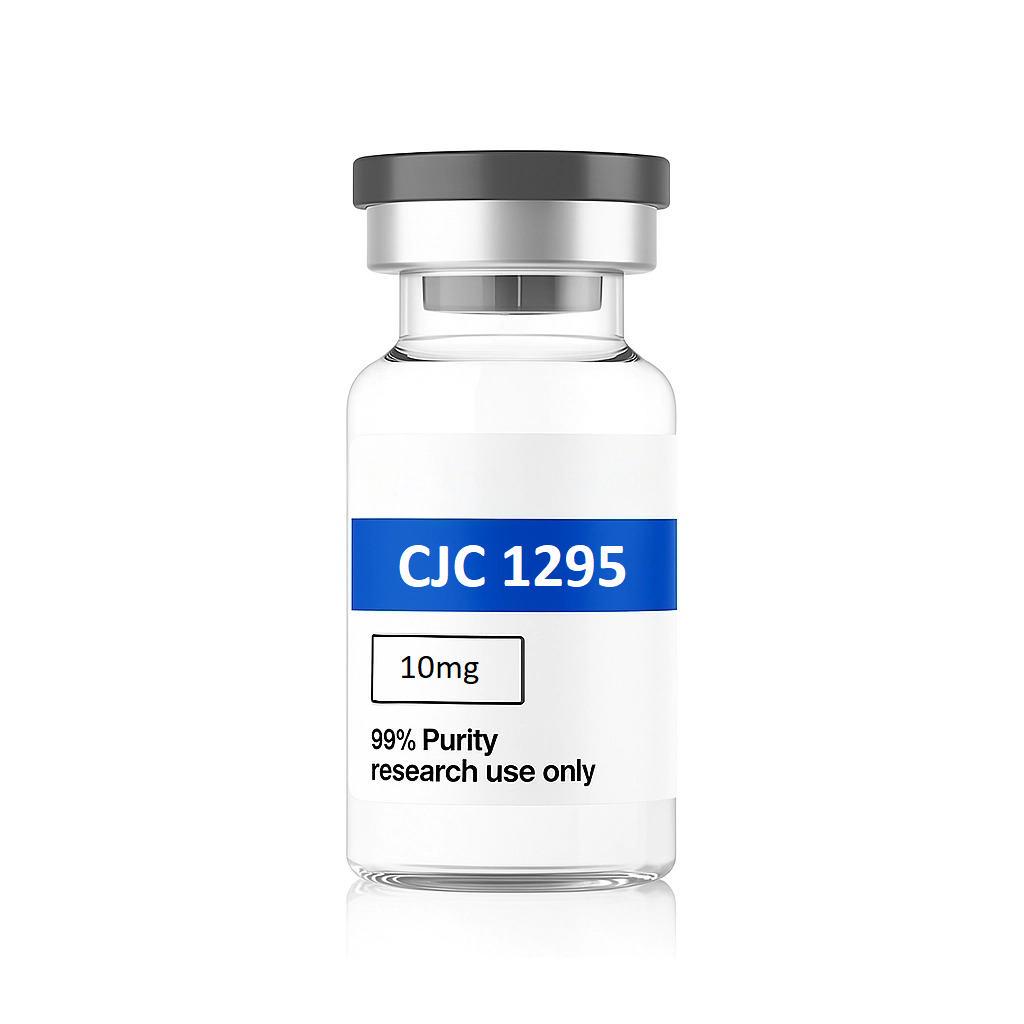
CJC-1295 is a synthetic peptide, meaning it is a man-made chain of amino acids designed to mimic a natural biological compound. Specifically, it is an analog of Growth Hormone-Releasing Hormone (GHRH). GHRH is the natural hormone produced by the hypothalamus that signals the pituitary gland to synthesize and release Growth Hormone (GH).
The “CJC” in its name refers to ConjuChem Biotechnologies, the company that developed it. The key innovation in its design is the addition of a Drug Affinity Complex (DAC), which allows it to bind reversibly to albumin in the bloodstream. This structural modification was intended to significantly increase its half-life compared to the endogenous GHRH molecule.
The Proposed Mechanism of Action: How CJC-1295 is Studied in Research
To understand how CJC-1295 is investigated, one must first understand the natural Growth Hormone axis:
1. **Natural Process:** The hypothalamus releases GHRH.
2. **Pituitary Stimulation:** GHRH binds to receptors on the pituitary gland.
3. **GH Release:** This binding stimulates the pituitary to produce and pulsate Growth Hormone into the bloodstream.
In a research context, CJC-1295 is studied for its ability to mimic the first step of this process. As a GHRH analog, it is designed to bind to the same receptors on the pituitary gland. Its prolonged half-life, due to the DAC technology, is a primary point of investigation, with researchers studying whether this leads to a sustained stimulation of the pituitary, resulting in a more prolonged and elevated pattern of Growth Hormone release compared to the natural, pulsatile secretion.
A Review of Key Scientific Studies on CJC-1295
The scientific literature contains several studies that have explored the pharmacokinetics and pharmacodynamics of CJC-1295. It is critical to present these findings as research outcomes, not as health benefits.
Study on Half-life and GH Elevation
A notable study published in the *Journal of Clinical Endocrinology & Metabolism* (2006) investigated the effects of a single injection of CJC-1295 in human subjects. The researchers reported a significant increase in the half-life of the compound and observed elevated plasma Growth Hormone and Insulin-like Growth Factor 1 (IGF-1) levels for several days post-administration. The study’s primary conclusion was centered on the proof-of-concept for its long-acting activity.
Research on Pulsatile Secretion:
Another area of research focuses on whether CJC-1295 maintains the natural pulsatile rhythm of GH secretion. Some studies suggest that while it elevates baseline GH levels, it may not entirely disrupt the natural pulsatile pattern, which is a distinct point of difference from other GH-secretagogues. This is a key differentiator examined in comparative research.
CJC-1295 vs. Other Research Peptides
In laboratory science, researchers often compare compounds to understand their unique profiles. CJC-1295 is frequently compared to other peptides like GHRP-6, Ipamorelin, and Tesamorelin.
CJC-1295 vs. GHRP-6
While both are studied for their potential to increase GH release, their mechanisms are different. CJC-1295 is a GHRH analog, while GHRP-6 is a Ghrelin mimetic, acting on a different receptor (the growth hormone secretagogue receptor). Research is often designed to compare these two distinct pathways.
CJC-1295 vs. Ipamorelin:
Ipamorelin is another Ghrelin mimetic. A key research distinction is that Ipamorelin is noted in some studies for its supposed selectivity, while CJC-1295 is investigated for its long-acting properties due to its DAC technology.
Important Research Considerations and Scientific Limitations
Any robust research program must account for limitations and variables. In the context of CJC-1295 studies, researchers note several factors:
* **Dosage and Protocol:** Scientific inquiry varies dosage amounts, frequency of administration, and methods of delivery (e.g., subcutaneous injection), all of which can influence experimental outcomes.
* **Purity and Sourcing:** The purity of a research compound is a fundamental variable. Contaminated or impure peptides can lead to skewed and unreliable data.
* **Individual Variability:** In vivo research must account for biological variability between test subjects, which can lead to a range of responses to the same compound.
Conclusion: The Role of CJC-1295 in Scientific Inquiry
CJC-1295 remains a subject of interest in biochemical and endocrinological research due to its design as a long-acting GHRH analog. Published studies have primarily focused on its ability to elevate plasma GH and IGF-1 levels over an extended period, providing a tool for scientists to study the growth hormone axis in a controlled manner. The scientific community continues to explore the nuances of its mechanism, its effects when combined with other compounds, and its place in the broader landscape of peptide research.
It is the responsibility of scientists and readers alike to interpret this data within the strict context of research and to understand that these findings are preliminary, require further replication, and are not indicative of any health-related outcomes.
—
**FAQ Section**
**Q1: Is CJC-1295 approved by the FDA for human use?**
A1: No. CJC-1295 is an investigational research compound and is not approved by the FDA for any therapeutic or human use. It is strictly for laboratory research purposes.
**Q2: What is the difference between CJC-1295 and CJC-1295 DAC?**
A2: They are the same compound. The “DAC” (Drug Affinity Complex) is an integral part of the CJC-1295 molecule’s design, which is responsible for its increased half-life.
**Q3: Where can I find published research on CJC-1295?**
A3: Peer-reviewed scientific studies can be found on databases like PubMed (National Institutes of Health), Google Scholar, and through academic journal publishers.
**Q4: Is this article making health claims about CJC-1295?**
A4: No. This article and any other articles on this website explicitly does not make any health or therapeutic claims. It is a summary of existing scientific research presented for informational and educational purposes only. The disclaimer at the beginning of the article is a critical part of this communication.
—
**Internal Linking Suggestion:** *”To learn about the research surrounding other growth hormone secretagogues, read our scientific overview of Ipamorelin here.”*
**Category Tags:** [Peptide Research, Endocrinology, Biochemistry, Scientific Studies]
**Focus Keyphrase:** CJC-1295 research