

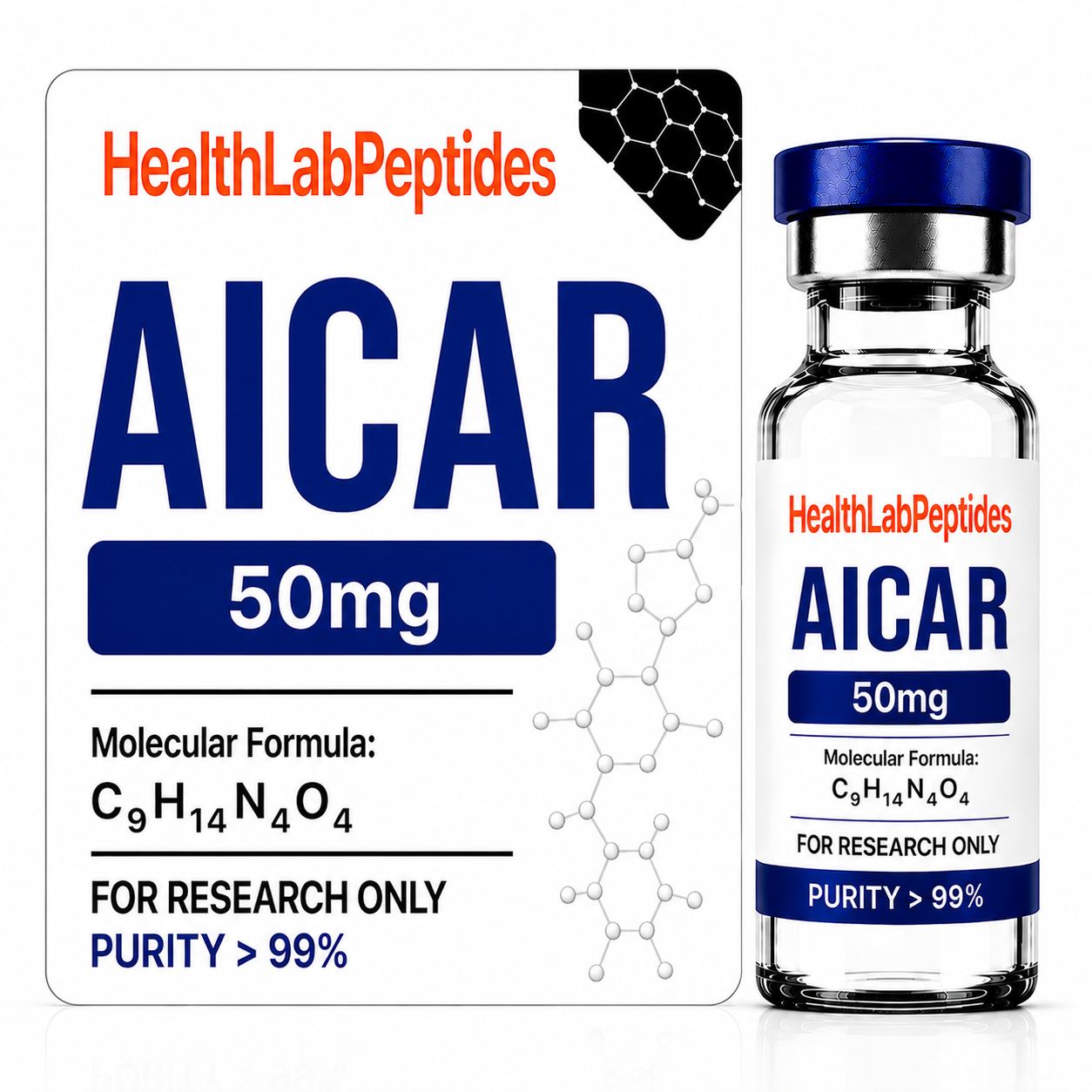
Research suggests that AICAR research can be misinterpreted when ZMP formation and endogenous nucleotide pools are not measured together. Researchers can review AICAR and Cellular Nucleotide Pools as an RUO reference while keeping every conclusion tied to the validated model.
Experimental objective
The primary question is whether cellular uptake and conversion produce ZMP while preserving, redistributing, or broadly disrupting AMP, ADP, and ATP pools. Specific compound names, analytical platforms, gene or protein endpoints, and cell-model terms create useful search relevance for laboratory researchers.
Study architecture
Quench metabolism rapidly, use validated extraction, chromatographically resolve nucleotides, employ internal standards, and normalize to a measured cell or protein basis while preserving raw amounts. The HealthLab Peptides research-material catalog provides related internal resources without implying equivalence among materials.
Sources of bias and assay failure
Extraction delay, phosphate-rich matrix, ion suppression, in-source fragmentation, nucleotide instability, unequal cell counts, and incomplete conversion can distort profiles. Record sample history, material lot, cell passage, plate position, instrument state, processing software, and analyst decisions.
Controls and related research materials
Include process blanks, time-zero controls, pooled quality controls, recovery spikes, internal standards, viability, and independently prepared cultures. A comparison with this related RUO product is informative only under matched, predefined conditions.
- Verify identity and lot documentation.
- Use independent biological preparations.
- Predefine normalization and exclusions.
- Evaluate viability, recovery, and direct interference.
- Retain raw data and complete metadata.
Complete reporting
Report quench time, extraction, chromatography, transitions or exact masses, recovery, matrix effects, ZMP and each nucleotide, normalization, and uncertainty. Publish replicate-level values, uncertainty, control results, unsuccessful runs, and method limitations.
Interpretation boundary
ZMP formation establishes conversion but not a single downstream mechanism. Broad energy-pool disruption should be separated from selective pathway signaling. Findings cannot be transferred to another laboratory material without direct evidence.
Replication strategy
Repeat central findings on a separate day using a fresh preparation. Confirm the endpoint with an orthogonal method and verify system suitability. Do not force a mechanistic conclusion from a run with failed controls.
Compliance-first search content
Durable SEO comes from answering precise research questions with natural product and method terminology. RUO articles should exclude dosing, administration, treatment, diagnostic, human-use, veterinary-use, and testimonial language.
Research Use Only disclaimer: This article and the referenced materials are intended strictly for laboratory research and in-vitro use. They are not for human or veterinary use, consumption, injection, diagnosis, treatment, or any therapeutic application.



 TB-500 Research Material — 5mg