

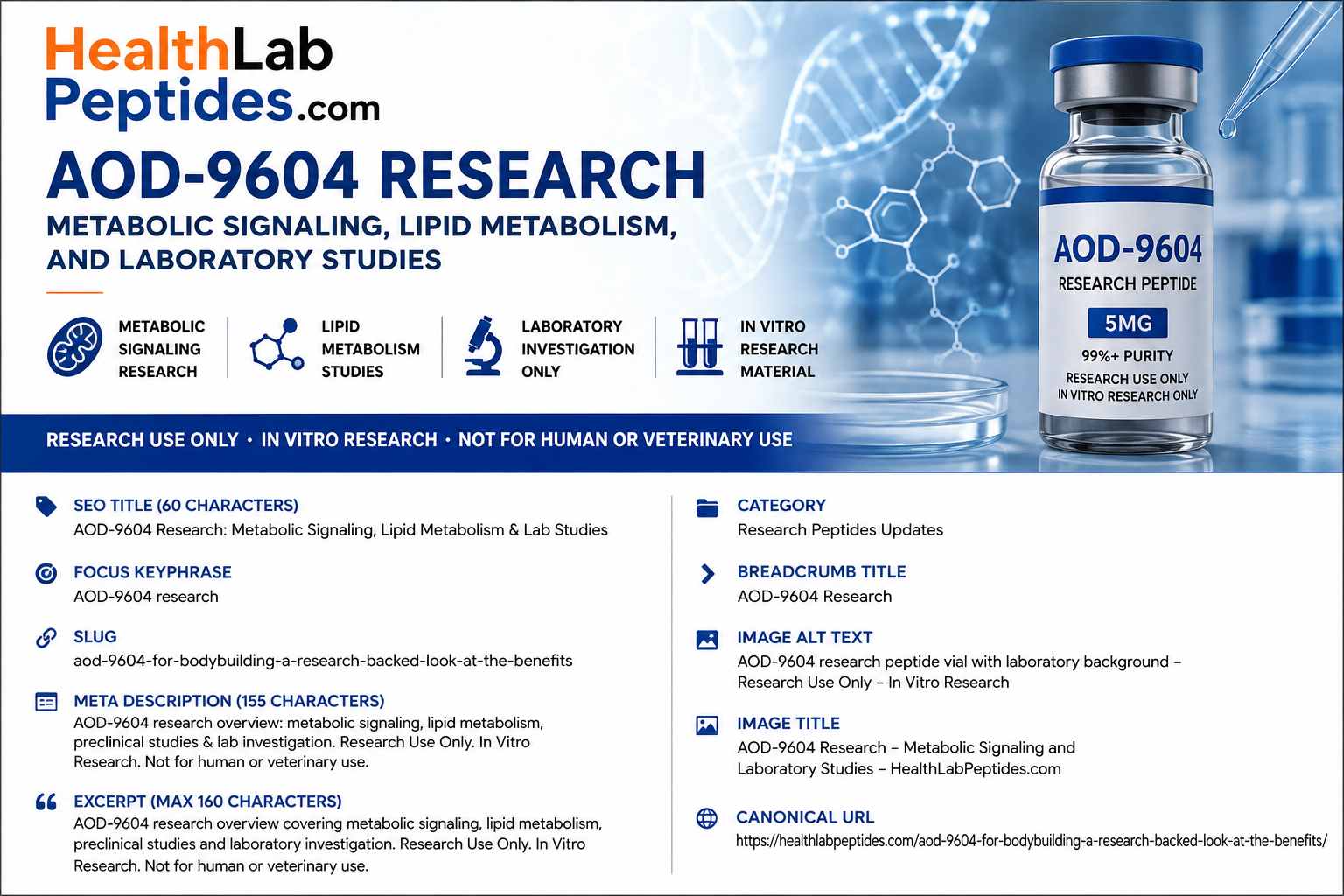
Research suggests AOD-9604 is a modified peptide fragment that has attracted scientific interest in experimental research involving metabolic signaling, lipid metabolism, peptide structure, and related biological pathways. Researchers investigating AOD-9604 can explore the broader selection of laboratory research peptides available from HealthLab Peptides, including AOD-9604 5mg and AOD-9604 10mg. All products are supplied strictly for Research Use Only (RUO) and in vitro laboratory investigation. (HealthLab Peptides)
AOD-9604 available through HealthLabPeptides.com is intended for laboratory, analytical, and scientific investigation. It is not intended for human or veterinary use or consumption.
What Is AOD-9604?
AOD-9604 is a modified peptide based on a portion of the C-terminal region of human growth hormone.
Researchers became interested in this region while investigating whether individual peptide sequences could demonstrate biological characteristics that could be studied separately from those of the complete growth hormone molecule.
This has made AOD-9604 an experimental compound of interest in areas including peptide structure-function relationships, metabolic signaling, and lipid-associated biological pathways.
Researchers interested in the broader scientific background of peptide compounds can also review What Are Peptides? A Simple Research Overview for an introduction to peptide structure and cellular signaling.
AOD-9604 and Lipid Metabolism Research
One of the principal areas of AOD-9604 investigation involves lipid metabolism.
Lipids have numerous biological functions. In addition to serving as energy-storage molecules, lipids contribute to cellular membranes, signaling processes, and other aspects of cellular biology.
Their synthesis, storage, mobilization, and utilization involve complex networks of enzymes and signaling pathways.
Researchers have investigated AOD-9604 in experimental models to better characterize its relationship with some of these processes.
Two concepts frequently encountered in this area of research are:
- Lipolysis — biochemical processes associated with the breakdown of stored lipids.
- Lipogenesis — biological processes associated with lipid synthesis and storage.
Experimental research involving AOD-9604 has examined these pathways as researchers attempt to better understand the peptide’s biological characteristics.
These investigations describe areas of scientific research and should not be interpreted as establishing AOD-9604 as a weight-management product or therapeutic treatment.
Metabolic Signaling Research
Metabolic regulation involves extensive communication among cells, enzymes, receptors, hormones, and intracellular signaling pathways.
Researchers use experimental compounds to investigate individual components of these complicated biological systems.
Depending upon the experimental model, laboratory investigations may examine cellular responses, molecular signaling, gene expression, enzymatic activity, lipid-associated pathways, and other biochemical measurements.
AOD-9604 provides researchers with another experimental compound through which aspects of metabolic biology can be investigated under controlled laboratory conditions.
Additional laboratory compounds intended for controlled research applications can be found in the HealthLab Peptides research catalog.
Relationship to Human Growth Hormone Research
AOD-9604 is scientifically interesting partly because of its structural relationship to human growth hormone.
Full-length human growth hormone is associated with numerous biological signaling processes. Researchers have consequently investigated individual regions of the molecule to determine whether particular peptide sequences exhibit distinct biological characteristics.
Studying smaller peptide fragments can help researchers investigate structure-function relationships and determine how alterations in peptide sequences may influence molecular behavior.
AOD-9604 represents one such experimental approach.
Despite its structural origins, AOD-9604 should not be considered interchangeable with full-length human growth hormone.
AOD-9604 in Preclinical Research
Preclinical research can involve biochemical assays, cultured cells, isolated tissues, and other experimental models.
These systems allow scientists to investigate biological mechanisms under controlled conditions and measure specific variables.
AOD-9604 has been examined experimentally in connection with metabolic and lipid-associated biological processes.
Experimental findings are valuable for understanding potential mechanisms. However, results obtained from laboratory models should not automatically be interpreted as demonstrating safety, efficacy, or therapeutic usefulness in humans.
For additional scientific background, HealthLab Peptides maintains a separate AOD-9604 research overview discussing the compound’s research history and investigational status.
Peptide Structure-Function Research
An important aspect of peptide science involves determining how molecular structure influences biological activity.
Even relatively small changes in an amino-acid sequence can affect properties such as molecular stability, receptor interaction, enzyme susceptibility, and biological signaling.
Researchers can compare peptide fragments with larger parent molecules to investigate which regions contribute to particular molecular interactions.
Because AOD-9604 is based on a specific region associated with human growth hormone, it provides an experimental model for investigating these types of structure-function relationships.
Cellular and Biochemical Investigation
Laboratory research involving peptides can examine biological activity at several different levels.
Depending upon the research design, scientists may investigate:
- Cellular signaling pathways
- Molecular interactions
- Enzyme activity
- Gene-expression responses
- Peptide stability
- Lipid-associated pathways
- Metabolic signaling
- Structure-function relationships
- Experimental tissue responses
The relevance of any observation depends upon the experimental model, methodology, and conditions under which the research was conducted.
Cartilage and Connective-Tissue Research
AOD-9604 has also appeared in experimental research involving cartilage and connective-tissue biology.
Researchers studying these areas may examine cellular responses, extracellular matrix activity, cartilage-associated signaling, and other biological processes within experimental models.
This represents a developing research area separate from much of the peptide’s earlier metabolic research.
Findings from these experimental models should not be interpreted as evidence that research-grade AOD-9604 is intended to treat injuries, improve recovery, relieve joint conditions, or provide therapeutic benefits.
Why Researchers Study Peptide Fragments
Peptide fragments can provide useful experimental tools for studying biological mechanisms.
A larger protein or hormone may interact with numerous biological pathways. By investigating smaller fragments, researchers can attempt to determine whether particular amino-acid sequences are associated with specific molecular characteristics.
This type of laboratory research can contribute to a better understanding of:
- Peptide structure
- Molecular interactions
- Cellular signaling
- Metabolic pathways
- Peptide stability
- Molecular modifications
- Lipid-associated processes
- Experimental tissue responses
AOD-9604 is one of many peptide compounds investigated within this broader field of experimental research.
HealthLab Peptides also provides a broader educational overview of research peptides for laboratory investigation.
Research Limitations
Scientific findings must be interpreted within the context of the experimental model in which they were obtained.
Results observed in cell cultures, biochemical assays, isolated tissues, or other experimental systems do not necessarily predict results outside those systems.
Different studies can also produce different findings depending upon methodology, experimental conditions, analytical techniques, concentrations, biological models, and other variables.
For these reasons, research involving AOD-9604 should be evaluated as experimental scientific evidence rather than as instructions or recommendations for personal use.
Intended Research Use
Although AOD-9604 may be discussed elsewhere in connection with various consumer or therapeutic applications, those discussions should not be confused with the intended purpose of research-grade AOD-9604 supplied by HealthLab Peptides.
AOD-9604 offered through HealthLabPeptides.com is supplied exclusively as a laboratory research material. It is not intended for human or veterinary use, therapeutic application, personal use, or consumption.
HealthLab Peptides does not provide human dosage, administration, injection, cycling, or treatment recommendations for AOD-9604.
References to quantities or concentrations encountered in scientific literature describe experimental methodologies and should not be interpreted as recommendations for personal use.
Research Material Quality and Documentation
Accurate identification and documentation of experimental materials are important components of laboratory peptide research.
Depending upon the requirements of a study, researchers may consider factors including:
- Compound identity
- Stated peptide quantity
- Lot information
- Analytical documentation
- Purity information
- Storage requirements
- Experimental conditions
Maintaining appropriate research documentation can contribute to reproducibility and allow investigators to better characterize materials incorporated into laboratory experiments.
Researchers looking specifically at this compound can review the laboratory listings for AOD-9604 5mg and AOD-9604 10mg. The current product pages identify these materials as research peptides intended for controlled scientific investigation. (HealthLab Peptides)
Continuing AOD-9604 Research
AOD-9604 remains scientifically interesting because it provides researchers with a modified peptide fragment through which molecular and metabolic mechanisms can be investigated.
Continued laboratory research may provide additional information regarding peptide structure, molecular interactions, lipid-associated pathways, cellular signaling, and other biological characteristics.
As with other investigational research compounds, new findings should be evaluated according to the experimental model, methodology, and quality of the supporting evidence.
Researchers can explore additional compounds and research materials through the HealthLab Peptides laboratory research catalog.
Research Use Only — In Vitro Research
AOD-9604 offered by HealthLabPeptides.com is sold strictly for Research Use Only (RUO) and In Vitro Research purposes.
This product is intended solely for qualified laboratory, analytical, and scientific research applications, including in vitro laboratory investigation.
NOT FOR HUMAN OR VETERINARY USE OR CONSUMPTION.
HealthLab Peptides does not market AOD-9604 as a drug, dietary supplement, weight-management product, bodybuilding product, therapeutic treatment, performance-enhancing substance, or as a product intended to diagnose, treat, cure, mitigate, or prevent any disease or medical condition.
Information provided by HealthLab Peptides is for educational and research purposes only. It does not constitute medical advice, prescribing information, dosage guidance, administration instructions, or instructions for human use.
Purchasers are responsible for ensuring that all research materials are handled and used in accordance with applicable laws, regulations, institutional requirements, and appropriate laboratory practices.
[…] bodybuilding […]