

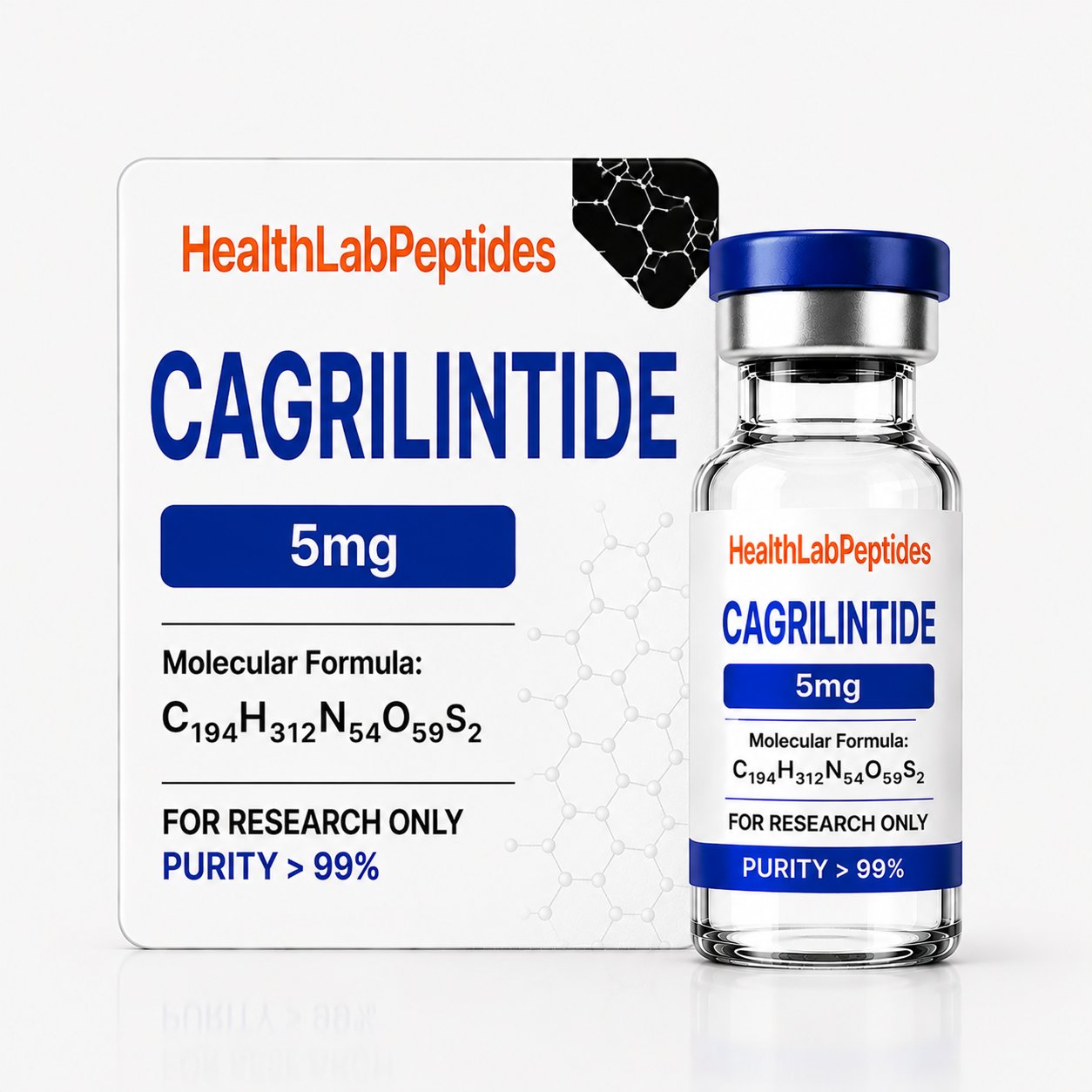
Research suggests:
Research suggests: cagrilintide is a chemically modified amylin analog whose development illustrates how peptide researchers investigate structural stability, protein aggregation, and molecular interactions. A 2021 Journal of Medicinal Chemistry paper described structure–activity decisions involved in designing a stable, lipidated analog. That is a molecular-design history, not a claim that a HealthLab research vial treats diabetes, obesity, or any other medical condition. This article focuses on the chemistry of native amylin, aggregation-related experiments, the role of lipidation, receptor-associated questions, and how to interpret study-specific findings. For the broader receptor-science context, see the earlier cagrilintide research review.
Native amylin and its molecular role
Amylin, also called islet amyloid polypeptide, is a pancreatic peptide investigated for its endocrine and receptor-associated biology. It is composed of amino-acid residues whose arrangement influences its chemical and biological properties. Native human amylin is also known for its capacity to form amyloid fibrils in certain environments. This feature presents a challenge when researchers design analogs intended to display different physicochemical behavior. It is important to distinguish the underlying hormone from a synthetic analog: similarities in molecular ancestry do not mean identical stability, receptor binding, or experimental outcomes.
Why amyloid formation matters
Amyloid formation refers to an ordered aggregation process associated with characteristic molecular arrangements. In peptide chemistry, the propensity to form assemblies can vary with sequence, chemical modifications, surrounding medium, and the state of the sample. An aggregation assay may measure turbidity, fluorescence, or another physical property, each with its own limitations. A material that shows less aggregation under one laboratory condition is not thereby proven safe or beneficial in humans. The scientific question is how a defined chemical structure behaves in a specified environment, not whether an unapproved catalog material changes human physiology.
The challenges of modifying a native sequence
Peptide analog development involves balancing properties that may work against each other. An amino-acid change can affect folding or intermolecular interactions, while an appended chemical group can alter binding to proteins or other experimental behavior. These design choices require evidence from structural and functional assays. A modification intended to improve one property may change another. The claim that a molecule is more stable should specify what kind of stability was tested and in which setting. Without that detail, the term can misleadingly suggest a universal property across formulations and biological systems.
The 2021 primary design publication
Kruse and colleagues reported “Development of Cagrilintide, a Long-Acting Amylin Analogue” in the Journal of Medicinal Chemistry (2021), PMID 34288673, DOI 10.1021/acs.jmedchem.1c00565. The paper describes a series of molecular design and structure–activity considerations that led to the selection of a lipidated analog for clinical development. This publication provides primary evidence for how the specific molecule was engineered. It should not be treated as an advertisement for unrelated research-material vials. It is also inappropriate to transfer a finding from an earlier analog to cagrilintide unless the experiment directly supports that comparison.
What structure–activity relationships mean
A structure–activity relationship compares chemical modifications with experimentally measured responses. A study may examine how variations in sequence or attached groups influence aggregation, receptor-associated signals, or another selected endpoint. The results can help identify promising candidates for further investigation. However, a correlation between a modification and an assay response does not identify every part of a molecular mechanism. It is also possible for multiple modifications to interact, making simple one-variable explanations incomplete. Scientific writing should describe what the authors tested rather than presume that every modification has a unique universal effect.
The meaning of lipidation
Lipidation adds a lipid-associated chemical component to a peptide, potentially changing how the molecule interacts with its surroundings. Depending on the exact design, lipidation can influence association with proteins, local partitioning, or properties relevant to a drug-development program. A lipidated peptide is not automatically more effective in every assay, and the chemical modification alone cannot establish human-use suitability. Researchers must identify the attachment site, molecular structure, and actual measurement used in the paper before discussing its consequences. The word long-acting is incomplete without context about what was measured and in which model.
Lipidated analogs and albumin
Albumin is an abundant serum protein involved in the distribution of many compounds. Some lipidated molecular designs investigate the possibility of association with albumin. Yet albumin binding is not a universal explanation for every experimental observation, and an interaction measured in a biochemical assay does not independently establish a clinical duration or outcome. In comparing different peptide analogs, the type of appended lipid and the peptide’s sequence can both matter. It is inappropriate to use general statements about albumin-associated drug design as proof of what a specific commercial research lot will do.
Receptor biology remains a separate question
Amylin-related receptor signaling has been investigated through complexes involving calcitonin receptor components and receptor activity-modifying proteins. The receptor-associated effect of a molecule must be evaluated experimentally rather than inferred from its structural similarity to native amylin. A binding assay, cell-signaling measurement, and animal physiological endpoint are different levels of evidence. The same chemical modification may influence different readouts in different ways. Research pages should separate chemistry and pharmacology, because a description of one cannot automatically substitute for measurements of the other.
Why comparisons with pramlintide need context
Pramlintide is another amylin analog with a separate development and regulatory history. The 2021 design paper discussed the limitations of existing amylin-analog approaches as part of its rationale for new molecular designs. Such comparisons help explain why chemists consider stability, aggregation, and other properties. But pramlintide and cagrilintide are not identical molecules, and the clinical history of one is not proof of an approved use for the other or for an independent RUO reagent. A clear article identifies each analog before discussing overlapping endocrine terminology.
Aggregation assays and their blind spots
A fluorescent probe that responds to assembled material can help investigators study aggregation kinetics, but the signal may be sensitive to dye interactions and the molecular assemblies present. Light-scattering or other structural measurements offer complementary information with different assumptions. A result under one set of conditions may not describe behavior under a different pH, protein concentration, or matrix. Researchers comparing papers should therefore look beyond phrases such as nonaggregating and examine the tested context. Analytical confirmation and replication are necessary before assigning broad properties to an analog.
When long-acting does not mean clinically interchangeable
The descriptive name long-acting refers to a goal or observation in drug-development research. It should not be interpreted as a guarantee that an independent laboratory sample behaves like a regulated medicinal formulation. Even when a scientific paper reports results from an investigational product, that evidence applies to the defined material and experimental conditions. Quality attributes such as formulation, batch characterization, and manufacturing controls matter separately. The HealthLab catalog should not imply that a named research material can substitute for a prescription drug or that readers should administer it.
A molecule investigated in clinical programs is still a research subject
Cagrilintide has appeared in the scientific literature about regulated clinical development and combinations with other endocrine agents. Those publications concern specific investigational formulations and study protocols. Their existence does not establish that an independent research-only product has clinical efficacy, acceptable risk, or authorization for personal use. A laboratory article may discuss this distinction to clarify the evidence landscape, but should not attach treatment claims or weight-related benefits to the HealthLab material. Molecular chemistry and regulatory evidence should remain distinct categories.
Chemical identity and the product listing
The Cagrilintide 5 mg research-material listing
Comparison with a different incretin research mechanism
Cagrilintide belongs to amylin analog research, while semaglutide belongs to a different molecular and receptor category associated with GLP-1R. Their pathways may appear together in clinical-development literature, but a shared research context does not make their chemical mechanisms identical. The semaglutide GLP-1 receptor research article
Frequently asked molecular questions
Is cagrilintide identical to native amylin? No, it is a modified analog. Why are fibrils discussed? Native human amylin aggregation is an important chemical-design challenge. What is lipidation? The introduction of a lipid-associated chemical moiety. Does an aggregation result prove clinical safety? No. Can a trial involving a defined formulation be generalized to a research vial? No. Does an albumin-binding hypothesis establish a personal-use duration? No.
Source and conclusion
Primary source: Kruse and colleagues, Journal of Medicinal Chemistry (2021), PMID 34288673, DOI 10.1021/acs.jmedchem.1c00565. This molecular-development study provides a research explanation for cagrilintide’s design in relation to amylin chemistry and aggregation. It does not independently establish safety or clinical efficacy for a HealthLab research-only material. The relevant educational lesson is that chemical structure, tested stability, and receptor-associated evidence are separate questions that must not be merged into unqualified medical claims.
Research Use Only
Research Use Only / Not for human or veterinary use. All referenced products are laboratory research materials. No dosing, administration, injection, treatment, or personal-use guidance is provided, and the research material is not represented as an FDA-approved medicine.


