

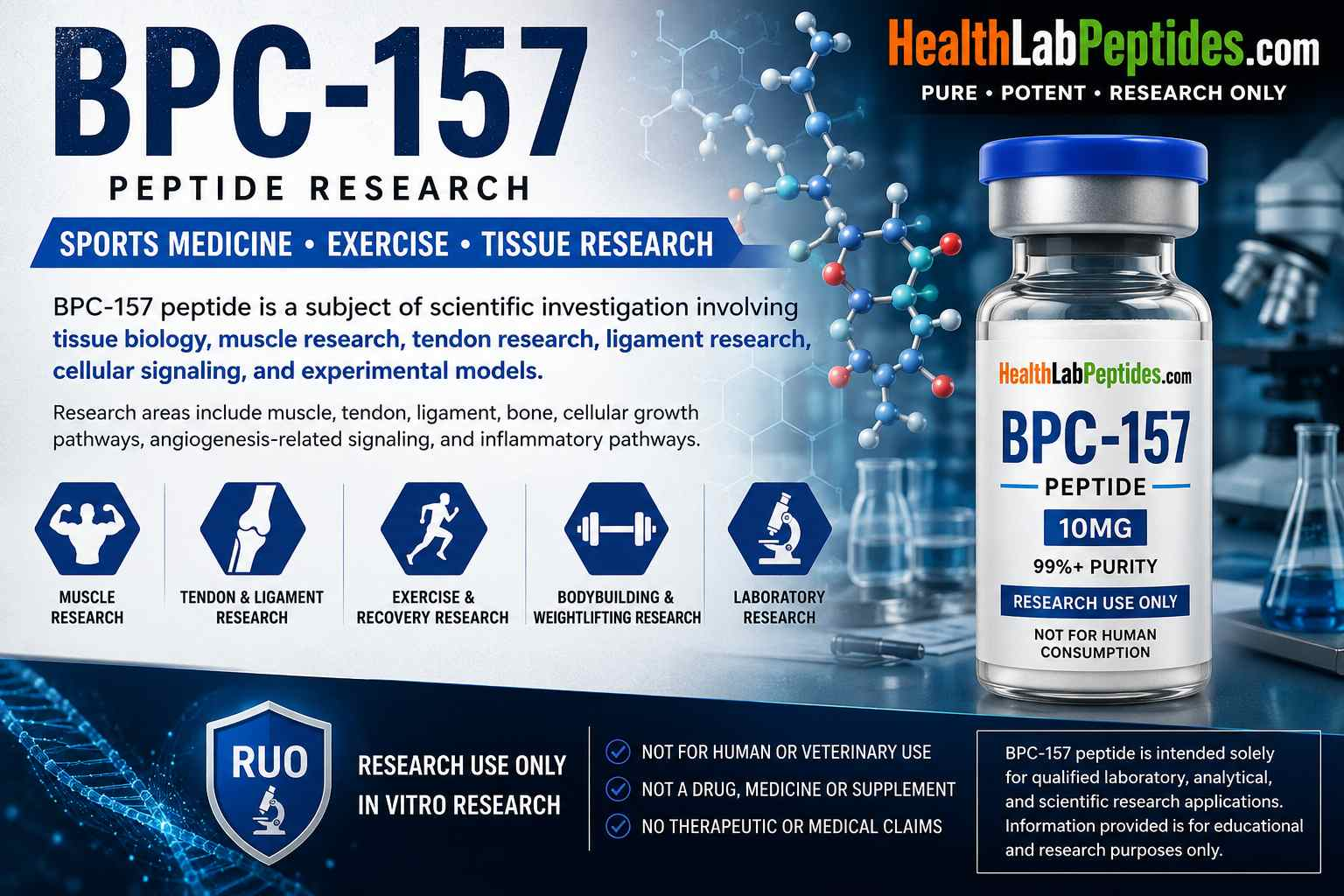
Research suggests that BPC-157 peptide has become a subject of scientific investigation involving tissue biology, musculoskeletal research, cellular signaling, and experimental models relevant to sports-medicine research. Researchers studying BPC-157 peptide have examined biological pathways associated with muscle, tendon, ligament, connective tissue, and other laboratory research models.
Interest in BPC-157 peptide has also expanded into scientific literature associated with exercise research, bodybuilding research, weightlifting research, muscle research, recovery research, and sports medicine. These terms describe areas of scientific interest and published research. They do not represent intended uses or claimed effects of BPC-157 research products sold by HealthLab Peptides.
What Does Current BPC-157 Research Show?
A 2025 systematic review published in HSS Journal examined the available BPC-157 literature from an orthopaedic sports-medicine perspective.
The researchers identified hundreds of publications during their initial search and ultimately included 36 studies meeting their criteria.
One of the most important limitations was the type of evidence available: 35 of the 36 included studies were preclinical, while only one was classified as a clinical study.
This distinction is critical when interpreting BPC-157 research. Findings from cellular, laboratory, and animal research models should not automatically be interpreted as evidence that the same results occur in humans.
BPC-157 Peptide and Tissue Research
BPC-157 peptide has been investigated in experimental research involving several types of biological tissue.
Published preclinical research discussed in the systematic review included models involving:
- skeletal muscle;
- tendons;
- ligaments;
- bone;
- cellular growth pathways;
- angiogenesis-related signaling; and
- inflammatory signaling pathways.
These areas make BPC-157 an interesting research subject for scientists studying biological mechanisms associated with tissue responses.
They do not, however, establish BPC-157 research material as a treatment for an injury or medical condition.
BPC-157, Bodybuilding and Weightlifting Research
BPC-157 is frequently discussed online in connection with bodybuilding, weightlifting, exercise, athletic recovery, muscle repair, and sports performance.
For laboratory researchers, these subjects can correspond with legitimate areas of investigation such as skeletal-muscle biology, connective-tissue signaling, mechanical-stress models, cellular responses, angiogenesis, inflammatory pathways, and exercise physiology.
The distinction between researching these biological subjects and marketing a product to produce an outcome in a person is important.
HealthLab Peptides does not market BPC-157 peptide for bodybuilding, weightlifting, exercise, athletic performance, muscle growth, injury recovery, pain relief, or other human applications.
Muscle, Tendon and Ligament Research
Muscle, tendon, and ligament biology represent significant areas of preclinical BPC-157 research.
Researchers may investigate experimentally measurable endpoints such as cellular signaling, structural characteristics, biochemical markers, mechanical properties, or other responses within controlled research models.
Terms such as muscle repair research, tissue repair research, recovery research, and sports injury research therefore describe scientific fields in which researchers may encounter BPC-157 in published literature.
They should not be interpreted as statements that BPC-157 peptide sold by HealthLab Peptides repairs tissue, accelerates recovery, treats injuries, or produces these effects in people.
BPC-157 and Exercise Research
Exercise creates complex biological responses involving skeletal muscle, connective tissue, metabolism, inflammatory signaling, cellular stress, and adaptation.
Consequently, exercise research and exercise physiology research can overlap with some of the biological pathways investigated in experimental peptide research.
Scientists may study these pathways independently to better understand biological mechanisms and experimental responses.
HealthLab Peptides provides research materials for laboratory investigation and does not provide exercise, bodybuilding, weightlifting, medical, or performance-enhancement protocols.
Important Limitations of BPC-157 Research
The current evidence base has significant limitations.
Most research discussed in the scientific literature remains preclinical. Animal or laboratory findings cannot establish effectiveness or safety in humans.
The 2025 systematic review also reported an absence of clinical safety data in the literature it evaluated.
Researchers should therefore distinguish carefully between:
preclinical observations, experimental hypotheses, mechanistic research, and established clinical evidence.
They are not interchangeable.
Why Published Research Should Not Be Treated as Instructions for Use
Scientific papers may discuss routes of administration, doses, experimental procedures, animal models, or observations involving human subjects because these details form part of the scientific record.
HealthLab Peptides may discuss the existence and conclusions of published research for educational purposes.
Such discussion does not constitute instructions, dosage guidance, administration guidance, medical advice, or recommendations for human use.
Researchers should consult original peer-reviewed publications when evaluating experimental methodology and study limitations.
BPC-157 Peptide for Laboratory Research
Researchers interested in BPC-157 can explore BPC-157 peptide research material and other research peptides available through HealthLab Peptides.
Research materials should be incorporated only into appropriately designed laboratory, analytical, and scientific investigations.
Research Use Only — In Vitro Research
BPC-157 peptide offered by HealthLabPeptides.com is sold strictly for Research Use Only (RUO) and In Vitro Research purposes.
This product is intended solely for qualified laboratory, analytical, and scientific research applications, including in vitro laboratory investigation.
NOT FOR HUMAN OR VETERINARY USE OR CONSUMPTION.
HealthLab Peptides does not market BPC-157 peptide as a drug, dietary supplement, bodybuilding product, weightlifting product, exercise-performance product, recovery product, injury treatment, therapeutic treatment, or as a product intended to diagnose, treat, cure, mitigate, or prevent any disease or medical condition.
References to bodybuilding research, weightlifting research, exercise research, sports-medicine research, muscle research, tissue repair research, injury research, or recovery research describe subjects of scientific investigation only. They do not represent intended uses or claims regarding BPC-157 peptide products offered by HealthLab Peptides.
Information provided by HealthLab Peptides is for educational and research purposes only. It does not constitute medical advice, prescribing information, dosage guidance, administration instructions, or instructions for human use.
Purchasers are responsible for ensuring that research materials are handled and used in accordance with applicable laws, regulations, institutional requirements, and appropriate laboratory practices.
[…] appears to have potent metabolic modulation properties (31). In this review, we argue that MDPs are metabolically active peptides by summarizing the evidence that they are endogenously responsive to metabolic stress and can […]