
Hexarelin Peptide Research: GHS-R Signaling and Laboratory Research
Hexarelin is a synthetic hexapeptide studied in experimental research involving growth hormone secretagogue receptor signaling and related endocrine pathways.
Hexarelin is also identified in scientific literature as Examorelin. Researchers have investigated compounds in this class to better understand receptor activity, peptide signaling, endocrine communication, and experimentally measurable biological responses.
This article discusses published scientific research and laboratory research concepts only. It is not intended to provide instructions for human or veterinary use.
What Is Hexarelin?
Hexarelin is a peptide associated with the growth hormone secretagogue class of research compounds. Scientific literature has examined its interaction with the growth hormone secretagogue receptor (GHS-R) and related signaling mechanisms.
Researchers interested in the fundamentals of peptide structure and signaling can also review What Are Peptides? A Simple Research Overview.
Hexarelin and GHS-R Research
An important area of Hexarelin research concerns receptor-mediated signaling.
Experimental investigation may examine topics including:
- GHS-R receptor interactions
- Receptor activation and response
- Peptide-receptor binding
- Intracellular signaling pathways
- Endocrine signaling mechanisms
- Comparative peptide pharmacology
These research areas help investigators characterize how peptide compounds interact with biological signaling systems under controlled experimental conditions.
Discussion of these mechanisms should not be interpreted as establishing that a Hexarelin research material is appropriate for administration to humans or animals.
Growth Hormone Secretagogue Research
Growth hormone secretagogues represent a broader field of endocrine and receptor research.
Different compounds may interact with different components of these signaling systems, allowing investigators to compare receptor selectivity, signaling behavior, biochemical responses, and other experimental endpoints.
For example, HealthLab Peptides also discusses CJC-1295 and Ipamorelin research in the context of laboratory investigation of related signaling pathways.
Researchers can use such comparisons to study differences among peptide classes and receptor systems without assuming that results from experimental models establish therapeutic safety or effectiveness.
Hexarelin in Laboratory Research
Appropriately designed Hexarelin research may involve areas such as:
- Analytical characterization
- Peptide identity and purity analysis
- GHS-R receptor research
- Peptide signaling studies
- Molecular and biochemical pathway research
- Comparative peptide investigations
- Controlled in-vitro experimental models
The appropriate methodology depends upon the investigator’s experimental design, institutional requirements, and applicable laboratory procedures.
Researchers interested in the broader landscape of peptide compounds can also review A Broad Look at Research Peptides and Their Roles in Modern Studies.
Interpreting Published Hexarelin Research
Scientific literature can include in-vitro experiments, animal models, mechanistic studies, pharmacological investigations, and human clinical research.
Those categories of evidence should not be treated as interchangeable.
An observation reported in an experimental model does not automatically establish that the same outcome will occur in humans, nor does the existence of published human research establish that a research material sold by HealthLab Peptides is approved, safe, effective, or appropriate for personal use.
Published research should therefore be evaluated according to study design, experimental model, sample size, methodology, endpoints, limitations, and quality of evidence.
Hexarelin and Related Peptide Research
Hexarelin is one of several compounds appearing in research involving peptide and endocrine signaling.
Researchers may encounter compounds such as CJC-1295, Ipamorelin, GHRP-2, and GHRP-6 when reviewing related scientific literature. These compounds should be evaluated individually because their structures, receptor interactions, and experimental characteristics are not identical.
For additional background, researchers can review Peptide Drug Discovery and the History of Peptide Research.
Research Material Information
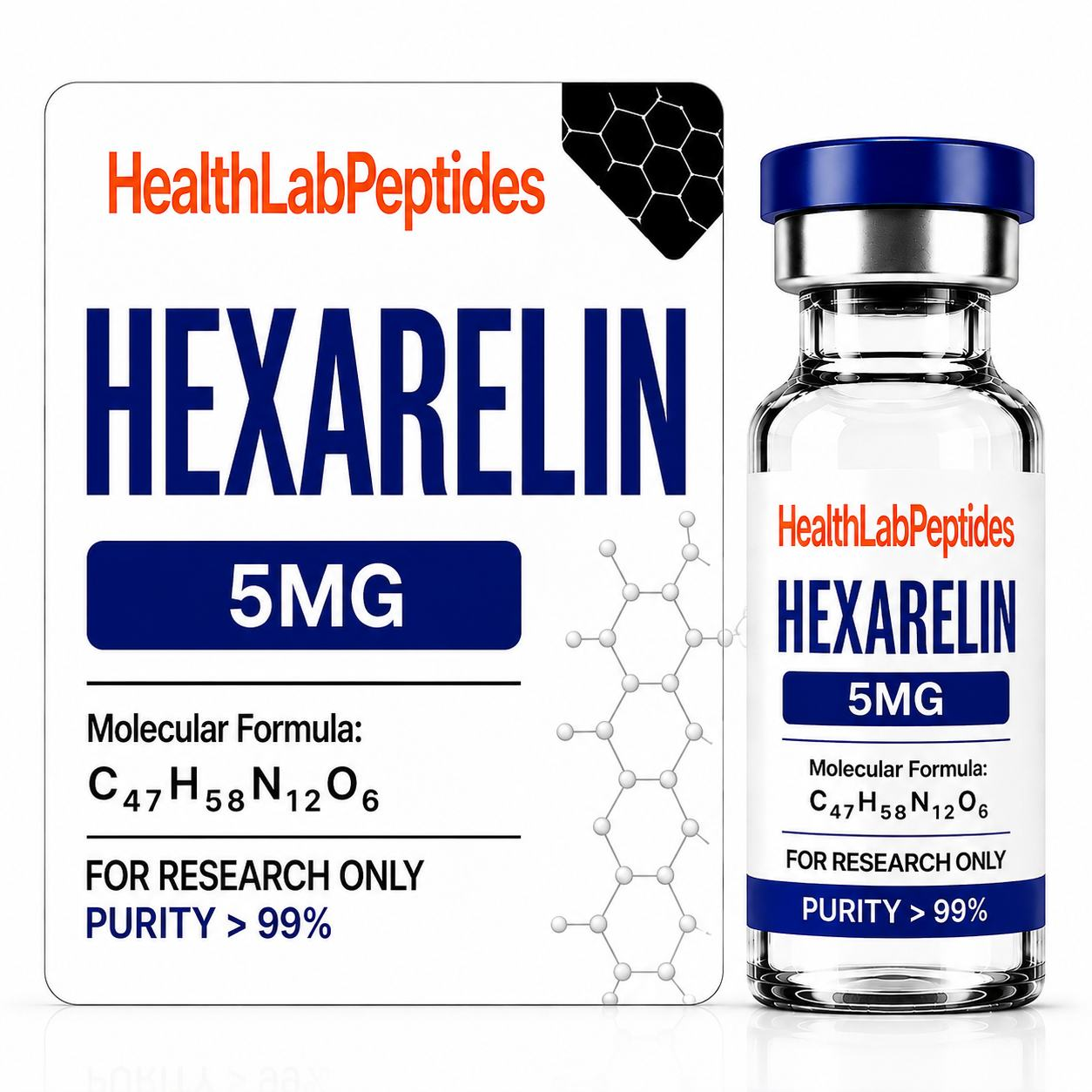
Researchers seeking Hexarelin for legitimate laboratory investigation may review Hexarelin Peptide Research Material — 5mg.
The linked material is supplied for Research Use Only (RUO) and is not offered for human or veterinary use.
IMPORTANT — RESEARCH USE ONLY
HealthLab Peptides provides research materials for legitimate laboratory, analytical, and scientific research applications.
NOT FOR HUMAN OR VETERINARY USE, CONSUMPTION, INGESTION, INJECTION, IMPLANTATION, OR OTHER BODILY ADMINISTRATION.
References to Hexarelin, growth hormone secretagogues, GHS-R signaling, scientific studies, experimental models, biological pathways, or physiological endpoints are provided for scientific and educational discussion.
Such references do not constitute medical advice, dosage guidance, administration instructions, treatment recommendations, or representations that any HealthLab Peptides research material is approved, safe, effective, or appropriate for human or veterinary use.