
Description
KLOW-80 Research Peptide Blend: Composition and Laboratory Research
Research suggests that multi-peptide formulations can provide useful experimental systems for investigating interactions among different cellular and molecular signaling pathways. KLOW-80 is a four-component research peptide blend containing GHK-Cu, BPC-157, TB-500, and KPV, providing researchers with multiple peptide components within a single laboratory formulation. Researchers can view the KLOW-80 research peptide blend and related research materials available from HealthLab Peptides.
KLOW-80 is intended strictly for Research Use Only (RUO) and laboratory investigation. It is not intended for human or veterinary use.
What Is KLOW-80?
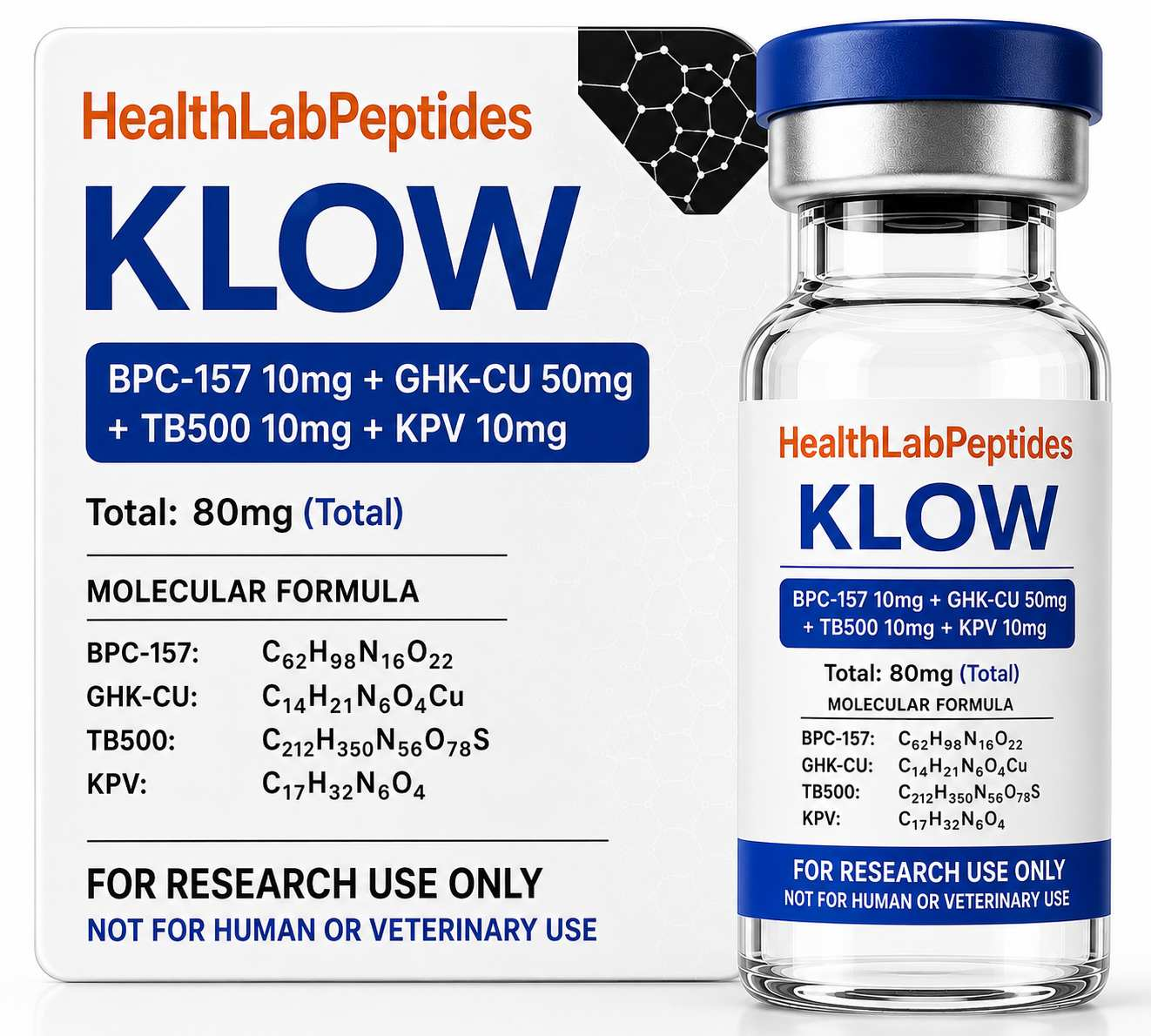
KLOW-80 is a research formulation containing four peptide components with a combined nominal quantity of 80 mg:
- GHK-Cu — 50 mg
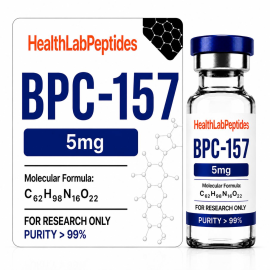
- BPC-157 — 10 mg
- TB-500 — 10 mg
- KPV — 10 mg
Total nominal peptide content: 80 mg
Rather than representing a single peptide sequence, KLOW-80 combines four independently studied compounds within one research material.
This makes the formulation relevant to experimental investigations involving multiple signaling systems and provides researchers with an opportunity to examine how different peptide-associated pathways behave within the same controlled research model.
Why Researchers Study Multi-Peptide Formulations
Biological systems involve interconnected signaling networks rather than individual molecular pathways operating independently.
Laboratory researchers may therefore investigate multi-component formulations when examining interactions among different molecular mechanisms.
Potential experimental areas include:
- Cellular signaling
- Peptide-peptide interactions
- Extracellular matrix-associated pathways
- Cellular migration
- Inflammatory signaling pathways
- Angiogenesis-associated mechanisms
- Cellular stress-response pathways
- Gene-expression responses
Importantly, observations involving a multi-component formulation cannot automatically be attributed to one individual component.
Controlled experimental designs and appropriate comparison groups are necessary when researchers want to distinguish activity associated with individual peptides from observations involving a combined formulation.
HealthLab Peptides also discusses this broader scientific trend in its article on the future of peptide research and multi-pathway laboratory models.
GHK-Cu Research
GHK-Cu (glycyl-L-histidyl-L-lysine copper) is a naturally occurring copper-binding peptide complex and represents the largest component of KLOW-80 by nominal quantity.
Laboratory investigations involving GHK-Cu have examined biological processes including:
- Copper-associated peptide signaling
- Extracellular matrix activity
- Collagen-associated pathways
- Fibroblast activity
- Gene-expression patterns
- Cellular migration
- Angiogenesis-associated signaling
- Oxidative and inflammatory signaling pathways
Because GHK-Cu interacts with several cellular and extracellular systems, it has become a subject of experimental investigation across numerous laboratory models.
Researchers interested in examining this component independently can also review GHK-Cu 50 mg research peptide.
Within KLOW-80, researchers can investigate GHK-Cu in the presence of three additional peptide components rather than studying the copper peptide exclusively as an isolated compound.
BPC-157 Research
BPC-157 is a synthetic peptide investigated primarily in experimental and preclinical research.
Research involving BPC-157 has examined areas including:
- Cellular migration
- Angiogenesis-associated signaling
- Fibroblast-related activity
- Growth-factor pathways
- Experimental connective-tissue models
- Gastrointestinal tissue models
- Inflammatory signaling pathways
These are descriptions of experimental research areas and should not be interpreted as established therapeutic indications.
Findings obtained from cell cultures, isolated biological systems, or animal models do not by themselves establish safety or effectiveness in humans.
TB-500 Research
TB-500 is a synthetic peptide associated with experimental research involving thymosin beta-4-related biological mechanisms.
Experimental areas involving TB-500 and related pathways include:
- Actin-associated cellular processes
- Cellular migration
- Angiogenesis-related signaling
- Cytoskeletal organization
- Cellular responses to experimental stress
- Tissue-remodeling mechanisms
These mechanisms make TB-500 an interesting experimental component when researchers are investigating cellular movement and structural signaling.
BPC-157 and TB-500 can also be investigated together as a separate experimental formulation. HealthLab Peptides provides a BPC-157 + TB-500 research peptide blend for laboratory research.
Its inclusion within KLOW-80 alongside GHK-Cu and KPV creates a substantially different four-component experimental material.
KPV Research
KPV is a short tripeptide sequence consisting of lysine-proline-valine.
Experimental research involving KPV has examined its interactions with cellular and inflammatory signaling pathways.
Research areas include:
- Cytokine-associated signaling
- Cellular inflammatory-response pathways
- Immune-associated signaling mechanisms
- Cellular stress-response models
- Experimental molecular signaling pathways
Within a multi-component formulation such as KLOW-80, KPV provides another distinct molecular component for researchers investigating interactions among different signaling systems.
As with the other components, experimental findings involving KPV should be interpreted according to the specific model, methodology, controls, and endpoints employed.
Comparing the Four KLOW-80 Components
Each component of KLOW-80 represents a different area of peptide research.
| Component | Nominal Quantity | Example Experimental Research Areas |
|---|---|---|
| GHK-Cu | 50 mg | Copper-associated signaling, extracellular matrix and cellular pathways |
| BPC-157 | 10 mg | Cellular migration and experimental tissue-response signaling |
| TB-500 | 10 mg | Actin-associated processes, cellular migration and cytoskeletal signaling |
| KPV | 10 mg | Cellular inflammatory and immune-associated signaling |
| Total | 80 mg | Multi-component peptide research formulation |
These descriptions identify areas of scientific investigation. They are not medical indications or representations of therapeutic effects.
Studying Individual Peptides vs. KLOW-80
There is an important experimental distinction between studying an individual peptide and studying a formulation containing several compounds.
An experiment using isolated GHK-Cu, for example, allows researchers to investigate responses associated with that particular material under defined conditions.
KLOW-80 introduces four components simultaneously.
Researchers examining a multi-component formulation therefore need to consider variables including:
- Individual component activity
- Interactions among components
- Experimental concentration
- Assay conditions
- Exposure duration
- Cell or tissue model
- Experimental controls
- Selected endpoints
Appropriate controls can help researchers determine whether an observed response is associated with an individual component, a combination of components, or another experimental variable.
Why Blend Composition Matters
A defining characteristic of KLOW-80 is its 50:10:10:10 mg composition.
The formulation contains substantially more GHK-Cu by nominal mass than any of its other three components.
This composition should be documented accurately when designing experiments or comparing results between different research materials.
Researchers should not assume that results obtained using an isolated component will necessarily reproduce observations obtained using the complete four-component formulation.
Likewise, research involving KLOW-80 should not automatically be treated as evidence concerning any one component independently.
In Vitro and Preclinical Research
The distinction between laboratory findings and clinical evidence is particularly important in peptide research.
In vitro research examines biological processes under controlled laboratory conditions, including cultured cells, isolated tissues, biochemical assays, and other experimental systems.
Preclinical research may include animal models designed to investigate biological mechanisms under more complex experimental conditions.
Neither category of evidence automatically demonstrates what will occur in humans.
Differences in species, experimental models, concentrations, endpoints, methodology, and biological complexity can substantially affect research findings.
For this reason, results should be described according to the experimental system in which they were obtained.
Evaluating KLOW-80 Research
Researchers working with multi-component peptide materials should carefully document experimental conditions.
Important considerations can include:
- Material identity
- Component composition
- Nominal quantity
- Lot or batch information
- Analytical documentation
- Experimental concentration
- Appropriate controls
- Assay methodology
- Experimental endpoints
- Reproducibility
Multi-component formulations introduce additional variables compared with isolated compounds, making careful experimental design particularly important.
Material Identity and Analytical Documentation
Reliable scientific investigation requires accurate characterization of research materials.
For a four-component formulation such as KLOW-80, researchers should distinguish among:
Material identity — which peptide components are represented.
Composition — the nominal amount of each component.
Analytical results — findings obtained from specific testing of a particular sample.
Lot or batch information — information connecting documentation with the research material being evaluated.
Analytical documentation should be interpreted according to the sample and methodology actually tested rather than being extended beyond what the underlying analysis establishes.
KLOW-80 and Multi-Pathway Peptide Research
KLOW-80 illustrates an important difference between single-compound and multi-component laboratory research.
The formulation combines compounds associated with several distinct areas of experimental peptide science rather than concentrating on one molecular target.
This creates opportunities to investigate interactions while simultaneously making experimental interpretation more complex.
Researchers interested in a more detailed examination of the scientific literature surrounding the four-component formulation can also read KLOW80 as a Multi-Peptide Research Blend: Composition, Evidence Landscape, and Regulatory/Ethical Considerations.
Frequently Asked Questions
What peptides are in KLOW-80?
KLOW-80 contains four research components: GHK-Cu 50 mg, BPC-157 10 mg, TB-500 10 mg, and KPV 10 mg, for a combined nominal quantity of 80 mg.
Is KLOW-80 a single peptide?
No. KLOW-80 is a multi-component research formulation containing four different peptide materials.
Why would researchers investigate a multi-peptide formulation?
Multi-component formulations can provide experimental systems for investigating interactions among different signaling pathways. Appropriate controls are necessary to distinguish observations involving the combined formulation from those associated with individual components.
What is GHK-Cu studied for?
GHK-Cu appears in laboratory research involving copper-associated signaling, extracellular matrix processes, fibroblast activity, gene expression, collagen-associated pathways, and other cellular mechanisms.
What is BPC-157 studied for?
BPC-157 has been investigated primarily in preclinical models involving cellular migration, angiogenesis-associated pathways, fibroblast activity, experimental connective-tissue models, and related signaling mechanisms.
What is TB-500 studied for?
TB-500 and thymosin beta-4-related mechanisms are investigated in experimental models involving actin-associated processes, cellular migration, cytoskeletal activity, and angiogenesis-associated signaling.
What is KPV studied for?
KPV has been investigated experimentally in relation to cellular inflammatory signaling, cytokine-associated pathways, and immune-associated signaling mechanisms.
Does research on an individual KLOW-80 component establish what the complete blend will do?
No. Research involving an individual component does not automatically establish the behavior of a multi-component formulation. Interactions among components and differences in experimental conditions must be evaluated independently.
Is KLOW-80 intended for human use?
No. KLOW-80 offered by HealthLab Peptides is intended strictly for Research Use Only (RUO) and laboratory investigation. It is not for human or veterinary use or consumption.
Research Use Only — In Vitro Research
KLOW-80 offered by HealthLab Peptides is sold strictly for Research Use Only (RUO) and In Vitro Research purposes.
This product is intended solely for qualified laboratory, analytical, and scientific research applications.
NOT FOR HUMAN OR VETERINARY USE, CONSUMPTION, INGESTION, OR INJECTION.
HealthLab Peptides does not market KLOW-80 as a drug, dietary supplement, therapeutic treatment, performance-enhancing substance, or as a product intended to diagnose, treat, cure, mitigate, or prevent any disease or medical condition.
Information provided by HealthLab Peptides is for educational and research purposes only. It does not constitute medical advice, prescribing information, dosage guidance, administration instructions, or instructions for human use.
Purchasers are responsible for ensuring that research materials are handled and used in accordance with applicable laws, regulations, institutional requirements, and appropriate laboratory practices.