

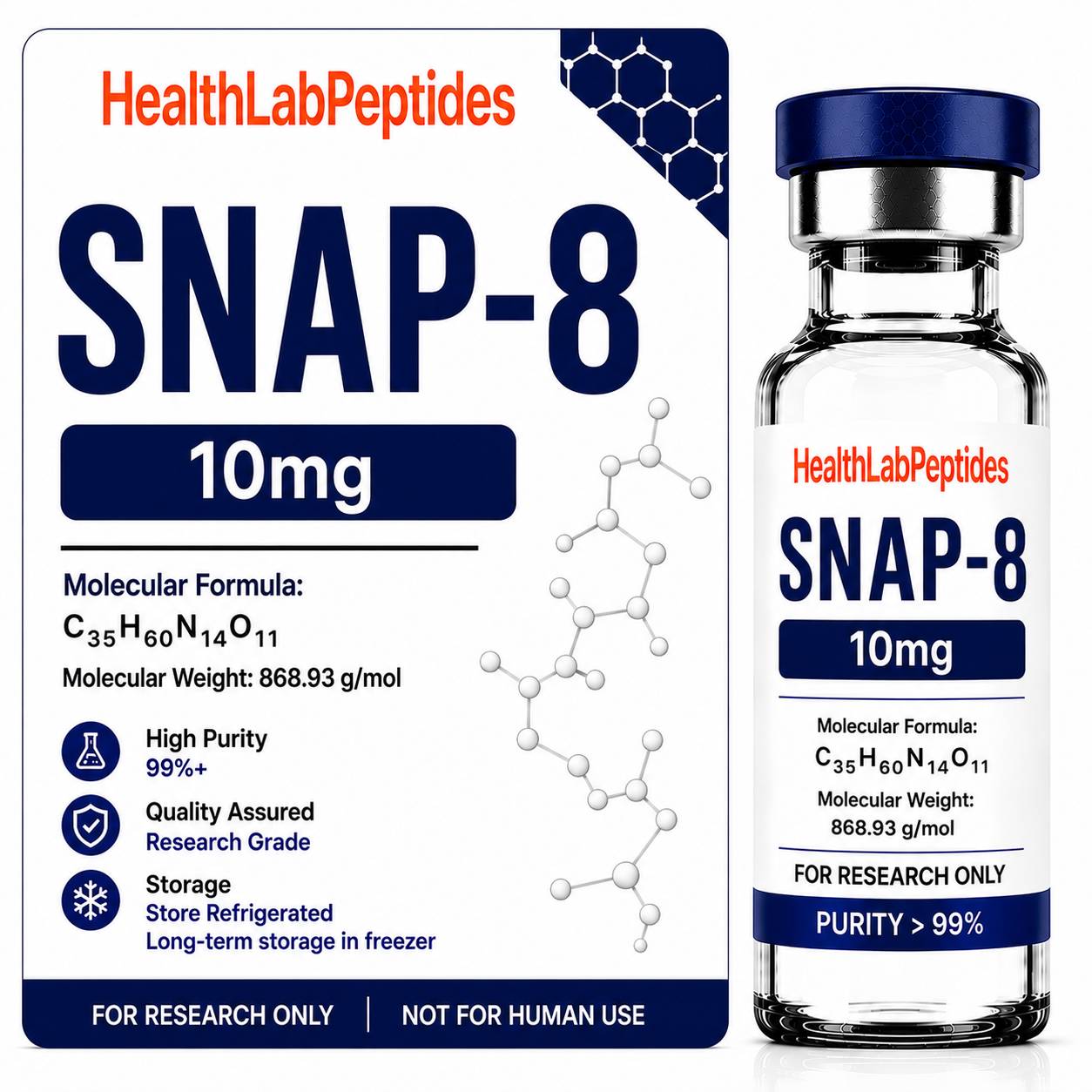
Research suggests that a peptide-fragment study should be interpreted from its exact sequence and assay context, not from a familiar shorthand name alone. SNAP-25 is a neuronal SNARE protein involved in vesicle fusion. Some primary studies used synthetic fragments patterned after portions of SNAP-25 to test specific in-vitro questions. Those findings do not automatically describe every product or sequence associated with the name SNAP-8.

The SNARE context
SNARE proteins form complexes that help drive membrane fusion in cellular systems. A paper describing a 20-residue peptide modeled on a SNAP-25 C-terminal sequence reported effects on a specific component of exocytosis in chromaffin cells (PMID 9006897). Another study examined the SNAP-25 C-terminal coil and its contribution to exocytosis (PMID 11373287). These experiments concern defined fragments and cell systems, not a universal property of all SNAP-25-derived materials.
A careful comparison asks whether the sequence, terminal modifications, assay, and endpoint match the study being cited. Product labels, commercial names, and research analogues can differ. If sequence identity is not documented, the article should state that limitation instead of treating two names as synonyms.
Questions for interpreting a fragment paper
- Which amino-acid sequence and modifications were tested?
- Was the endpoint binding, complex assembly, or a cellular response?
- What control fragment or reference condition was included?
- Did the authors test the complete protein, a fragment, or a marketed analogue?
- Are the conclusions limited to the experimental model?
For related context see SNAP-8 research material, peptide sequence basics, and limits of model-based evidence.
Takeaway
SNAP-25 fragment research is sequence-specific. A useful article preserves the distinction between a defined experimental fragment and a commercial material unless direct evidence confirms they are identical.
For Research Use Only (RUO). Not for human or veterinary use, consumption, or administration. Not for diagnostic or therapeutic use.
Fragment identity must be established before assigning function
SNAP-25 is a SNARE protein involved in vesicle fusion, while a short synthetic peptide based on part of its sequence is a separate experimental reagent. The fragment may be used to test binding or competition hypotheses, but a fragment result does not reproduce the full protein’s structure, localization, or cellular role. Published biochemical studies of SNAP-25 fragments should therefore be read with the exact residues and assay format in view (PMID: 9006897; PMID: 11373287).
When a commercial name resembles a sequence fragment, check the documented amino-acid sequence and modifications before relating it to a paper. Then separate biochemical interaction data from cellular readouts. This sequence-first approach is the same one used in our Tβ4/TB-500 identity discussion.
Research use only: This material and discussion are intended solely for controlled laboratory research and in vitro use. Not for human or veterinary use, consumption, injection, diagnosis, treatment, or prevention of disease. No dosing or administration guidance is provided.


