

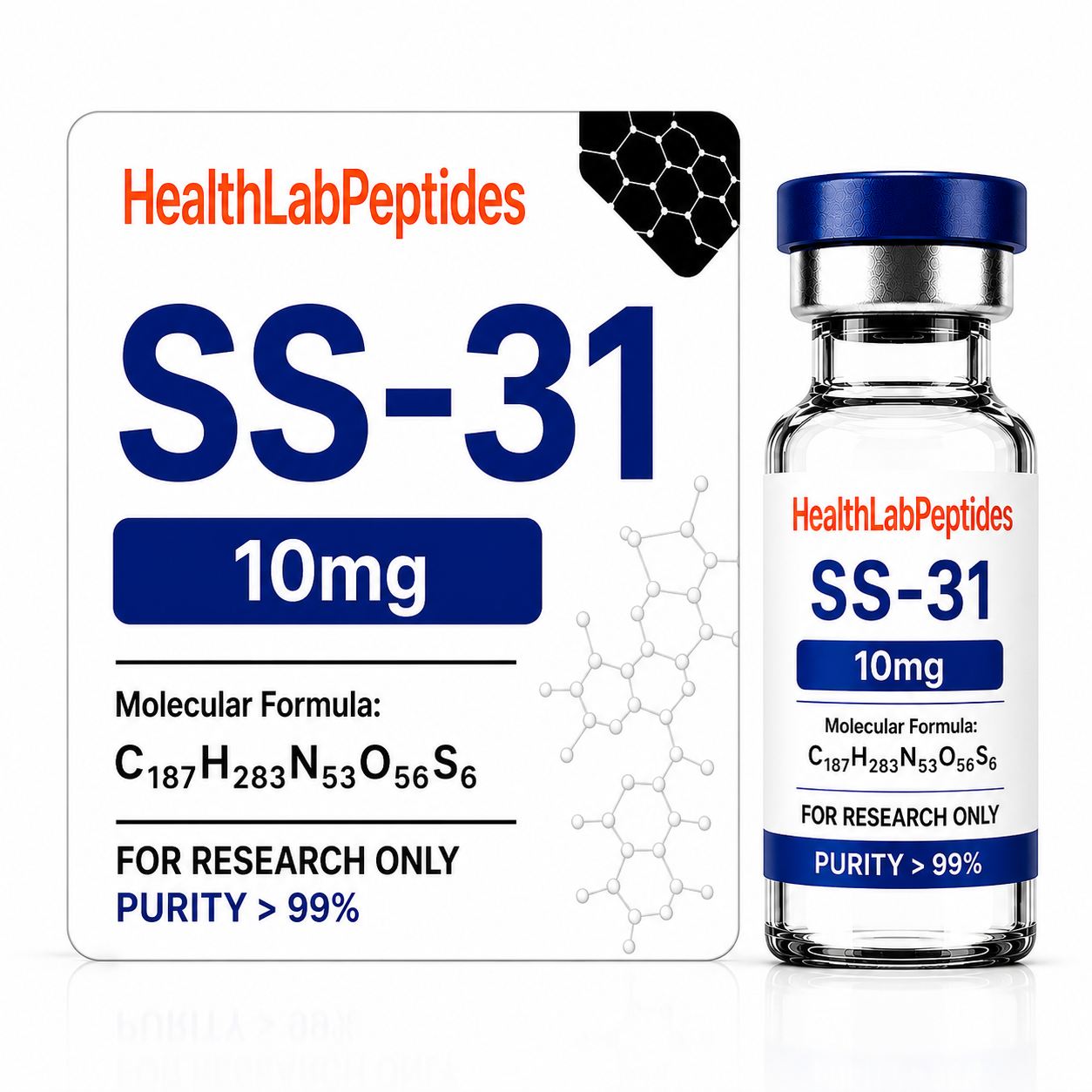
Research suggests that the mitochondria-targeted tetrapeptide SS-31, also known as elamipretide, has been investigated through membrane biophysics, cardiolipin-associated chemistry, mitochondrial protein interactions, and regulated drug research. These different evidence categories must not be confused. Importantly, in September 2025 the U.S. Food and Drug Administration granted accelerated approval to a specific prescription elamipretide product, Forzinity, for a defined indication involving Barth syndrome. That approval does not extend to laboratory research samples sold by other suppliers, including HealthLab’s SS-31 catalog material. This article explains the molecular research and regulatory distinctions without making medical or consumer-use claims for RUO material. The MOTS-c research overview provides context on a different mitochondrial peptide research category.
What is SS-31 in molecular terms?
SS-31 is a synthetic tetrapeptide containing four amino-acid residues, commonly represented by the sequence D-Arg–2′,6′-dimethyl-Tyr–Lys–Phe-NH2. Its combination of cationic and aromatic features has been studied in relation to membrane-associated interactions. SS-31 is not the same molecule as MOTS-c, a mitochondrially encoded peptide, and its sequence does not imply that it behaves like other compounds described as mitochondrial research peptides. Researchers should identify the exact molecule and formulation used in any experiment before comparing results. For the broader classification of short amino-acid chains, see the HealthLab guide to peptides and proteins. The alternative names SS-31 and elamipretide are common in the literature, but a commercial label alone does not establish equivalence to an approved medicinal product.
Cardiolipin: A distinct mitochondrial phospholipid
Cardiolipin is a specialized phospholipid enriched in the inner mitochondrial membrane. It interacts with multiple proteins involved in mitochondrial architecture and energy-related reactions. Laboratory studies of SS-31 frequently explore its relationship with cardiolipin or with membranes containing this lipid. The words mitochondrial targeting in a paper describe a research mechanism or measured distribution, not a guarantee that any research sample is clinically effective. The relevant tests may use liposomes, mitochondrial membrane preparations, spectroscopy, or protein assays. Each method reveals only part of the interaction.
Primary research on cardiolipin and cytochrome c
Birk and colleagues published a study in the British Journal of Pharmacology (2014; PMID 24134698; DOI 10.1111/bph.12468) examining interactions among SS-31, cardiolipin, and cytochrome c. The authors used experimental membrane preparations and other biophysical methods to explore electron-transfer and peroxidase-associated responses. Findings in these systems are meaningful for understanding the molecular mechanism of the peptide. They do not justify claims that research-only SS-31 treats heart disease, neurological conditions, aging, or any other human health problem. Translating a biochemical measurement into a clinical conclusion would require a separate body of evidence and regulatory context.
What a lipid-binding assay can establish
An assay using cardiolipin-containing liposomes can investigate whether a peptide associates with a defined model membrane. It can also help researchers compare how binding differs when the lipid composition or surrounding ions change. These observations are not direct readouts of cellular energy, tissue function, or a clinical endpoint. Liposomes and purified preparations lack many factors present in intact mitochondria. As a result, researchers should describe whether a study tested direct lipid interactions, membrane packing, surface electrostatics, or a downstream biological response. Treating these measurements as interchangeable leads to inaccurate summaries.
Membrane electrostatics and a 2020 biophysical study
Mitchell and colleagues investigated SS-31’s interaction with lipid bilayers in a Journal of Biological Chemistry paper (2020; PMID 32273339; DOI 10.1074/jbc.RA119.012094). The research examined membrane binding and changes in surface electrostatics using model and mitochondrial membrane systems. The authors also considered calcium distribution in the interfacial region. These observations help refine hypotheses about how an amphipathic tetrapeptide influences membrane properties. They do not independently demonstrate a clinical effect. Such studies also illustrate why the presence or absence of cardiolipin and other negatively charged lipids can matter to the experiment.
Membrane binding is not the same as receptor activation
Unlike research focused on a conventional cell-surface receptor, SS-31 investigations often involve physical interactions with membranes and membrane-associated proteins. A molecule that partitions into a lipid bilayer can alter experimental readouts without directly occupying a classic hormone receptor. These mechanistic categories should remain separate. Membrane packing, electrostatics, and calcium interactions are measurable questions, while a claim about broad mitochondrial recovery or patient improvement is a different proposition. A high-quality explanation identifies what the scientists directly observed and which parts remain mechanistic hypotheses.
Mitochondrial protein interaction mapping
A study indexed under PMID 32554501 investigated SS-31 interactions with mitochondrial proteins using chemical cross-linking coupled to mass spectrometry. The reported protein associations included groups involved in oxidative phosphorylation and other mitochondrial processes, many related to cardiolipin-associated complexes. Such experiments can map candidate molecular proximity or interactions but do not necessarily establish an exclusive primary binding site or a complete mechanism. Mass-spectrometric results should be evaluated alongside controls, identification confidence, and biochemical validation. A protein interaction list cannot by itself prove a therapeutic effect.
Structural comparisons among tetrapeptide analogs
Studies of SS-31-related compounds have investigated how changes in aromatic residues and sequence ordering influence membrane-associated behavior. A 2022 structure–activity study indexed under PMID 35913044 compared the membrane properties of different tetrapeptide analogs. Observing differences in surface charge, membrane binding, or conformation helps researchers understand which molecular features are important within the tested system. It does not establish that any one analog is universally safer or more effective in people. The comparison also reinforces why the exact chemical sequence must accompany any claim about experimental peptide activity.
Why ATP and oxidative-phosphorylation claims need precision
A mitochondrial experiment may measure oxygen consumption, redox-associated reactions, electron transport, or an ATP-related endpoint. Those outcomes depend on the experimental conditions and biological preparation. An observed change in oxygen consumption is not identical to measured ATP production, and neither demonstrates improved organism-level function by itself. Research on SS-31 has explored mitochondrial bioenergetic endpoints, but broad phrases such as restores energy or rejuvenates cells are not adequately precise for a research-only product page. The model, readout, and uncertainty should remain explicit.
Clinical development and the September 2025 FDA decision
Regulatory status is an especially important distinction for SS-31 because the FDA granted accelerated approval on September 19, 2025 to the specific prescription product Forzinity (elamipretide) for improving muscle strength in certain adults and children with Barth syndrome who meet the approved label’s conditions. The approval relies on a defined evidence and product-quality record. It does not apply to generic research samples marketed under the SS-31 name. A scientific article may accurately discuss that regulatory event while making clear that HealthLab’s research-only materials are not approved medications, are not substitutes for the prescription product, and are not intended for human or veterinary use.
What accelerated approval means for interpreting evidence
Accelerated approval is a defined FDA regulatory pathway and should not be described as universal proof of a medicine’s effectiveness for every proposed indication. The approval for Forzinity is based on specific findings and may require confirmatory evidence for continued approval. Even when a molecule has an approved pharmaceutical formulation, other applications, preparations, and populations remain separate questions. For an RUO supplier, the relevant point is narrower: scientific and regulatory information about an approved medicine does not confer approval on an independent laboratory material. It would be misleading to suggest otherwise.
Research samples versus regulated formulations
Molecular names can recur across biochemical literature, investigational programs, and commercial catalogs. The presence of the same common name does not guarantee the same formulation, manufacturing controls, testing, or regulatory status. For experimental laboratory work, a Certificate of Analysis may document selected attributes of a batch. It does not establish that the sample meets the specifications of an FDA-approved prescription product or is suitable for administration. HealthLab’s SS-31 10 mg research material listing is included for laboratory catalog identification only. It is not a clinical alternative to an approved medicine.
How to evaluate an SS-31 paper
Readers should first determine whether the publication reports a molecular biophysics experiment, a cell or tissue model, an animal study, or evidence from a regulated clinical program. Next, identify the chemical entity, controls, experimental conditions, endpoint, and limitations. A cross-linking result and a membrane-binding result answer different questions, and their combined interpretation may remain incomplete. Comparisons among model systems should not assume that a measured effect remains constant across cell types or species. Research summaries are most useful when they preserve this complexity without burying readers in unsupported promises.
Common research questions
What does SS-31 stand for? It is a name used for a Szeto–Schiller family tetrapeptide known as elamipretide. What is cardiolipin? A phospholipid associated with the inner mitochondrial membrane and important protein interactions. Does research on Forzinity make HealthLab SS-31 a prescription medicine? No. Can a lipid-binding assay establish a human treatment outcome? No; the experimental endpoint is different. Is SS-31 interchangeable with other mitochondrial research peptides? No, molecular identities and mechanisms must be evaluated separately.
Selected sources and regulatory documentation
Birk et al., British Journal of Pharmacology (2014), PMID 24134698, DOI 10.1111/bph.12468; Mitchell et al., Journal of Biological Chemistry (2020), PMID 32273339, DOI 10.1074/jbc.RA119.012094; mitochondrial protein cross-linking study, PMID 32554501; tetrapeptide structure–activity study, PMID 35913044. Regulatory background: FDA Forzinity Drug Trials Snapshot and the approved U.S. label, initial approval September 19, 2025. These identifiers are presented as research context, not as authorization for human use of a HealthLab catalog item.
Conclusion: Keep the molecular evidence and product status separate
SS-31 research is valuable because it addresses membrane-associated molecular behavior in a well-defined experimental framework. Its relationship to cardiolipin, electrostatics, and mitochondrial protein systems has produced a substantial biochemical literature. A specific FDA-approved elamipretide product now exists for a narrow indication, but research material from an unrelated source remains separate and restricted to lawful research. An accurate overview can explain both facts without making broad medical claims or implying that a laboratory vial is equivalent to an approved medicine.
For Research Use Only
For Research Use Only. Not for human consumption, medical, or veterinary use. No dosing, administration, injection, treatment, or personal-use guidance is provided. These statements have not been evaluated by the FDA. This research material is not intended to diagnose, treat, cure, or prevent any disease.



[…] can manifest in several ways, such as the loss of muscle mass, compromised immune reactions, diminished skin elasticity and the emergence of fine lines and wrinkles (2–4). Moreover, as aging progresses, individuals […]