
TB-500 peptide research has attracted scientific interest in areas involving actin biology, cell migration, tissue-repair mechanisms, angiogenesis, cellular signaling, and regenerative biology.
TB-500 is commonly discussed alongside thymosin beta-4 (Tβ4), but an important scientific distinction must be made between the two compounds. TB-500 is a synthetic peptide fragment associated with a sequence found within the larger thymosin beta-4 molecule. Research involving full-length thymosin beta-4 should therefore not automatically be attributed to TB-500 itself.
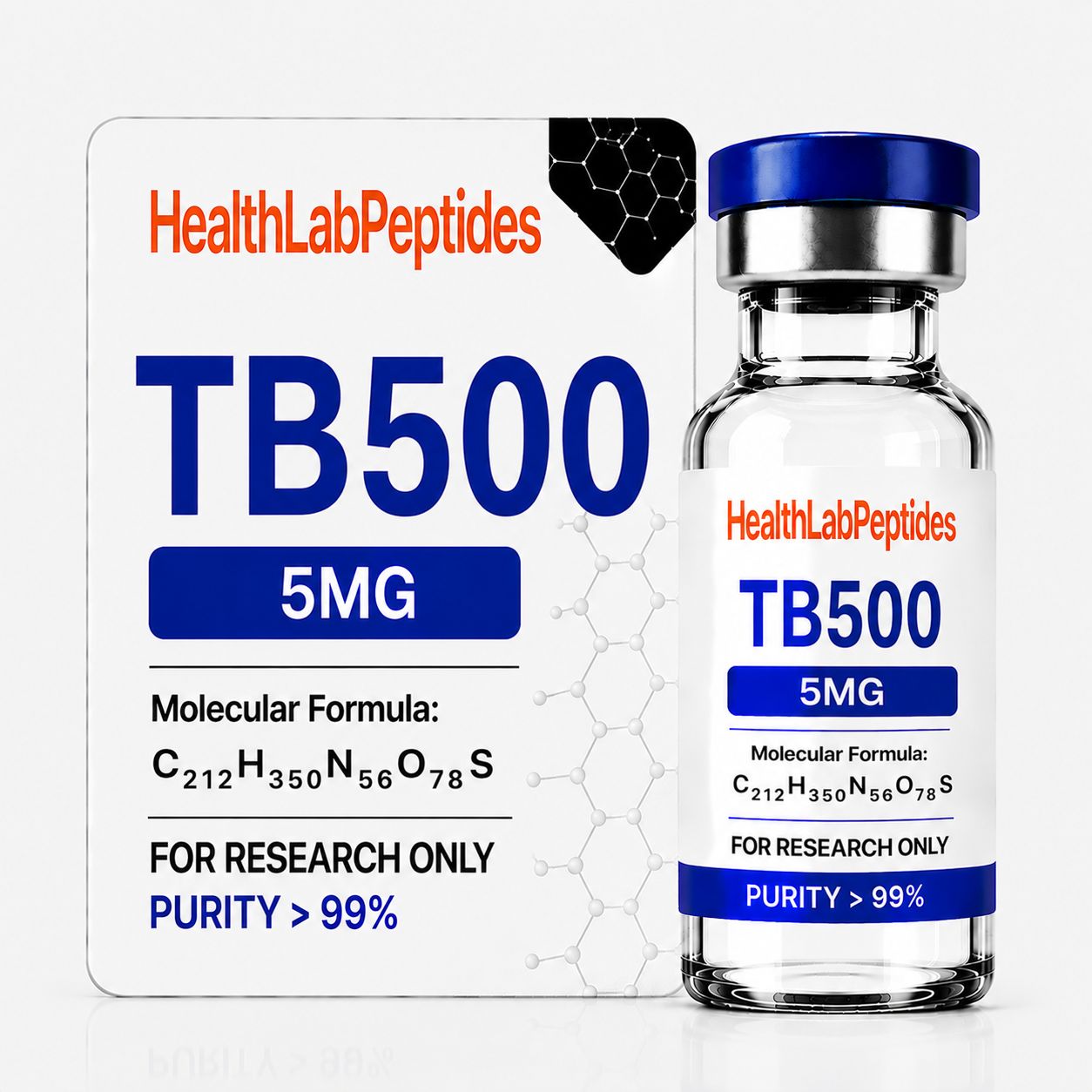
Scientists interested in the compound can review the TB-500 5mg research peptide offered by HealthLab Peptides strictly for laboratory research.
This article discusses TB-500 solely in the context of scientific and laboratory research. References to tissue repair, wound healing, recovery, inflammation, muscle biology, exercise, bodybuilding, weightlifting, or regenerative processes describe research subjects, not claimed benefits or intended uses of TB-500 products offered by HealthLab Peptides.
What Is TB-500?
TB-500 is generally described as a synthetic N-acetylated peptide fragment corresponding to the LKKTETQ sequence associated with residues 17–23 of thymosin beta-4.
Full-length thymosin beta-4 is a naturally occurring 43-amino-acid peptide involved in numerous cellular processes.
The distinction between TB-500 and thymosin beta-4 is important when evaluating scientific literature.
Research performed using full-length thymosin beta-4 does not necessarily establish that the TB-500 fragment produces the same biological activity.
Researchers should therefore verify the precise compound investigated in a publication before drawing conclusions about TB-500.
TB-500 and Actin Research
One of the most important areas associated with thymosin beta-4 biology involves actin.
Actin is a structural protein that contributes to:
- cell shape
- cell movement
- cytoskeletal organization
- intracellular transport
- cell division
- tissue architecture
Researchers studying peptide fragments associated with thymosin beta-4 may investigate how particular sequences interact with actin-related pathways under controlled experimental conditions.
This makes TB-500 actin research relevant to broader investigations involving cellular movement and structural biology.
However, observations concerning actin signaling or full-length thymosin beta-4 should not automatically be interpreted as evidence that TB-500 repairs injuries or accelerates healing in humans.
Cell Migration Research
Cell migration is fundamental to numerous biological processes.
Researchers studying cellular repair models may investigate how cells move in response to signaling molecules, environmental conditions, structural proteins, and experimental compounds.
Areas of investigation can include:
- fibroblast migration
- endothelial-cell behavior
- cytoskeletal organization
- extracellular-matrix interactions
- cellular signaling
- tissue-remodeling mechanisms
TB-500-related research may therefore overlap with broader cell-migration and tissue-repair research.
These experimental topics do not establish a therapeutic use for TB-500.
TB-500 and Tissue Repair Research
The phrase TB-500 tissue repair research frequently appears in discussions surrounding this peptide.
Tissue repair itself is a complex biological process involving numerous interconnected mechanisms, including cellular migration, extracellular-matrix remodeling, inflammatory signaling, vascular responses, and cellular proliferation.
Researchers may investigate these processes using cellular, molecular, biochemical, animal, or other experimental models.
HealthLab Peptides does not claim that TB-500 products sold on this website heal injuries, repair tendons, regenerate tissue, accelerate recovery, or produce therapeutic effects.
References to tissue repair research describe the scientific field in which related biological mechanisms may be investigated.
Wound-Healing Research
Wound healing is another research area commonly associated with thymosin beta-4 literature.
Experimental wound-healing research can involve several stages and biological processes, including:
- cellular migration
- inflammatory signaling
- extracellular-matrix remodeling
- vascular signaling
- epithelial biology
- fibroblast activity
- cellular proliferation
When evaluating this literature, researchers should determine whether a study actually investigated TB-500, another peptide fragment, or full-length thymosin beta-4.
These substances should not be assumed to be scientifically interchangeable.
HealthLab Peptides does not market TB-500 as a wound-healing treatment.
Angiogenesis Research
Angiogenesis refers to the biological formation of new blood vessels from existing vascular structures.
It is an important research subject in areas including developmental biology, wound biology, cancer research, cardiovascular science, and regenerative biology.
Research involving thymosin beta-4 has contributed to scientific interest in angiogenesis-related pathways.
Researchers studying TB-500 should nevertheless distinguish findings involving the full-length parent peptide from findings involving the shorter TB-500 fragment.
References to angiogenesis on this page describe a research mechanism and are not claims that TB-500 improves circulation, heals injuries, or produces regenerative effects in humans.
Inflammatory Signaling Research
Inflammatory signaling is involved in many aspects of cellular and tissue biology.
Researchers may examine cytokines, oxidative pathways, immune-cell signaling, cellular stress responses, and other molecular mechanisms when investigating tissue-repair models.
Thymosin-related peptides have appeared in scientific literature involving some of these pathways.
However, HealthLab Peptides does not claim that TB-500 reduces inflammation or treats inflammatory conditions.
The phrase TB-500 inflammation research refers to scientific investigation of relevant pathways rather than an established therapeutic effect.
Muscle Research
TB-500 is frequently discussed online in connection with muscle recovery, muscle repair, bodybuilding, weightlifting, sports, and exercise.
Those associations require careful distinction between research terminology and intended product use.
Scientists studying skeletal-muscle biology may investigate:
- cellular responses to mechanical stress
- cytoskeletal signaling
- muscle-cell biology
- extracellular-matrix remodeling
- tissue-repair mechanisms
- inflammatory signaling
- exercise-associated molecular pathways
These areas make muscle research scientifically relevant to broader investigations involving tissue biology.
HealthLab Peptides does not claim that TB-500 increases muscle mass, repairs exercise-related injuries, improves strength, accelerates workout recovery, or enhances athletic performance.
TB-500 Bodybuilding Research
The phrase TB-500 bodybuilding appears frequently in online searches and discussions.
For purposes of this website, TB-500 bodybuilding research refers only to scientific investigation of biological mechanisms that may be relevant to skeletal-muscle, cellular, tissue, or exercise research.
It does not mean that TB-500 offered by HealthLab Peptides is intended to be used by bodybuilders.
HealthLab Peptides does not provide bodybuilding protocols, cycles, dosage recommendations, or instructions for using TB-500 for physique or performance enhancement.
Weightlifting and Exercise Research
Weightlifting research and exercise research involve numerous biological systems.
Scientists may investigate how mechanical loading and physical activity relate to:
- skeletal-muscle signaling
- connective-tissue biology
- cellular stress
- inflammatory pathways
- metabolic signaling
- tissue remodeling
- recovery-associated molecular mechanisms
These subjects overlap with some of the biological pathways appearing in peptide research.
Accordingly, references to TB-500 exercise research, weightlifting research, sports research, or recovery research on this website describe scientific areas of investigation only.
They do not represent intended uses of TB-500 products sold by HealthLab Peptides.
TB-500 and BPC-157 Research
TB-500 is also frequently discussed alongside BPC-157 because both compounds appear in online and scientific discussions concerning tissue biology and experimental repair mechanisms.
However, they are chemically distinct research compounds and should not be considered interchangeable.
Researchers interested in these areas can review the BPC-157 5mg research peptide and the TB-500 5mg research peptide individually.
References to BPC-157 or TB-500 in tissue-repair literature do not establish that either product offered by HealthLab Peptides heals injuries or produces therapeutic effects in humans.
TB-500 and Regenerative Research
Regenerative biology examines the molecular and cellular processes through which biological tissues develop, respond to damage, remodel, and maintain structural organization.
Research in this field may involve:
- cell migration
- cytoskeletal biology
- angiogenesis
- extracellular-matrix signaling
- cellular differentiation
- inflammatory signaling
- tissue remodeling
TB-500 is discussed within this broader research context because of scientific interest surrounding thymosin-related peptide sequences and these biological processes.
The term regenerative research should not be interpreted as a claim that TB-500 regenerates human tissue.
TB-500 Safety Research
The safety profile of TB-500 for human use has not been established.
Available scientific evidence concerning TB-500 itself is limited, and findings involving full-length thymosin beta-4 should not automatically be used to establish the safety of the shorter TB-500 fragment.
Researchers should distinguish carefully between:
- TB-500 research
- full-length thymosin beta-4 research
- cellular studies
- animal studies
- mechanistic observations
- human clinical evidence
HealthLab Peptides does not represent TB-500 as safe or effective for human administration.
Limitations of Current TB-500 Research
One of the most important limitations in evaluating TB-500 is the tendency for online discussions to treat TB-500 and thymosin beta-4 as though they were the same compound.
They are not identical substances.
Researchers should examine the materials and methods section of original publications to determine precisely which compound was studied.
Another limitation is that mechanistic findings do not necessarily predict clinical outcomes.
Evidence involving actin, cell migration, angiogenesis, inflammatory signaling, or tissue biology may provide useful scientific hypotheses without demonstrating that a research compound produces a particular health outcome.
For this reason, experimental findings should not be converted into claims of injury recovery, healing, muscle growth, athletic performance, or therapeutic effectiveness.
Human-Use Information
HealthLab Peptides does not provide human-use instructions for TB-500.
This website does not provide:
- human dosage recommendations
- injection instructions
- injection locations
- administration schedules
- loading phases
- maintenance phases
- bodybuilding cycles
- athletic-performance protocols
- instructions for personal use
Published scientific literature may describe experimental methodologies where relevant to a particular study. Researchers interested in original methodologies should consult the primary scientific publication rather than interpreting educational material on this website as directions for use.
Laboratory Research
TB-500 offered by HealthLab Peptides is intended for controlled laboratory and in-vitro research.
Researchers may investigate areas involving peptide chemistry, analytical characterization, cellular biology, molecular signaling, actin-associated mechanisms, and other appropriately designed experimental questions.
Scientists interested in related research materials can explore:
- TB-500 5mg Research Peptide
- BPC-157 5mg Research Peptide
- CJC-1295 Without DAC + IPA Research Peptide
- MOTS-C 40mg Research Peptide
- SS-31 Research Peptide
Each compound has a distinct molecular structure and research literature. Researchers should not assume that findings involving one peptide apply to another.
Frequently Asked Questions
What is TB-500?
TB-500 is generally described as a synthetic N-acetylated peptide fragment associated with the LKKTETQ sequence found within thymosin beta-4.
Is TB-500 the same as thymosin beta-4?
No.
TB-500 is a shorter peptide fragment, while thymosin beta-4 is a larger 43-amino-acid peptide.
Research involving the full-length molecule should therefore not automatically be attributed to TB-500.
Why is TB-500 studied?
Scientific interest includes research involving peptide chemistry, actin-associated biology, cell migration, cellular signaling, tissue biology, and related molecular mechanisms.
Does TB-500 heal injuries?
HealthLab Peptides makes no such claim.
Tissue repair and wound healing are areas of scientific research associated with thymosin-related biology. Research into those mechanisms does not establish that TB-500 products sold by HealthLab Peptides heal injuries in humans.
Is TB-500 used for bodybuilding?
TB-500 is frequently discussed online in connection with bodybuilding, weightlifting, exercise, recovery, and sports.
HealthLab Peptides does not market TB-500 for bodybuilding, athletic performance, muscle growth, exercise recovery, or human use.
References to these subjects on this website describe areas of scientific research only.
Does HealthLab Peptides provide TB-500 dosing information?
No.
HealthLab Peptides does not provide human dosage, injection, cycling, loading-phase, maintenance-phase, or administration instructions for TB-500.
Is TB-500 intended for human use?
No.
TB-500 offered by HealthLab Peptides is sold strictly for Research Use Only and is not intended for human or veterinary use or consumption.
Related Peptide Research
Researchers interested in tissue and cellular biology may also explore:
CJC-1295 Without DAC + IPA Research Peptide
Conclusion
TB-500 remains a subject of scientific interest involving peptide chemistry, actin biology, cell migration, tissue-repair research, regenerative biology, muscle research, exercise research, bodybuilding research, weightlifting research, and cellular signaling.
However, researchers should distinguish TB-500 from full-length thymosin beta-4 and avoid extrapolating findings from one compound to the other without supporting evidence.
Likewise, mechanistic or laboratory findings should not be interpreted as evidence of clinical effectiveness.
Research concerning cellular migration, tissue biology, angiogenesis, inflammatory signaling, or related mechanisms does not establish that TB-500 heals injuries, accelerates recovery, builds muscle, improves athletic performance, or provides therapeutic benefits in humans.
Research Use Only — Important Notice
TB-500 products offered by HealthLab Peptides are sold strictly for Research Use Only (RUO) and in-vitro laboratory research.
NOT FOR HUMAN OR VETERINARY USE OR CONSUMPTION.
HealthLab Peptides does not market TB-500 as a drug, medication, dietary supplement, bodybuilding product, weightlifting product, athletic-performance product, injury-recovery product, wound-healing product, regenerative treatment, or therapeutic product.
TB-500 products offered by HealthLab Peptides are not intended to diagnose, treat, cure, mitigate, or prevent any disease, injury, or medical condition.
References to tissue repair research, wound-healing research, muscle research, bodybuilding research, weightlifting research, exercise research, recovery research, regenerative research, angiogenesis, inflammation, or other biological processes describe subjects of scientific investigation only. They do not represent intended uses or claimed effects of TB-500 products offered by HealthLab Peptides.
HealthLab Peptides does not provide dosage recommendations, injection instructions, administration instructions, cycling protocols, loading phases, maintenance phases, or directions for human or veterinary use.
Information on this page is provided for educational and scientific discussion and should not be interpreted as medical advice, prescribing information, dosage guidance, or instructions for personal use.
Researchers and purchasers are responsible for ensuring that research materials are acquired, handled, stored, and used in accordance with applicable laws, regulations, institutional requirements, and laboratory practices.