

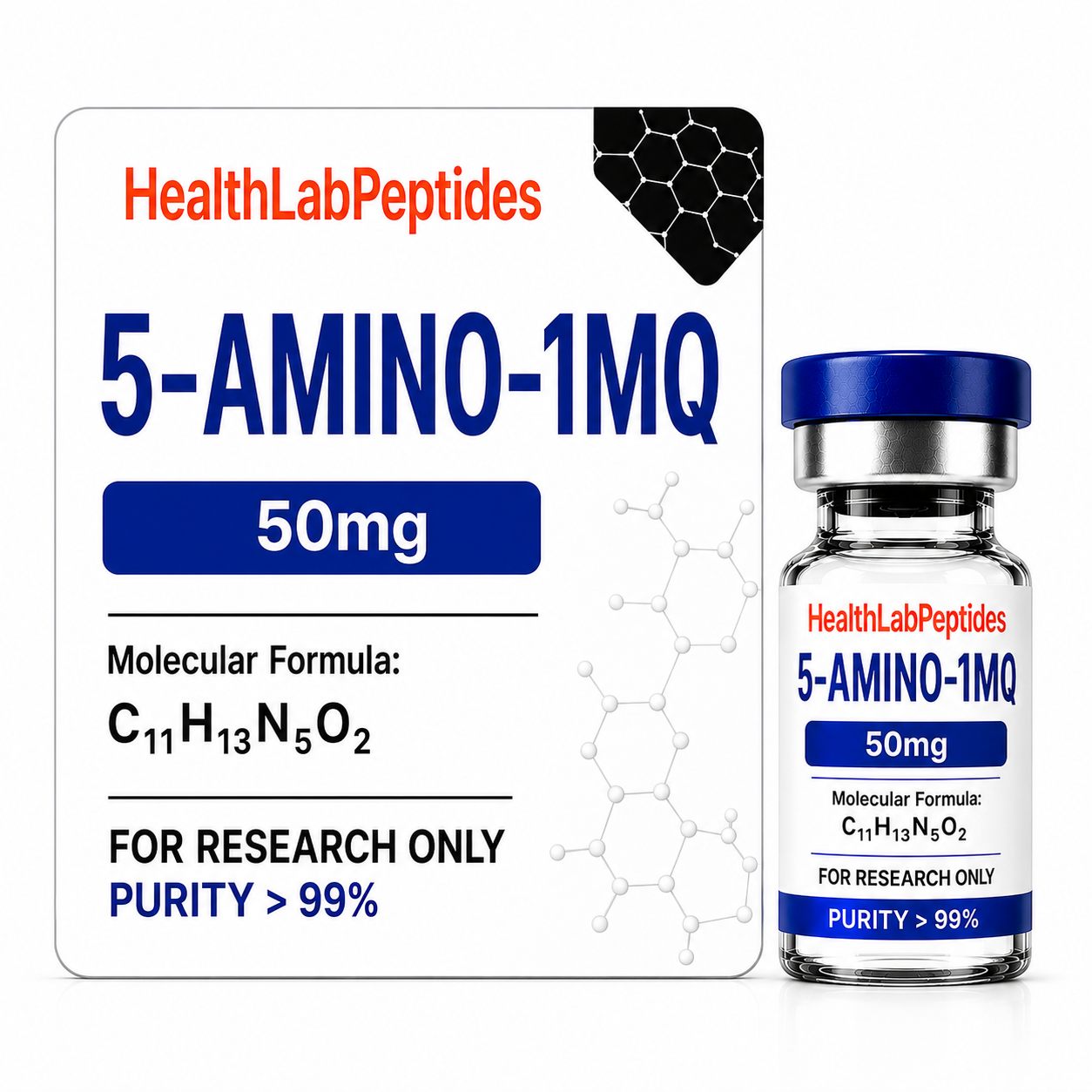
Research suggests that 5-Amino-1MQ data should be read in layers. The compound is a small-molecule NNMT inhibitor, not a peptide. A biochemical enzyme assay can test whether NNMT activity changes under defined conditions; a cellular experiment asks whether that change is observed in a living cell system. These measurements are related, but they are not interchangeable.
For research context only, HealthLab lists 5-Amino-1MQ research material. The classification matters: peptide handling assumptions do not automatically apply to a small molecule.

From enzyme activity to cellular context
NNMT catalyzes methyl transfer from S-adenosylmethionine to nicotinamide and related substrates. The 2018 primary study by Neelakantan and colleagues examined membrane-permeable inhibitors, including 5-amino-1-methylquinolinium, and reported biochemical and cell-based findings (Biochemical Pharmacology; PMID 29155147). The study’s biochemical result does not by itself predict every downstream metabolite in every cell type.
Cellular interpretation depends on NNMT expression, substrate availability, cofactor pools, competing pathways, and the endpoint selected. A change in one metabolite may reflect a shift in production, consumption, transport, or cell number. Measuring multiple related endpoints can help distinguish those possibilities, but each method brings its own sensitivity and normalization limits.
What a strong report includes
- The model and baseline NNMT expression.
- The biochemical or cellular endpoint and how it was quantified.
- Comparator conditions and an explanation of the analysis.
- Whether the observation was replicated in another model.
- A careful separation of cell findings from animal-model results.
These principles connect with HealthLab’s articles on orthogonal readouts, evidence limits across models, and analytical measurements. The last link discusses analytical interpretation broadly; it does not imply that one method answers every NNMT question.
Takeaway
5-Amino-1MQ research is most informative when enzyme inhibition, cellular pathway changes, and animal findings are reported as separate evidence levels. The article’s conclusions should stay within the model and measurements actually used.
For Research Use Only (RUO). Not for human or veterinary use, consumption, or administration. Not for diagnostic or therapeutic use.
From enzyme inhibition to a cellular readout
NNMT transfers a methyl group from S-adenosylmethionine to nicotinamide, producing methylated nicotinamide and S-adenosylhomocysteine. A purified-enzyme assay can test inhibition under controlled biochemical conditions. A cell experiment adds permeability, intracellular concentration, metabolism, and compensatory pathways. The two experiments therefore answer related but different questions.
The published 5-Amino-1MQ research includes preclinical work investigating NNMT inhibition and metabolic consequences (PMID: 29155147). When summarizing such work, state whether the result came from an enzyme preparation, cultured cells, or an animal model. A change in one metabolite or enzyme activity should not be generalized into a broad physiological claim. Researchers can also ask whether the measured response tracks with NNMT perturbation and whether a suitable comparator or orthogonal assay supports the proposed interpretation.
Research use only: This material and discussion are intended solely for controlled laboratory research and in vitro use. Not for human or veterinary use, consumption, injection, diagnosis, treatment, or prevention of disease. No dosing or administration guidance is provided.


