

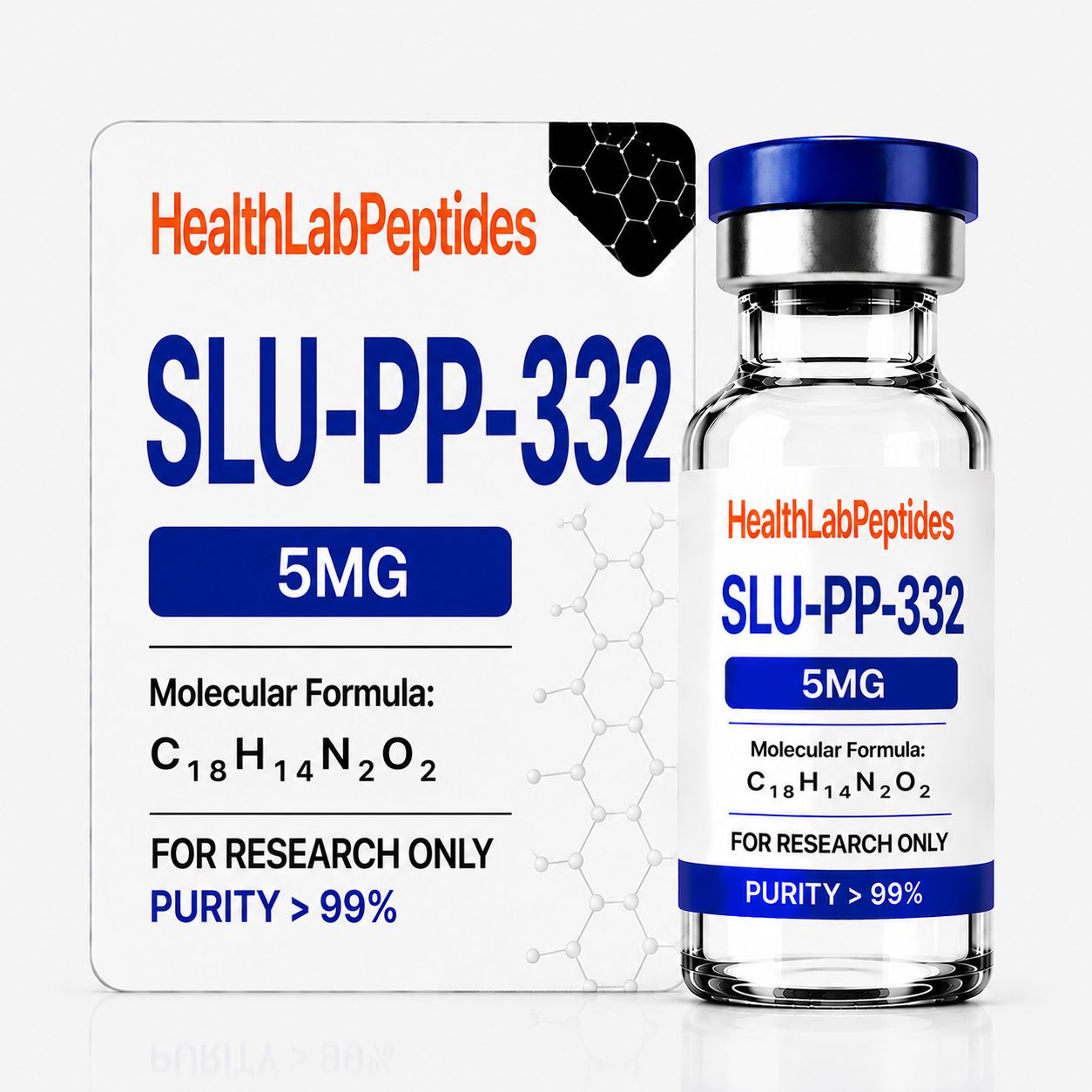
Research suggests that the first question in a SLU-PP-332 experiment should be which estrogen-related receptor (ERR) isoform the selected model is testing. ERRα, ERRβ, and ERRγ are distinct nuclear-receptor proteins, and a result in one expression system does not establish equivalent activity across all three. A useful report identifies the receptor construct, cell context, reporter or gene-expression endpoint, and the comparator used.
This article is limited to laboratory research. SLU-PP-332 is a small molecule, not a peptide; it appears in HealthLab’s research catalog and is discussed here only as an assay compound.

Separate receptor activation from downstream biology
A reporter assay can measure transcriptional activity downstream of a receptor under the assay’s defined conditions. It does not directly measure every endogenous gene, organelle process, or whole-organism response. The distinction matters because results can depend on receptor abundance, co-regulator availability, reporter design, and the timing of the measurement. Researchers comparing ERRα, ERRβ, and ERRγ should therefore treat isoform-specific data as separate observations before proposing a broader mechanism.
Billon and colleagues reported SLU-PP-332 as a pan-ERR agonist with greater potency for ERRα and included cellular respiration and gene-expression work in their 2023 study (Cell Metabolism; PMID 36988910). That paper provides a primary research example, but its preclinical findings should not be restated as a consumer or clinical claim. Follow-up work in other models answers different questions and should be evaluated on its own design.
Controls and comparisons
A comparison set can include an appropriate vehicle condition, a reference ligand where available, and a receptor-negative or altered-receptor model when the hypothesis concerns target dependence. A reporter signal should also be checked against cell condition and assay interference. If a treatment changes a reporter and cell number at the same time, the two effects should not be conflated.
For broader context, see HealthLab’s notes on binding versus functional response, cell-model selection, and controls in cell-based studies. The SLU-PP-332 catalog page identifies the research material listing.
Takeaway
Interpret SLU-PP-332 research at the level actually measured: a particular ERR isoform, a particular model, and a defined endpoint. Replication across models can broaden confidence in an observation, but it does not remove the limits of cell-based evidence.
For Research Use Only (RUO). Not for human or veterinary use, consumption, or administration. Not for diagnostic or therapeutic use.
Separating receptor activation from downstream phenotype
ERR-family experiments can combine receptor reporters with measurements of transcription or cellular respiration, but each readout sits at a different level. A reporter signal indicates activity in the construct and conditions used; it does not by itself identify every gene regulated by the receptor. A respiratory measurement reflects the integrated state of the cells and may be influenced by cell number, substrate availability, and other pathways. The primary SLU-PP-332 study reported activity across ERR isoforms with relative differences and examined metabolic gene-expression and cellular respiration endpoints (PMID: 36988910). Those findings are best summarized as model-specific pharmacology, not as proof that every readout is caused by one exclusive molecular route.
For a comparison, report receptor isoform, expression system, normalization approach, exposure interval, and the response range. Distinguish an ERR-dependent result from a general change in cell metabolism by including appropriate controls and, where feasible, a second method. Since SLU-PP-332 is a small molecule rather than a peptide, its chemistry and assay behavior should not be assumed to match peptide materials.
Research use only: This material and discussion are intended solely for controlled laboratory research and in vitro use. Not for human or veterinary use, consumption, injection, diagnosis, treatment, or prevention of disease. No dosing or administration guidance is provided.


