

Research suggests:
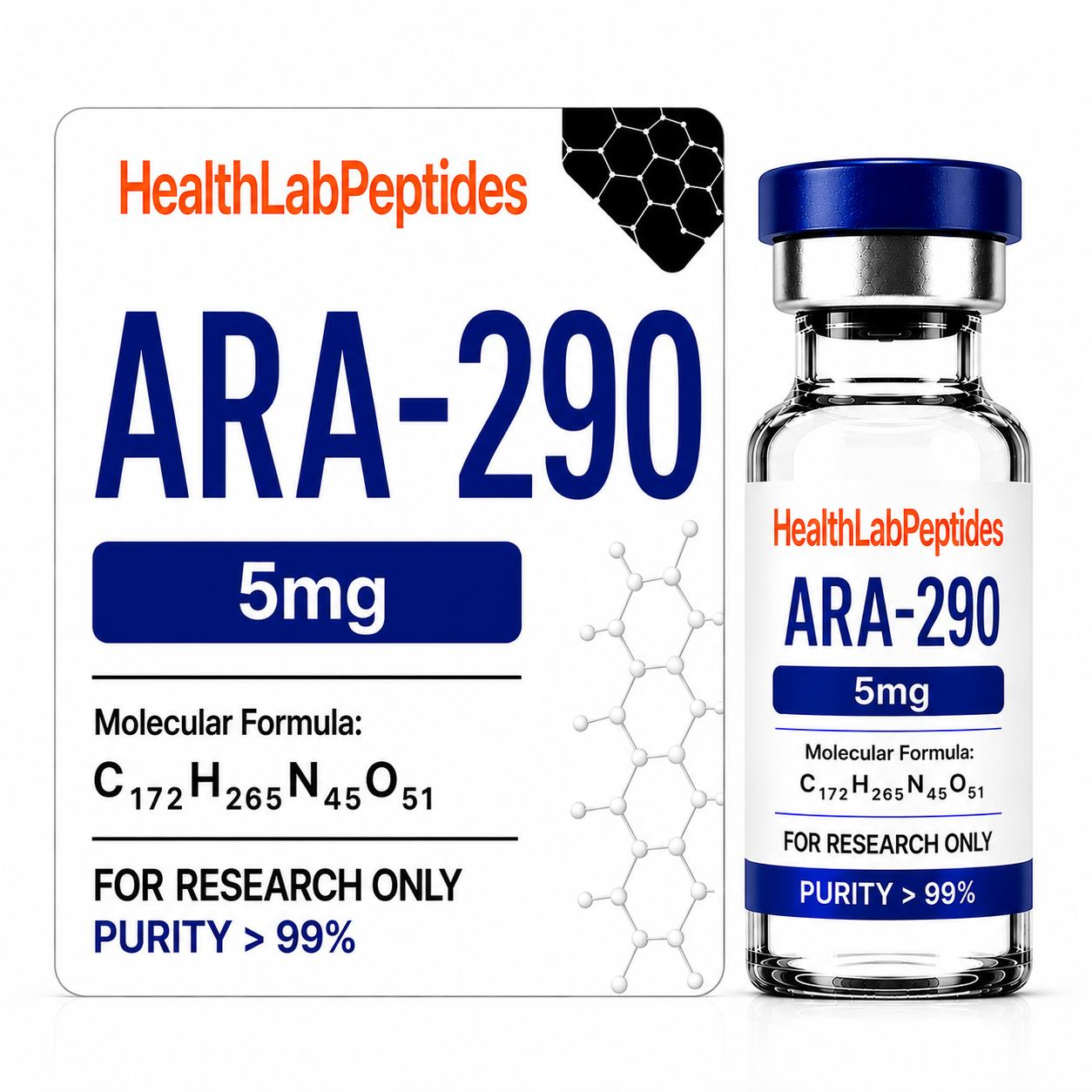
Research suggests: ARA-290, also called cibinetide, is an engineered 11-amino-acid peptide whose research history began with a structural region of erythropoietin rather than the complete hormone. Investigators have explored whether a short peptide inspired by the helix-B surface can be studied separately from erythropoietin’s red-blood-cell signaling. Such work raises questions about molecular structure, receptor complexes, pathway specificity, and the limits of evidence from animal or clinical investigations. This article examines those distinctions without attributing therapeutic claims to a HealthLab research-only vial. For background on the molecule’s broader history, see the ARA-290 erythropoietin-derived signaling overview.
Erythropoietin is a larger glycoprotein hormone
Erythropoietin, usually abbreviated EPO, is a much larger protein with glycosylation and a complex three-dimensional structure. It is studied in connection with red-blood-cell production and other biological pathways. A peptide modeled after a surface region of EPO is not equivalent to the intact hormone. Short synthetic fragments cannot automatically preserve every binding interface or physiological function of the parent protein. The distinction is fundamental to evaluating ARA-290 because its development was intended to investigate selected aspects of erythropoietin-related signaling without simply recreating native EPO. Molecular ancestry helps explain the hypothesis but does not establish identical receptor behavior.
What the helix-B designation means
Helix B refers to a structural region within the folded erythropoietin molecule. Designing a peptide based on the exposed surface of this region differs from isolating a full active domain with all of the parent protein’s structural constraints. ARA-290 is often described in the literature as pyroglutamate helix-B surface peptide, or pHBSP. Its amino-acid sequence and modifications define a new chemical entity. Investigators should distinguish structure-inspired design from proof of a specific binding mode. A modeled surface can motivate a receptor hypothesis, but biochemical experiments are needed to test it.
An 11-residue research molecule
ARA-290 is reported in primary clinical and preclinical literature as an 11-amino-acid peptide. That concise structure differs greatly from the glycosylated EPO protein. The peptide’s identity should be established through appropriate analytical documentation, and any study should identify which molecular form was used. A research catalog abbreviation such as ARA-290 may refer to the same named compound, but a product label alone does not demonstrate equivalence to a studied pharmaceutical formulation. Sequence identity, purity, and quality attributes remain independent questions.
EPO receptor complexes are not one entity
Erythropoietin signaling research discusses different receptor arrangements. The classical EPO receptor homodimer is central to erythropoiesis, while a proposed complex involving EPO receptor components and the beta common receptor has been investigated in tissue-associated signaling. These distinctions are mechanistically important because a peptide may be studied for interaction with a hypothesized receptor arrangement without having the same erythropoietic response as intact EPO. The identity and functional role of receptor complexes require direct evidence, and terminology in a review should not be used as a substitute for validated molecular interaction experiments.
The beta common receptor
The beta common receptor is often identified as CD131 or beta-cR and participates in several cytokine-receptor systems. In some ARA-290 publications, investigators describe a proposed heteroreceptor involving EPO receptor-related components and beta-cR. A mechanistic paper may test signaling in particular cells or compare outcomes in model systems. Nevertheless, receptor association, activation, and downstream tissue effects are distinct kinds of evidence. A title mentioning CD131 does not prove every proposed direct binding interaction. Scientists should distinguish the measured result from the receptor model used to interpret it.
A 2015 review of the helix-B peptide concept
A review indexed under PMID 25728128 discussed the development of nonerythropoietic peptides inspired by EPO and a proposed innate repair receptor signaling framework. It described ARA-290 as an 11-residue molecule modeled after EPO’s helix-B surface and considered why molecular responses might outlast a short-lived ligand signal in certain experiments. Reviews can organize hypotheses and experimental findings, but their terminology should not be read as direct evidence for a universal clinical effect. The review’s discussion of tissue-protection models does not approve an independent laboratory research product for bodily administration.
A clinical research paper is a different evidence category
Brines and colleagues published a phase 2 study involving a defined investigational ARA-290 preparation in Molecular Medicine (2015), PMID 25387363, PMCID PMC4365069, DOI 10.2119/molmed.2014.00215. The publication evaluated clinical and laboratory endpoints in a particular group of participants under a controlled research protocol. That evidence belongs to the exact tested formulation and study design. It does not confer an FDA-approved indication on a HealthLab research vial or show that independently sourced material has the same manufacturing quality. Its reported clinical findings also require interpretation in light of sample size and study limitations.
Why phase 2 does not mean approved medicine
A phase 2 clinical study is part of a possible drug-development pathway, not the same as product approval. Such investigations can examine selected efficacy and safety questions under defined protocols, but their conclusions do not authorize commercial research chemicals for human use. Even a positive trial result may require confirmation through additional studies. An RUO supplier should not use the existence of a clinical paper to imply a therapeutic indication for a product with different sourcing and quality controls. Scientific education can explain the trial as historical evidence while maintaining the strict boundary between tested medicine and laboratory catalog item.
Model-based tissue protection is not a product claim
The ARA-290 literature includes animal and cell models relevant to injury-associated signaling. In such experiments, a measured marker or tissue observation can inform a molecular hypothesis. However, the words tissue protection or repair can become misleading when used outside the model. A biochemical pathway associated with a particular response does not establish what happens in every tissue or disease. For a research-only product, these terms must be clearly framed as descriptions of historical experimental questions rather than claims of expected effects in people or animals.
What nonerythropoietic really means
Nonerythropoietic is used in ARA-290 literature to distinguish certain experimental effects from the red-cell-producing activity of the parent EPO hormone. It is not a general guarantee that a compound has no other biological effects or is safe for personal administration. The claim depends on the assays and comparator conditions used by the researchers. Scientists should specify whether the paper directly measured erythropoietic responses or inferred selectivity from a set of other experiments. The absence of one measured activity does not establish a universal lack of risks in untested systems.
Receptor activation versus downstream markers
A cell study may detect a change in phosphorylation, gene expression, or another downstream marker after exposure to an experimental peptide. Such a signal can be consistent with a proposed receptor pathway without proving that the ligand directly bound every component of the hypothesized receptor complex. Direct binding studies, structural data, and appropriate genetic controls address different parts of the mechanism. An evidence-based article should distinguish the observation from its interpretation. When receptor nomenclature changes or a hypothesis remains debated, certainty should be limited accordingly.
Chemical and regulatory comparisons with EPO
Intact erythropoietin and the engineered ARA-290 peptide differ in size, structure, and development histories. Even where a paper discusses both molecules, any results must be attributed to the tested material. Regulatory status is also product specific: an approved erythropoietin medicine does not create approval for a separate research compound derived from part of its structure. This principle applies equally to comparisons among ARA-290, unrelated peptide analogs, and broad groups of research chemicals. The shared term peptide signaling cannot establish equivalence.
How to evaluate an ARA-290 publication
Begin with the exact molecular entity, whether the source is a primary mechanistic paper, animal experiment, clinical investigation, or review. Next identify the biological model, proposed receptor, measured endpoints, controls, and limitations. A review may use a mechanistic name for a receptor complex, but the reader should check what the underlying primary experiments directly demonstrated. Clinical observations should be evaluated separately from cell-signaling hypotheses. A detailed, accurate explanation is more useful than collecting all positive findings under a generic healing headline.
Catalog identity and internal research navigation
The ARA-290 5 mg research-material listingpeptides-versus-proteins guide
Common questions about ARA-290 research
Is ARA-290 identical to erythropoietin? No, it is a short engineered peptide. What does helix B refer to? A structural region of the parent EPO protein. What is CD131? A beta common receptor component discussed in certain signaling models. Does nonerythropoietic mean universally safe? No. Do phase 2 findings approve a research vial? No. Can receptor associations prove treatment effects? No; they answer a different experimental question.
Selected literature and conclusion
Sources include the ARA-290 helix-B peptide review, PMID 25728128, and Brines and colleagues, Molecular Medicine (2015), PMID 25387363, PMCID PMC4365069, DOI 10.2119/molmed.2014.00215. The scientific importance of ARA-290 lies in the structure-guided attempt to examine specific EPO-related signaling pathways. Its short sequence, proposed receptor interactions, and experimental findings must not be confused with approval for human-use research materials. This article is intended solely to clarify molecular and evidence categories.
Research Use Only
Research Use Only / Not for human or veterinary use. No dosing, injection, administration, treatment, or personal-use guidance is given. The HealthLab research vial is not represented as an FDA-approved clinical formulation or treatment.



 TB-500 Research Material — 5mg