

Research suggests:
Research suggests: tirzepatide is a dual GIP and GLP-1 receptor agonist whose experimental signaling profile cannot be summarized simply as activating two receptors equally. A 2020 laboratory study described imbalanced receptor engagement and a signaling pattern at the GLP-1 receptor that favored cyclic AMP responses relative to beta-arrestin recruitment under its tested conditions. Those observations are relevant to modern receptor pharmacology but should not be transferred into claims about a HealthLab research-only sample. This article explains cAMP, beta-arrestin, receptor internalization, receptor occupancy, and the difference between cell-signaling experiments and clinical evidence. Related receptor background appears in our peptide hormone-receptor communication guide.
Tirzepatide is a dual-receptor molecular subject
Tirzepatide is a chemically modified peptide developed in relation to two incretin receptor systems. It should not be treated as a mixture of two independent peptides merely because the term dual is used. Both receptor classes may participate in endocrine signaling, but their ligand interactions and cellular pathways differ. Scientific descriptions should identify GIPR and GLP-1R separately rather than imply that all measurements at one receptor can be transferred to the other. The named compound’s molecular structure is distinct from that of native GIP and native GLP-1, so identical biological behavior cannot be assumed on the basis of the class label alone.
What the GIP receptor does in research
The glucose-dependent insulinotropic polypeptide receptor, commonly abbreviated GIPR, is a G-protein-coupled receptor studied through ligand binding and intracellular signaling assays. A test may measure cyclic AMP production, recruitment of regulatory proteins, or receptor movement. Each reveals different aspects of the same general receptor system. A strong response in an engineered cell line does not establish a predictable organism-level result. Experimental data depend on receptor expression, ligand identity, assay conditions, and choice of comparator. Scientific summaries should avoid equating receptor activation with a clinical claim.
The GLP-1 receptor is a separate target
GLP-1R is another G-protein-coupled receptor that can engage overlapping intracellular signaling machinery but is structurally and pharmacologically distinct from GIPR. Researchers may compare native GLP-1 with a modified peptide to determine whether the ligands favor different readouts. This does not necessarily establish one molecule’s superiority in humans; the assays answer narrow questions about receptor behavior. A paper that reports lower beta-arrestin recruitment under one condition should not be simplified into the assertion that the molecule lacks beta-arrestin interactions in every tissue.
A key 2020 signaling study
Willard and colleagues published “Tirzepatide is an imbalanced and biased dual GIP and GLP-1 receptor agonist” in JCI Insight in 2020 (PMID 32730231, PMCID PMC7526454, DOI 10.1172/jci.insight.140532). The research examined receptor occupancy calculations, cyclic AMP responses, beta-arrestin recruitment, and other experimental readouts. The findings showed that the signaling behavior of the molecule differed between GIPR and GLP-1R in the reported systems. This is strong evidence for a particular experimental pharmacology profile, not a general statement that an unrelated research vial is clinically interchangeable with a regulated prescription product.
What imbalanced agonism refers to
The word imbalanced describes a difference in engagement or potency across the two receptor targets, rather than equal activity at both. The 2020 analysis found a greater degree of GIP receptor engagement than GLP-1 receptor engagement under the conditions and assumptions examined. That does not mean the GLP-1 receptor was inactive. It means the relationship between the two receptor systems was not simply one-to-one. Receptor occupancy estimates also depend on binding and exposure assumptions. They should be described as model-based or experimental results rather than universal attributes independent of formulation and biological setting.
Cyclic AMP as one readout
Cyclic AMP, usually written cAMP, is a cellular second messenger generated in response to activity of certain G-protein-coupled receptor pathways. Measuring its abundance can provide a useful functional readout in a cell assay. But cAMP is not a direct measure of all receptor-associated effects, and its relationship to a later biological outcome can be complex. A cAMP result should be interpreted alongside receptor expression, comparison ligands, and assay sensitivity. A product’s ability to generate a signal in cultured cells cannot independently demonstrate a clinical benefit or safety profile.
Beta-arrestin recruitment as another readout
Beta-arrestins are proteins involved in regulating G-protein-coupled receptors, including signaling and trafficking processes. A recruitment assay tests how strongly a particular ligand-associated receptor state attracts the measured arrestin under defined conditions. It is not interchangeable with a cAMP assay. The 2020 study reported that tirzepatide showed relatively weak beta-arrestin recruitment at GLP-1R compared with its cAMP-associated activity. Such results are described as signaling bias, but the conclusion remains tied to the receptor, ligand, cell system, and quantitative framework used.
What signaling bias means
Biased agonism describes a pattern in which a ligand favors some signaling pathways relative to others when compared with a reference agonist. Bias is not simply the strongest signal being higher than another, because assay amplification and differences in experimental design can distort raw comparisons. A rigorous analysis considers reference ligands and suitable quantitative models. Researchers should not infer that a biased ligand is automatically safer or more effective for clinical purposes. The term is useful for molecular pharmacology, not a substitute for clinical studies or regulatory approval.
Receptor internalization and trafficking
After activation, some receptors can be moved from the cell surface into intracellular compartments. This process can affect the available surface population and certain signaling dynamics. The 2020 study described weaker GLP-1 receptor internalization associated with tirzepatide than with native GLP-1 in the tested preparations. A difference in internalization may help explain receptor behavior, but it does not automatically predict how the compound behaves in every tissue or individual. A cellular trafficking observation is a mechanistic endpoint and should not be presented as a direct treatment outcome.
Why GIPR and GLP-1R should not be averaged
A single summary number for a dual agonist can hide differences in affinity, potency, maximal response, and downstream regulation at separate receptors. The proper comparison depends on the research question. A ligand may show one relative pattern in a cAMP assay and a different pattern in a trafficking assay. Those observations can be simultaneously valid. An article that merely claims dual receptor activation misses the most informative aspect of the experimental pharmacology. Understanding imbalance and bias requires retaining the distinct pathways and the methodological details.
Primary islets versus engineered cell lines
The 2020 study also considered responses in primary islet preparations, extending the analysis beyond engineered receptor expression systems. Such experiments introduce additional biological complexity but remain distinct from clinical trials. A signal observed in a cell line can help explain what might happen in another preparation, yet direct evidence is needed to connect the models. The use of multiple cell systems can strengthen a hypothesis while also revealing model-dependent differences. A scientific review should state exactly where the evidence came from rather than merge findings into a universal assertion.
How albumin in assay conditions can influence results
Some chemically modified peptides interact with serum albumin, which can affect the free concentration available in a particular assay. The 2020 receptor study examined differences in measured potency when comparing assay conditions involving protein components. A shift in a concentration-response curve under those conditions does not imply a clinical schedule or duration for a research-only product. It demonstrates that the surrounding matrix can influence a measured response. This detail matters when comparing laboratories using different assay media or reference ligands.
The distinction from single-receptor GLP-1 analogs
Tirzepatide’s dual-receptor design differs from semaglutide’s GLP-1R-associated pharmacology. The molecules have different sequences, modifications, and evidence bases. A reader can explore the semaglutide receptor research overview for a related but different molecular question. Similar terms in clinical and research headlines do not show that different compounds are interchangeable. Comparisons should identify what was actually tested and resist translating receptor effects into consumer recommendations.
Pharmacology versus regulated medical products
Tirzepatide is an active ingredient in FDA-approved prescription medicines, but an independent laboratory vial sold under a related name does not thereby become an approved pharmaceutical product. The regulatory authorization belongs to a specified formulation with tested quality and approved labeling. Cell-culture findings likewise cannot establish that a research-only material is clinically equivalent. A laboratory article may discuss how the molecule’s receptors work without recommending its administration or making health and body-composition claims about a research reagent.
Material identity and navigation
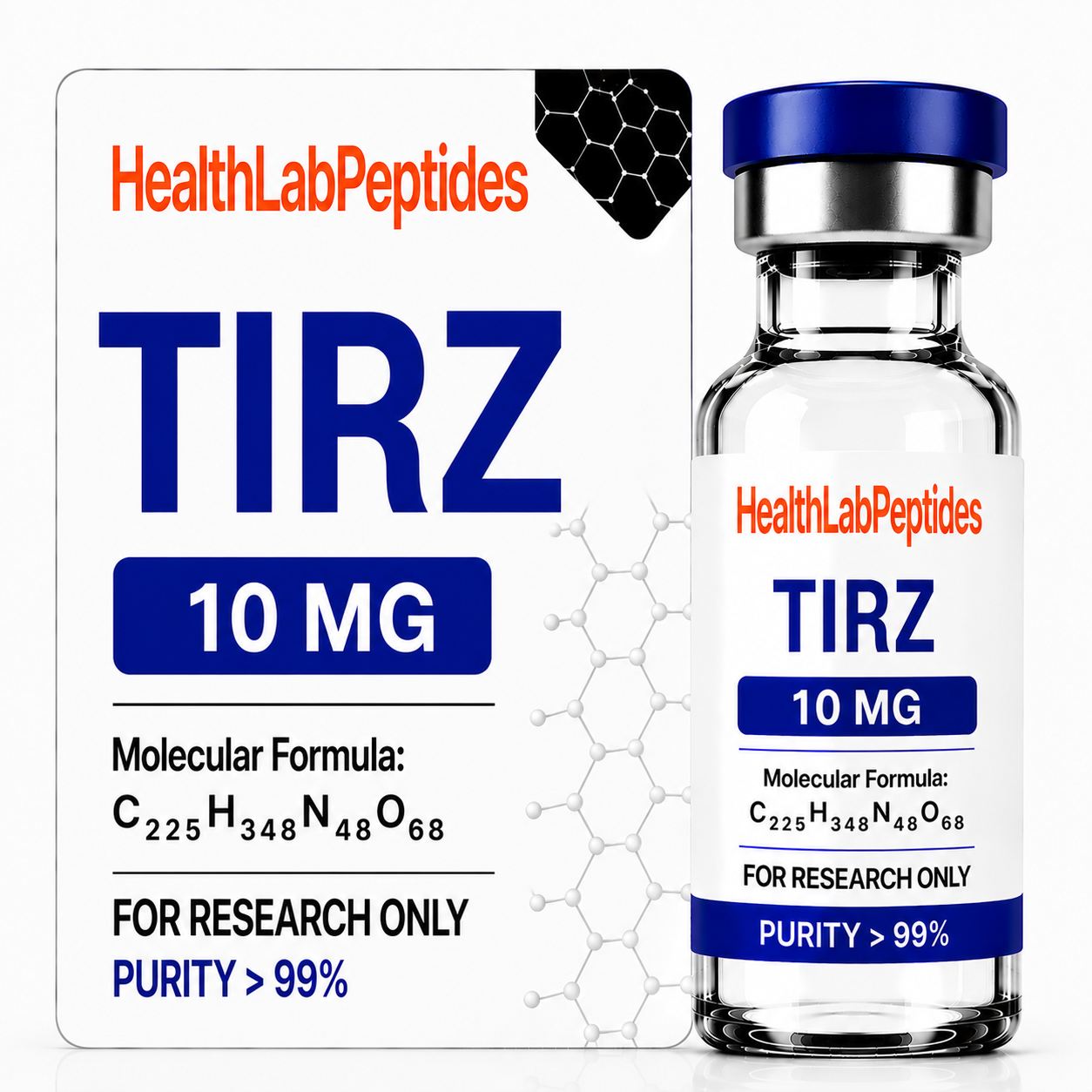
HealthLab’s Tirz 10 mg research-material listing identifies a product for legitimate analytical and in-vitro work. The catalog amount is not a personal-use recommendation. A Certificate of Analysis may document selected tests performed on a particular batch, but not the entire safety, efficacy, or manufacturing record of an approved medicine. If a published study used a different source or formulation, its results cannot be attributed automatically to that catalog material. Research documentation and clinical evidence must remain separate.
Questions for interpreting a receptor-bias paper
Which receptor was measured? Did the authors report binding, cAMP, beta-arrestin recruitment, or internalization? What comparator ligand established the reference response? Did the study use engineered cell lines, primary cells, or other preparations? Could assay amplification or albumin affect the results? The answers help distinguish a well-supported mechanistic observation from an overgeneralization. No single response curve fully describes an organism-level effect. A strong research article explains those uncertainties rather than converting them into promotional promises.
Source and conclusion
Primary publication: Willard and colleagues, JCI Insight (2020), PMID 32730231, PMCID PMC7526454, DOI 10.1172/jci.insight.140532. The paper provides a detailed receptor-pharmacology account of imbalanced GIPR versus GLP-1R engagement and signaling bias at GLP-1R in its tested systems. Its conclusions are best understood as molecular and cellular evidence, not as approval or efficacy support for an independent RUO sample. Precise distinction among receptors and readouts makes this article scientifically useful.
Research Use Only
Research Use Only / Not for human or veterinary use. This page provides no dosing, administration, injection, treatment, or consumer-use guidance. HealthLab catalog materials are restricted to lawful research and are not represented as substitutes for prescription medicines.



 IGF-1 LR3 Research Material — 1mg
 SLU-PP-332 Research Material — 5mg
 DSIP Research Material — 10mg