

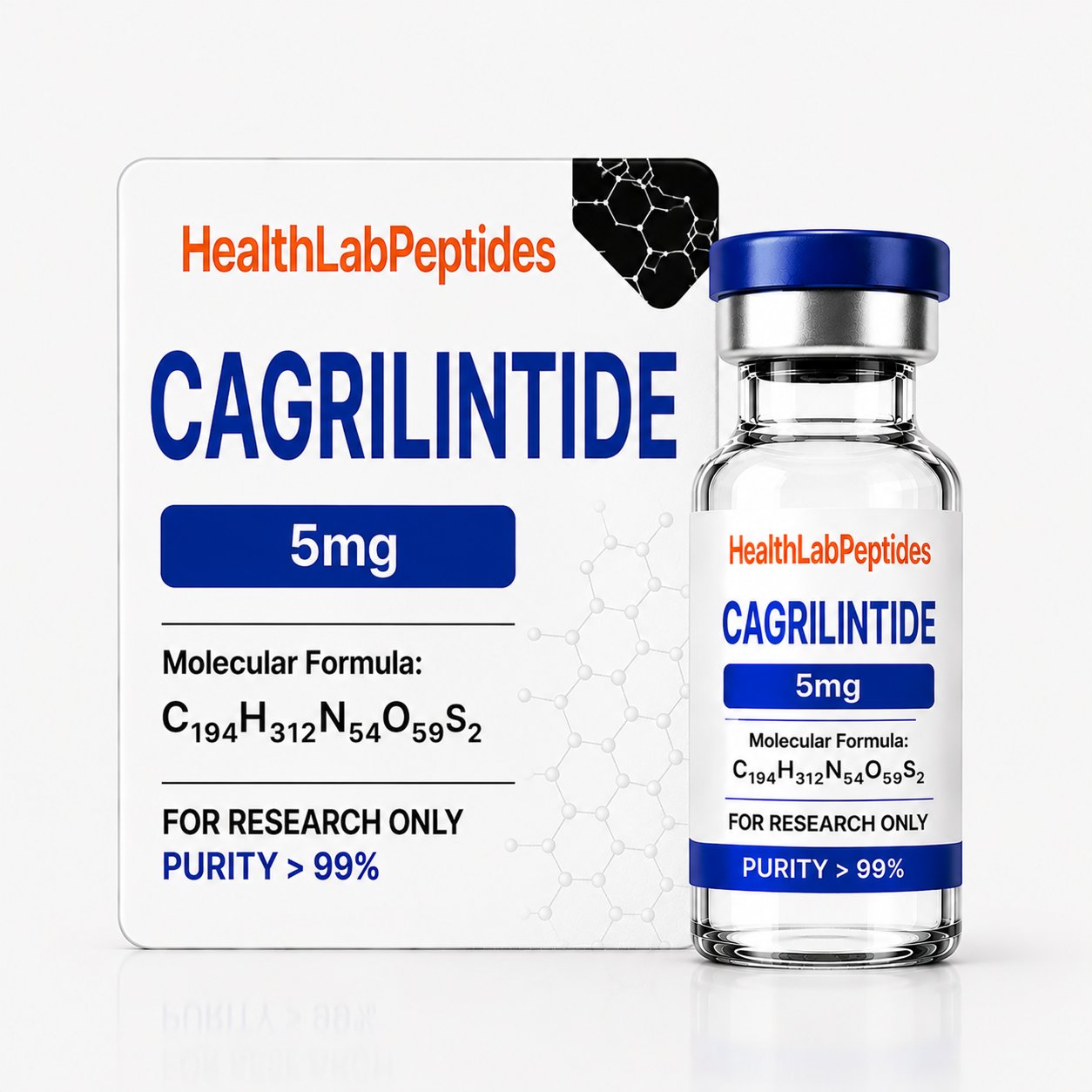
Research suggests: Cagrilintide is a lipidated amylin analog studied at calcitonin and amylin receptor complexes. The primary scientific question in cagrilintide cryo-em research: amy1r, amy2r, amy3r and calcitonin receptor concerns evidence from defined experiments, not the effects of any independent commercial preparation. This article examines structural identity, the original assays, and relevant uncertainties. For additional background, see HealthLab’s existing research overview. The material is discussed solely for research and educational purposes, not for human or veterinary use.
The receptor complex is more than one protein
Amylin receptors include complexes formed from calcitonin receptor components and receptor activity-modifying proteins, often called RAMPs. The identity of the associated RAMP contributes to the molecular and functional properties of the receptor system. AMY1R, AMY2R, and AMY3R therefore do not designate three unrelated genes encoding independent complete receptors. Their definitions arise from different combinations. A research overview should distinguish the calcitonin receptor itself, the associated RAMP isoform, and the peptide ligand tested in each experimental preparation.
A 2025 structure-based study
A 2025 Nature Communications paper reported cryo-electron microscopy structures of cagrilintide associated with active, Gs-coupled amylin receptor variants and the calcitonin receptor. The investigators compared the resulting complexes with structures involving other ligands. This work describes molecular geometry and dynamics in prepared receptor complexes. It does not directly test a HealthLab research vial or establish a clinical outcome. Structural biology is valuable because it can show how a peptide approaches a receptor, but an observed contact is not itself proof of a whole-organism effect.
AMY1R, AMY2R, and AMY3R should not be combined
The reported structures included receptor complexes involving different RAMP partners. Although the complexes share a common receptor component, they can differ in how the peptide is positioned and how the active-state structure behaves. A paper that averages all amylin receptors into one category may obscure these differences. Researchers should compare each receptor composition individually and note how the ligand’s structural contacts were observed. Claims of selectivity also depend on functional assays, which should be interpreted alongside the structural observations rather than replaced by them.
What cryo-EM structures do not tell us
Cryo-EM can reconstruct structural features of carefully prepared receptor complexes, often including bound G proteins or stabilizing factors. A structural snapshot is not a direct measurement of receptor signaling duration, peptide metabolism, or clinical efficacy. Differences in particle selection and conformational flexibility may also affect the structures researchers can resolve. When a study discusses conformational dynamics, the evidence may combine structural analysis with computational or functional information. Those methods should be identified rather than treated as one universal measurement.
For a complementary but distinct approach, the related HealthLab research article discusses a different dimension of the evidence. A structural characterization, receptor response, cellular endpoint, or analytical method may be informative without proving the others. Comparing the two pages is useful only when the actual molecular species, tested model, and measured signal are kept separate. Shared keywords do not make experiments interchangeable.
The calcitonin receptor comparison
The 2025 study included the calcitonin receptor without a RAMP as a separate comparison. This matters because cagrilintide’s activity cannot be described exclusively through one assembled amylin receptor. The receptor context and comparison peptide influence the reported conformation and relative signaling. A scientific review should state that the original paper considered multiple calcitonin-family receptor complexes. One result should not be extrapolated to a different receptor subtype or to a product marketed only by a generic compound name.
Why amylin-like binding does not mean identical outcomes
The authors described an amylin-like mode of binding alongside distinct conformational dynamics compared with certain other peptides. That combination makes chemical and mechanistic sense: similar receptor contacts can coexist with different functional profiles. A simplistic statement that cagrilintide works exactly like amylin would omit the key experimental finding. Receptor structural differences are hypotheses about possible functional behavior, which require properly controlled signaling and physiological measurements to evaluate.
Structural identity, receptor biology, and formulation
A lipidated peptide can have properties affected by its sequence and added chemical groups. A structural study uses a defined sample and controlled receptor preparations; an independently sourced vial may have different analytical documentation and is not thereby validated. A comprehensive research article separates chemical identity, receptor structure, cell signaling, and human clinical development. No claims about weight outcomes or disease treatment are appropriate for research-only commercial materials.
Questions of scientific interpretation
The relevant research citations are Nature Communications (2025), PMID 40204768, PMCID PMC11982234, DOI 10.1038/s41467-025-58680-y. Before repeating a published statement, identify its experimental setting, reference compounds, sample size or replication, analytical controls, and statistical uncertainty. A null result can be just as informative as a positive one, especially where the authors evaluated multiple models. Correlations do not necessarily show causation, and an observation from an engineered cell system cannot describe an entire living organism. The authors’ conclusions should be read alongside the methods and limitations.
Why the measured endpoint matters
A molecular structure establishes atomic arrangement in a preparation. A binding assay tests association under specified conditions. A cellular reporter measures a chosen downstream pathway, and an analytical chemistry experiment characterizes chemical species. Results at these levels are not interchangeable. It is possible to observe strong evidence for one property with little evidence for a related biological effect. More convincing mechanistic claims need independent methods or direct tests of proposed causal steps. This is the difference between describing actual research and making unsupported promises.
Research-only product keyword and catalog link
The Cagrilintide 5 mg HealthLab research-material listing corresponds to the compound discussed here. Its amount and commercial name identify a catalog item; they do not provide an experimental protocol or an instruction for use. Any available Certificate of Analysis supports only the batch properties tested and documented. A publication using a different material does not establish purity, equivalence, clinical safety, or FDA approval of an independently supplied sample. The correct relationship between the article and product link is informational.
Limitations, negative findings, and remaining questions
Readers should ask whether a result would reproduce with an independent preparation, whether the biological model reflects the question being asked, and whether unexpected assay interference was excluded. When the evidence is incomplete, the article should state uncertainty rather than omit it. Published work may use clinical-sounding language in a hypothesis, but that does not authorize applying the findings to consumers. Even an investigational clinical program uses defined regulated formulations that are distinct from unrelated RUO materials. A careful summary keeps those boundaries visible.
Scientific references and conclusion
Sources: Nature Communications (2025), PMID 40204768, PMCID PMC11982234, DOI 10.1038/s41467-025-58680-y. The literature is useful because it defines a research problem and supplies measurable evidence for selected steps. This article does not assert that any HealthLab item reproduces those results in people or animals. The key conclusion is that methods, molecular identity, and experimental context determine what can reasonably be inferred. Naming a product and linking it for lawful research navigation is not a substitute for an evidence-based mechanism or regulatory review.
Research Use Only
Research Use Only / Not for human or veterinary use. No dosing, preparation, injection, administration, therapeutic, weight-loss, athletic-performance, or other personal-use guidance is offered. No HealthLab research material is represented as a medical treatment or an FDA-approved drug.


