

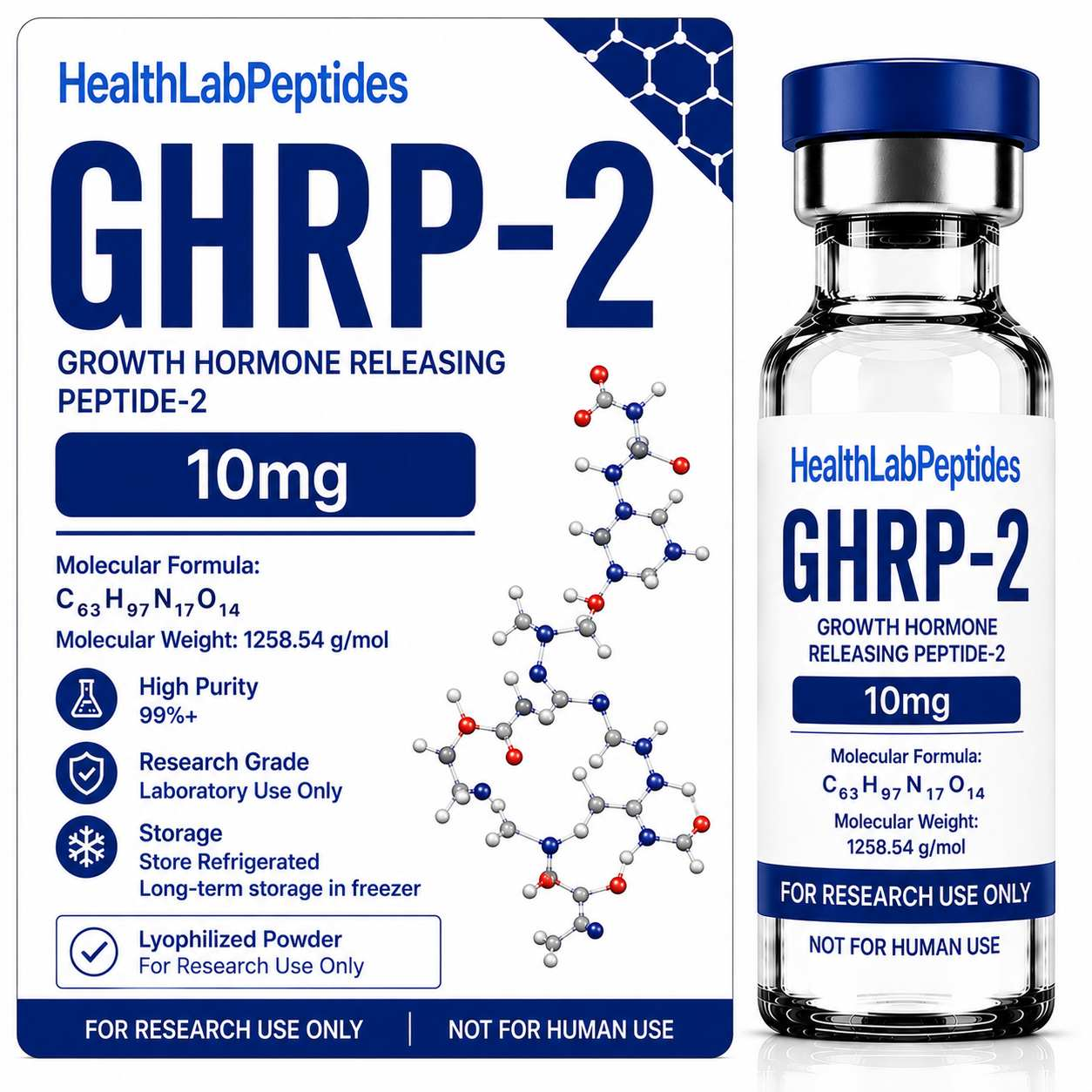
Research suggests that GHRP-2 assays need deliberate time-course design because an early receptor response and a later adapted state are not equivalent endpoints. The GHRP-2 Time-Course Design product page identifies the RUO material discussed here, while the experimental conclusion must come from a validated model and transparent controls.
Start with a narrow experimental question
The key question is whether reduced response after a first exposure reflects receptor desensitization, depletion of a signaling component, material instability, or a change in cell condition. Define the primary endpoint, sampling time, and success criteria before beginning the run.
A layered laboratory strategy
Use a primary exposure, a defined recovery interval, and a second challenge while measuring both proximal and downstream signals. The experimental clock should be identical across wells. Researchers can use the HealthLab RUO catalog to identify documented comparators, but shared category labels do not establish experimental equivalence.
Variables that can distort the conclusion
Receptor overexpression, unequal confluence, variable wash efficiency, and detector saturation can compress differences. A single late time point may miss an early peak entirely. Record these conditions contemporaneously rather than trying to reconstruct them after an unexpected result.
Essential controls
Include vehicle-pretreated cells, a general second-challenge control, matched wash steps, and an independent measure of cell health. A related GHS-R1a ligand can help assess whether the adapted state is ligand-specific or shared. A scientifically justified comparator such as this related research material should be evaluated with the same analytical acceptance criteria.
- Confirm identity and lot documentation before the assay.
- Use independent preparations and technical replicates appropriately.
- Randomize run order or plate position when practical.
- Set exclusion rules before inspecting group differences.
- Retain raw files, instrument settings, and analysis scripts.
Reporting the result
Report the complete time course, baseline subtraction method, peak and area-under-curve calculations, recovery interval, and replicate hierarchy. Show individual replicate values where possible and distinguish technical repeats from independent experiments.
Interpretation boundaries
Evidence for desensitization is stronger when reduced functional response aligns with a proximal trafficking or regulatory marker and cannot be explained by diminished viability or assay exhaustion. Results with another RUO comparator should be interpreted independently unless identity, exposure, and assay performance are matched.
Reproducibility checklist
Before expanding the claim, verify the assay window, confirm concentration and sample history, repeat from a fresh preparation, and add an orthogonal readout. The strongest conclusion is the narrowest one that explains all controls without extending beyond the in-vitro model.
Careful documentation turns an isolated result into a reusable research record. It also makes negative findings valuable by showing whether the model, material, and measurement system performed as intended.
Research Use Only disclaimer: This article and the referenced materials are intended strictly for laboratory research and in-vitro use. They are not for human or veterinary use, consumption, injection, diagnosis, treatment, or any therapeutic application.


