

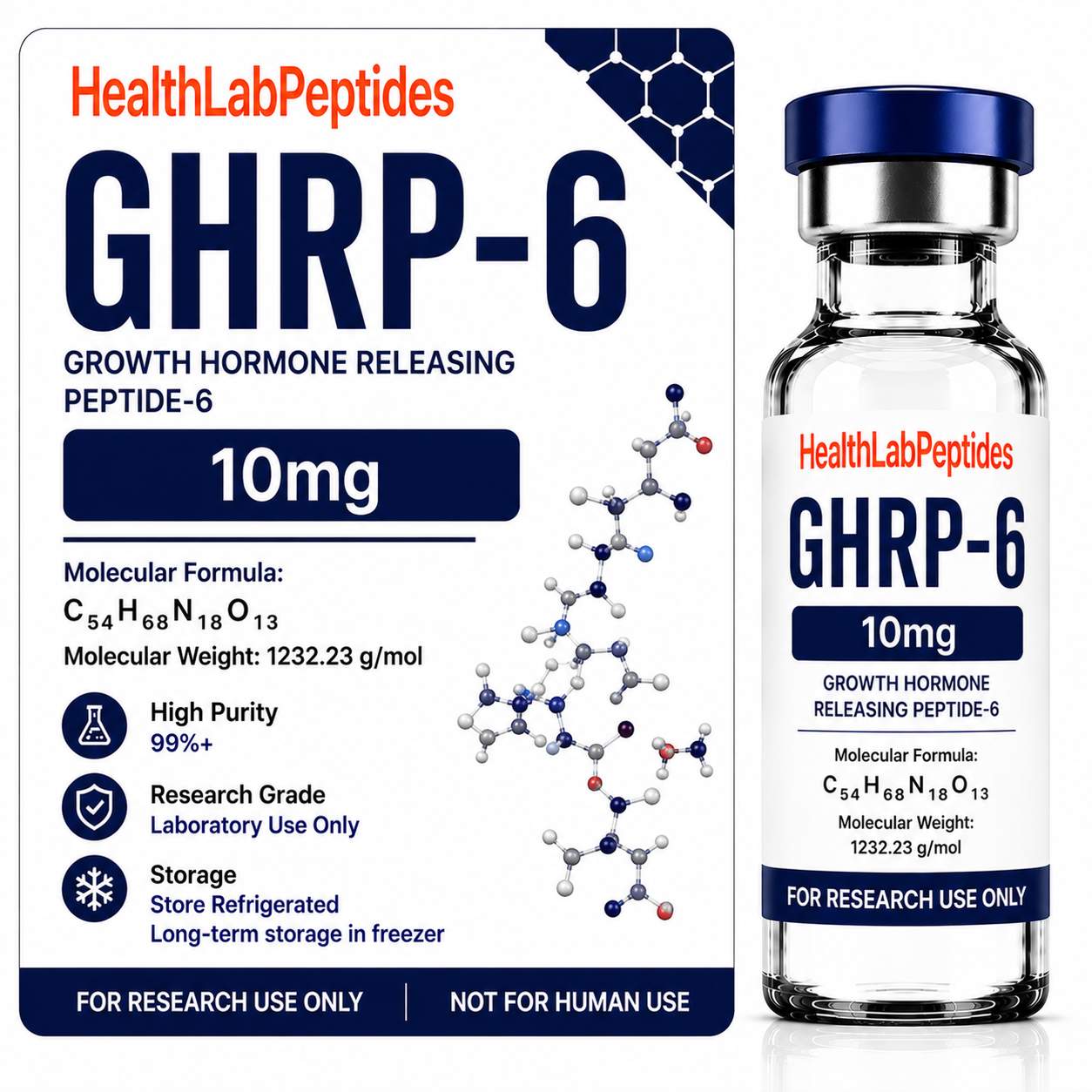
Research suggests that GHRP-6 experiments may use calcium flux, cAMP, or other signaling outputs, but each readout samples a different part of receptor biology. The corresponding HealthLab RUO material should be evaluated only in a defined laboratory model with lot-level documentation.
Frame the question
A response in one pathway does not guarantee the same rank order or time course in another. The question should specify proximal signaling, integrated response, or pathway preference. Set the hypothesis, primary endpoint, and decision rule in advance.
Experimental structure
Run matched concentration series in the same cellular background, document receptor abundance, and align acquisition timing. Analyze peak, kinetic, and integrated outputs separately. The research-material catalog can support comparator selection, but catalog proximity is not evidence of equivalence.
Confounders to control
Indicator loading, baseline drift, phosphodiesterase activity, receptor reserve, and detector saturation can change apparent potency. Separate-day comparisons add batch variation. Record plate map, operator timing, instrument settings, and sample history for every run.
Controls and comparators
Use vehicle, ionophore or pathway-performance controls, parental cells, viability, and plate-edge monitoring. Repeat from independent cell passages. A comparator such as this related RUO material is informative only under matched assay conditions.
- Confirm molecular identity before functional testing.
- Separate independent experiments from repeated instrument reads.
- Randomize position and run order where practical.
- Predefine exclusions and curve-fitting rules.
- Retain complete raw data and audit trails.
Minimum reporting set
Report raw kinetics, normalization formula, assay window, EC50 only when curves support it, and confidence intervals. Include individual replicate data and effect-size uncertainty, not significance values alone.
Interpretation boundary
Concordance across readouts supports a robust receptor response; divergence is a result to investigate, not a reason to select only the preferred graph. Results for another related material require their own identity, exposure, and performance checks.
What a reproducible result looks like
A reproducible finding survives a fresh preparation, a separate experimental day, and at least one orthogonal measurement. Controls remain inside their acceptance windows, and the conclusion does not extend beyond the model or endpoint actually tested.
Transparent negative results are valuable when they show the material, model, and assay worked as intended. That discipline helps laboratories decide whether the next step should refine the method, change the model, or retire the hypothesis.
Research Use Only disclaimer: This article and the referenced materials are intended strictly for laboratory research and in-vitro use. They are not for human or veterinary use, consumption, injection, diagnosis, treatment, or any therapeutic application.


