

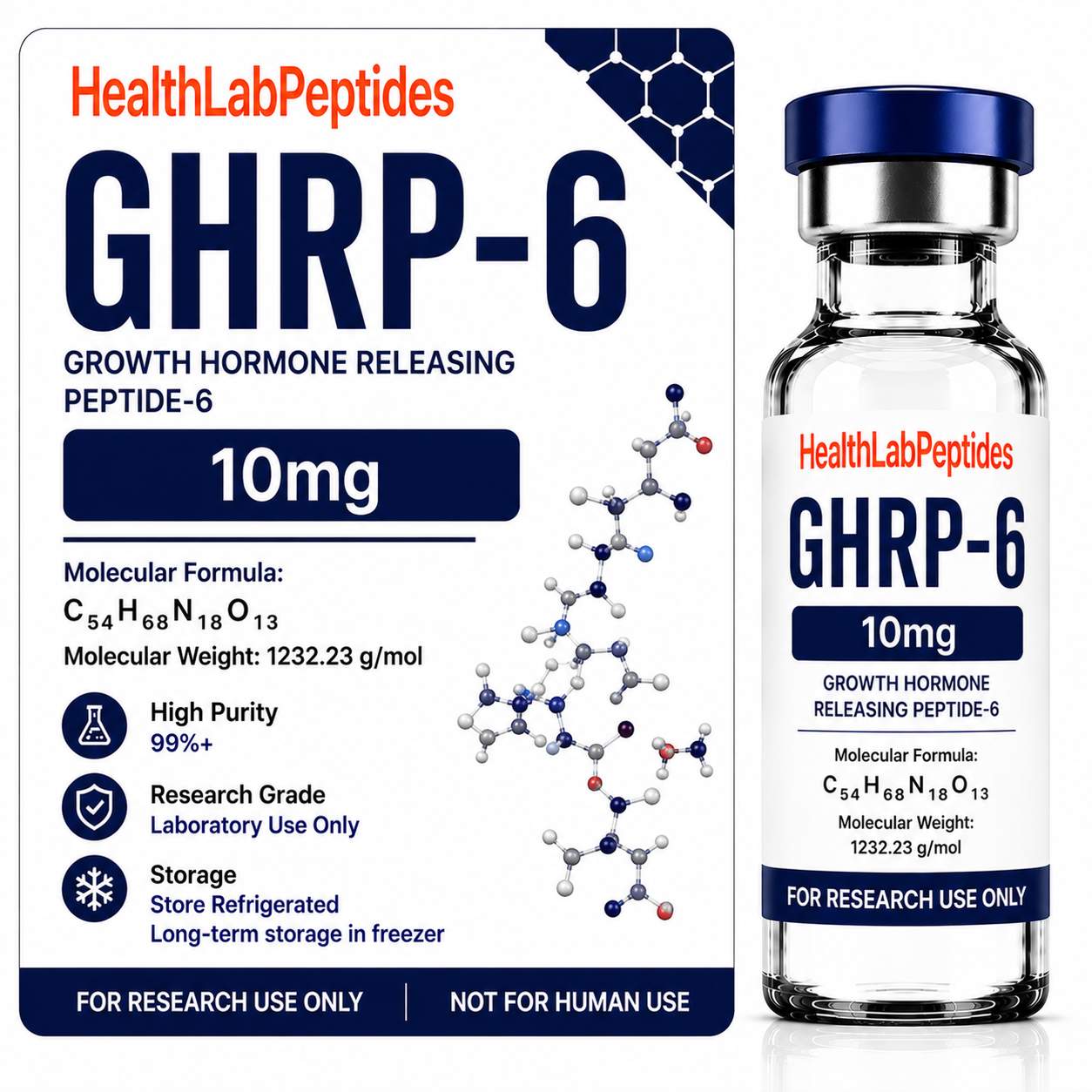
Research suggests GHRP-6 has been used as a laboratory probe for studying peptide signaling in pituitary models. Several experiments compared it with growth-hormone-releasing hormone (GHRH) to examine whether the two signals use the same receptor-linked pathways. This is a research review of those experimental questions, not a guide to human or veterinary use.
GHRP-6 as a signaling research subject
GHRP-6 is a synthetic hexapeptide studied in relation to secretagogue signaling. In research, its value as a probe comes from comparing measured responses under controlled conditions. The presence of a response in a study does not, by itself, establish how a commercial product would behave in another model or context.
An early study used rat primary pituitary cell culture to examine GHRP-6 alongside GHRH. The authors reported that the two peptides stimulated measured growth-hormone release through distinct receptor-linked mechanisms in that experimental system. The finding helped frame later questions about how separate signaling inputs can interact in pituitary models (primary cell-culture paper).
Distinct pathways and experimental design
A later desensitization study using perifused rat pituitary cells also compared GHRH and GHRP-6. The reported data supported distinct receptor sites and signaling pathways under the tested conditions (perifused-cell study). A perifusion system allows investigators to observe responses over time; it does not make the result interchangeable with another cell preparation or an organism-level study.
The research question is therefore narrower than “what does the product do?” It asks which pathway was activated in a defined model, how that pathway was measured, and how the result changed when a second signal or experimental condition was introduced. Claims should name the model and endpoint.
Why GHRH comparison matters
Comparative experiments help separate signals that may converge on a shared measured output while beginning at different receptor systems. A result showing that two inputs influence the same endpoint does not mean they are identical or interchangeable. It also does not justify combining products or inferring a personal-use protocol.
Researchers should review the peptide identity, cell source, culture conditions, controls, measurement method, timing, and statistical analysis. The design determines which conclusions the study can support. Replication in another system can add evidence, but the new system must be interpreted on its own terms.
For connected site context, see the GHRP-6 research-material listing, the existing GHRP-6 research article, and the GHRP-2 research-material listing. These pages do not imply that the products have identical properties.
Questions for reading GHRP-6 papers
- Was the study conducted in primary pituitary cells, an animal model, or another system?
- Which response was measured and over what time course?
- How did the authors distinguish GHRP-6 signaling from GHRH signaling?
- Were the controls appropriate for the proposed receptor or pathway?
- Which conclusions are direct measurements, and which are hypotheses?
Evidence boundaries
The cited studies describe findings in specific pituitary-cell systems. They do not establish clinical effectiveness, personal-use safety, or an appropriate method of using a product. A laboratory result should not be reframed as a consumer or treatment promise.
Frequently asked questions
What did pituitary-cell studies compare? They compared measured responses to GHRP-6 and GHRH and examined whether their signaling pathways were distinct.
Does a cell-culture result predict every biological setting? No. The result is limited to the cells, methods, and conditions tested.
Are GHRP-6 and GHRP-2 interchangeable? No. Related research categories do not establish identical molecules or experimental results.
For lawful laboratory, analytical, and in-vitro research discussion only. For Research Use Only. Not for human consumption, medical, or veterinary use.


