

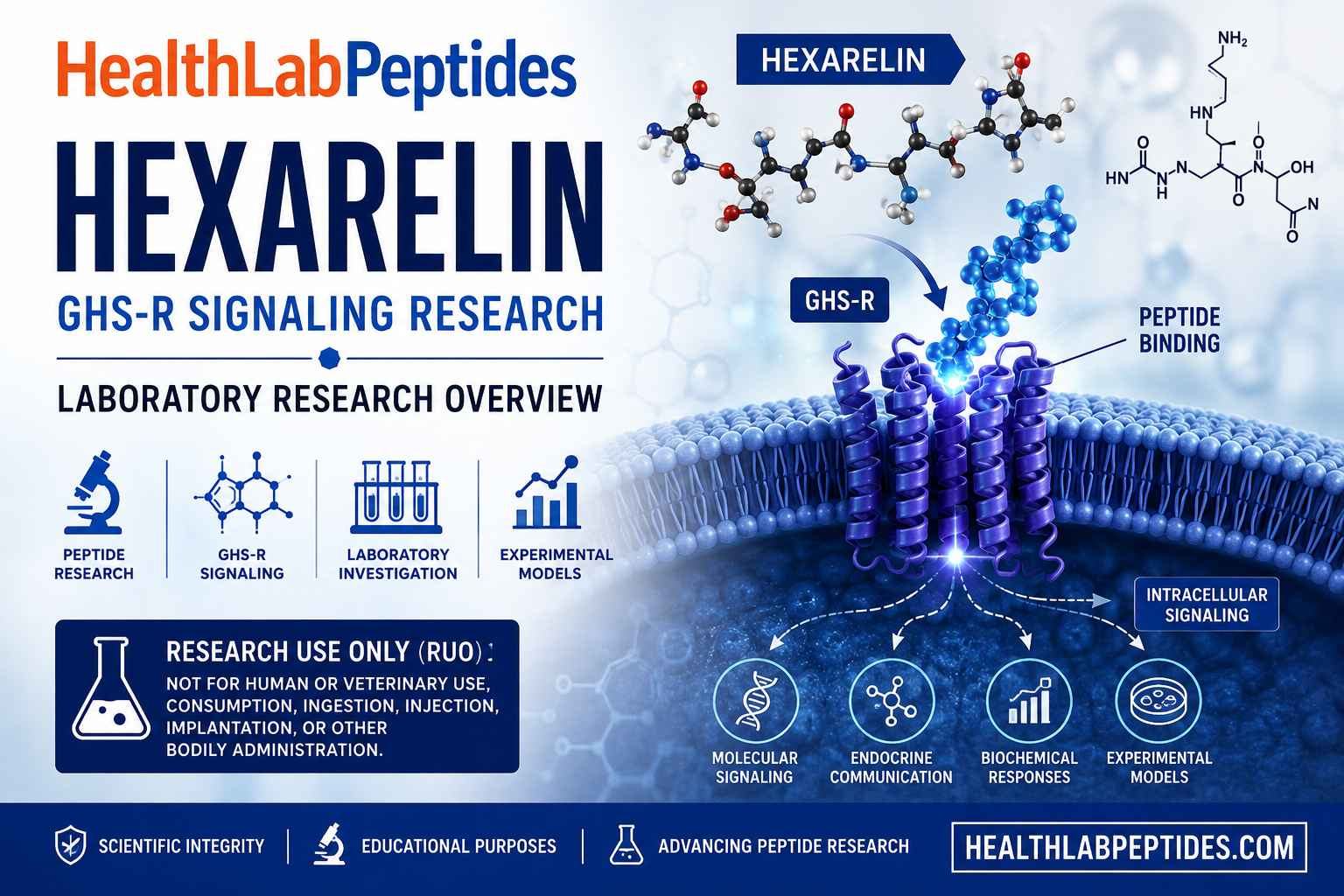
Research suggests Hexarelin is a synthetic hexapeptide examined in studies of growth-hormone secretagogue receptor signaling. This article focuses on what selected laboratory research measured about receptor expression and cellular signaling. It does not provide human or veterinary use directions or make claims about consumer outcomes.
Hexarelin as a research subject
Hexarelin belongs to a group of synthetic peptides studied in relation to the growth-hormone secretagogue receptor, commonly described as GHS-R1a. Research on a peptide’s interaction with a receptor asks a narrower question than whether a product produces a particular outcome: investigators examine binding, signaling, expression, and responses in defined systems.
One rat study examined whether Hexarelin exposure was associated with changes in GHS-R1a messenger RNA in hypothalamic and pituitary sites. The investigators also considered age and the role of growth-hormone-releasing hormone in the experimental design. The result is evidence about the reported rat model and measurement—not a prediction about every species or biological setting (primary study in PubMed).
Why receptor expression is a distinct endpoint
A change in receptor messenger RNA is not the same measurement as receptor protein abundance, receptor occupancy, downstream signaling, or a whole-organism response. These levels of evidence are related but not interchangeable. A paper reporting one endpoint should be described in those terms rather than expanded into a broad claim about the peptide.
Cell systems also have boundaries. Cell type, culture conditions, exposure design, controls, and assay sensitivity can all affect the result. Replication in another model can help establish whether an observation generalizes; it does not erase differences between experimental systems.
Desensitization and signaling context
A separate in-vitro study investigated rapid desensitization of the ghrelin/secretagogue receptor after Hexarelin exposure. Desensitization experiments examine how receptor-mediated responses change under the study’s conditions. They can help frame mechanistic questions about exposure and signaling, but should not be converted into a regimen or personal-use instruction (in-vitro receptor study).
When comparing research on Hexarelin with other secretagogue peptides, keep the tested molecule, receptor system, and measured endpoint explicit. For related site context, see our Hexarelin research-material listing, the growth-factor and peptide-signaling research overview, and the GHRP-2 research-material listing. These links identify related catalog and research topics; they do not imply the products are interchangeable.
Questions for reading Hexarelin papers
- Which model was used: receptor-expressing cells, cultured tissue, or an animal model?
- Was the endpoint receptor RNA, receptor protein, binding, signaling, or another measurement?
- What controls and comparison conditions were reported?
- Do the authors distinguish a direct observation from a proposed mechanism?
- Are the findings independently replicated in a comparable model?
What the evidence does not establish
The studies described here do not establish a clinical or consumer effect, a safety profile for personal use, or an appropriate way to use a product. They address selected receptor and signaling questions under defined experimental conditions. Further model-specific work would be needed before making broader scientific conclusions.
Frequently asked questions
What is Hexarelin studied for in laboratory research? Selected studies examine its relationship to secretagogue-receptor expression and signaling in defined models.
Does receptor messenger RNA prove a whole-organism effect? No. It is one molecular endpoint and does not alone establish protein abundance, function, or an outcome.
Are Hexarelin and other secretagogue peptides interchangeable? No. Similar research categories do not establish identical structures, receptor behavior, or results.
For lawful laboratory, analytical, and in-vitro research discussion only. For Research Use Only. Not for human consumption, medical, or veterinary use.


