

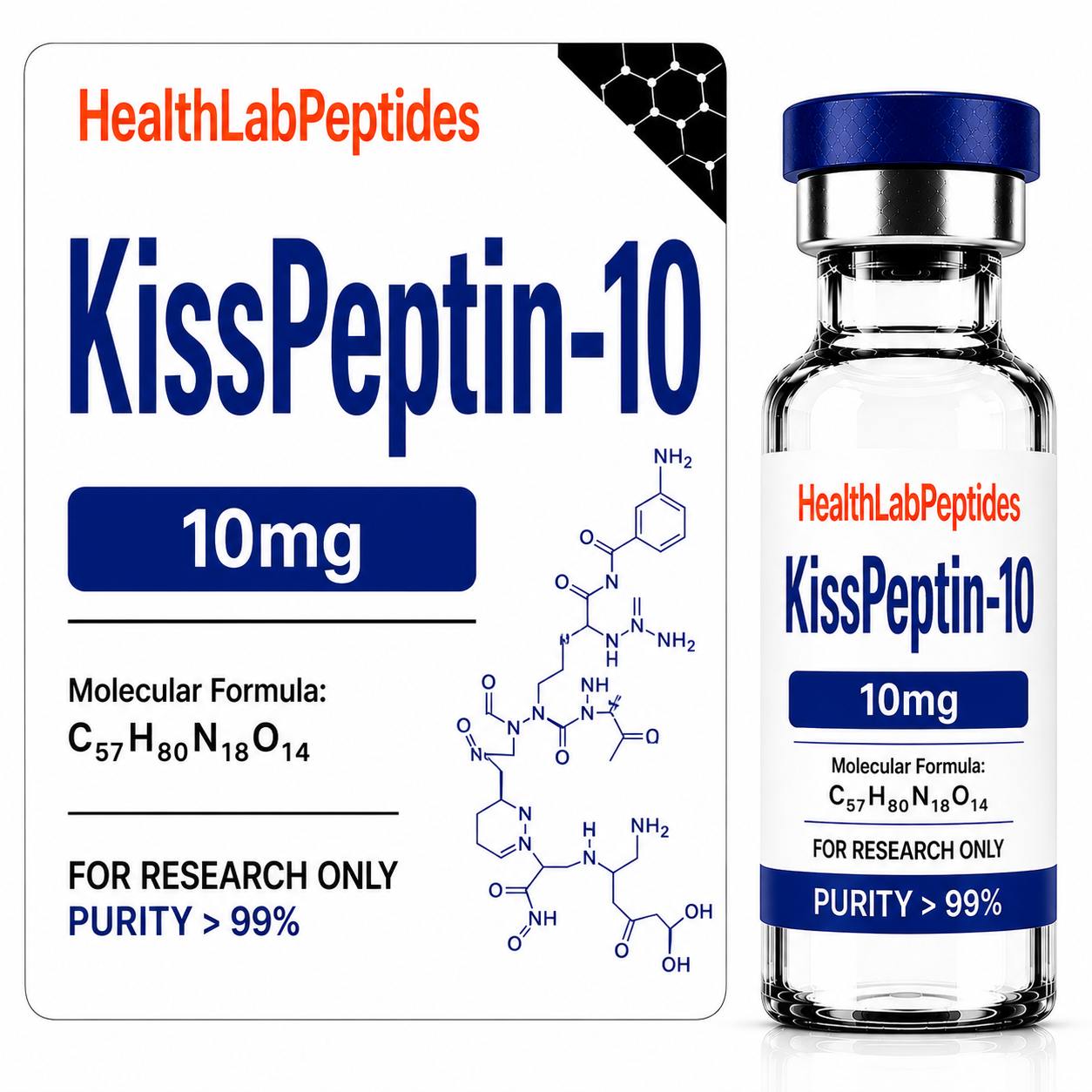
Research suggests that Kisspeptin-10 assay results can change with KISS1R expression because receptor reserve alters the relationship between occupancy and measured response. The corresponding HealthLab RUO material should be evaluated only in a defined laboratory model with lot-level documentation.
Frame the question
The experiment should determine whether it is comparing affinity, functional potency, efficacy, or signaling kinetics. Those quantities are related but not interchangeable. Set the hypothesis, primary endpoint, and decision rule in advance.
Experimental structure
Pair a binding or engagement method with at least one functional readout across expression-matched models or a documented expression range. The research-material catalog can support comparator selection, but catalog proximity is not evidence of equivalence.
Confounders to control
Transient transfection, unequal receptor density, peptide adsorption, proteolysis, and different acquisition windows can shift curves. High receptor reserve may conceal partial responses. Record plate map, operator timing, instrument settings, and sample history for every run.
Controls and comparators
Include parental cells, vehicle, a system-performance agonist, expression measurement, viability, and a time-course pilot. Use consistent passage and transfection conditions. A comparator such as this related RUO material is informative only under matched assay conditions.
- Confirm molecular identity before functional testing.
- Separate independent experiments from repeated instrument reads.
- Randomize position and run order where practical.
- Predefine exclusions and curve-fitting rules.
- Retain complete raw data and audit trails.
Minimum reporting set
Report receptor abundance, full curves, maximum response, baseline, fitting model, replicate structure, and any excluded points. Include individual replicate data and effect-size uncertainty, not significance values alone.
Interpretation boundary
A potency shift across expression levels can reveal system dependence. Mechanistic claims should reflect the receptor context rather than assuming a universal value. Results for another related material require their own identity, exposure, and performance checks.
What a reproducible result looks like
A reproducible finding survives a fresh preparation, a separate experimental day, and at least one orthogonal measurement. Controls remain inside their acceptance windows, and the conclusion does not extend beyond the model or endpoint actually tested.
Transparent negative results are valuable when they show the material, model, and assay worked as intended. That discipline helps laboratories decide whether the next step should refine the method, change the model, or retire the hypothesis.
Research Use Only disclaimer: This article and the referenced materials are intended strictly for laboratory research and in-vitro use. They are not for human or veterinary use, consumption, injection, diagnosis, treatment, or any therapeutic application.


