

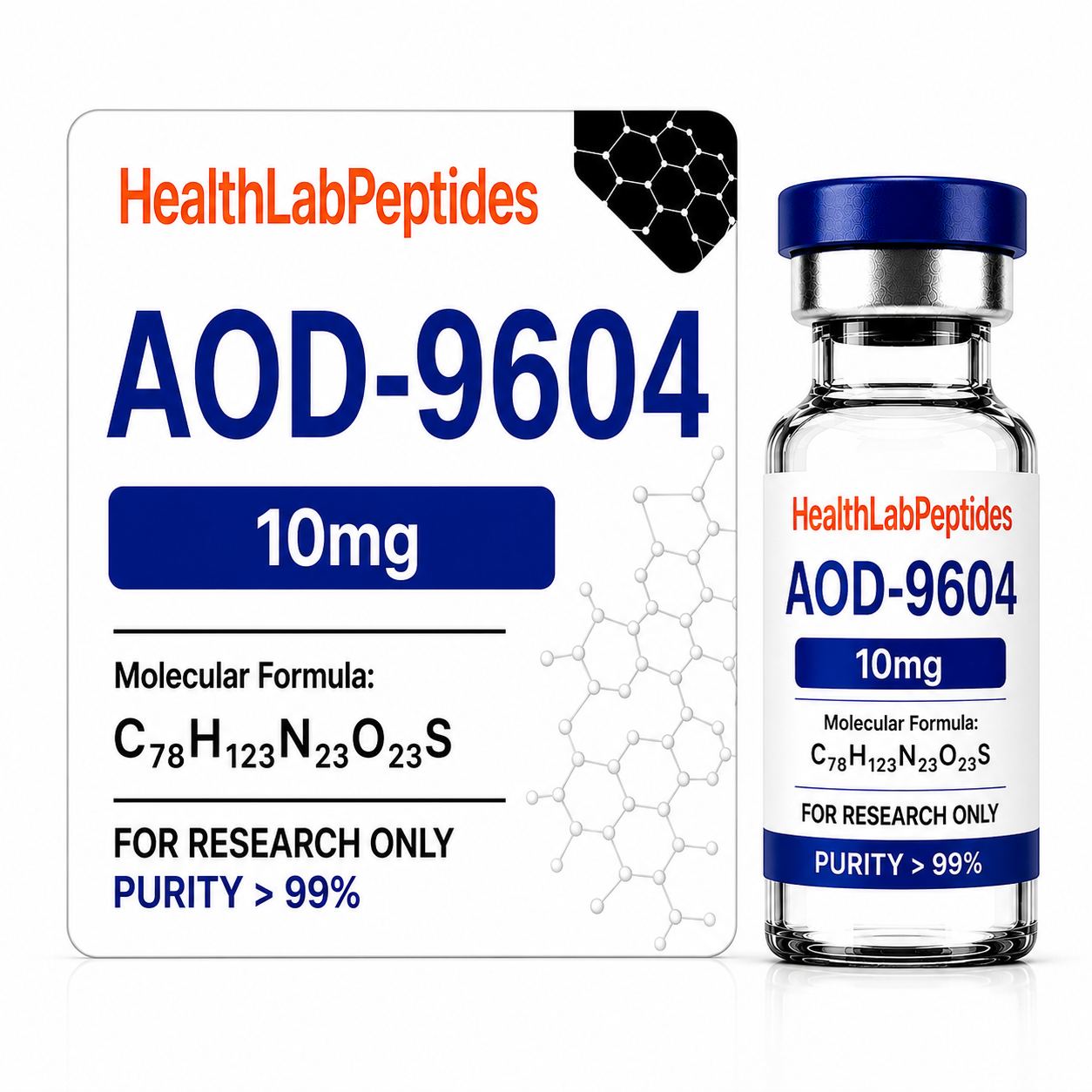
Research suggests that AOD-9604 is a short, sequence-defined research peptide whose interpretation depends on confirming that the material placed into an assay matches the intended molecular species. Researchers evaluating AOD-9604 Fragment Mapping should begin with a clearly bounded question and an identity-controlled material.
Define the measurement before selecting the assay
The central laboratory question is not whether two fragment names sound similar, but whether sequence, terminal chemistry, charge state, and observed mass support the identity assigned to the sample. This distinction matters because an assay can be technically precise while still answering the wrong question. A written objective, primary endpoint, and decision rule should be fixed before data collection.
Build an identity-first workflow
An identity-first workflow can combine intact-mass measurement, chromatographic retention behavior, and—when the research question warrants it—fragment-ion mapping. Each method answers a different question: intact mass screens the whole molecule, chromatography separates major components, and fragmentation helps localize sequence differences. Researchers can review the broader HealthLab research-material catalog when planning matched comparators, but every material should retain its own lot record and analytical documentation.
Common sources of misleading variation
A nominal mass alone may not distinguish every positional or terminal variant. Salt, residual solvent, adduct formation, oxidation, and in-source fragmentation can also complicate spectra. A blank, a system-suitability reference, and a documented integration rule help separate sample behavior from instrument behavior. Plate position, operator timing, instrument drift, and unplanned exclusions should also be tracked. These routine variables can be large enough to obscure a genuine experimental effect or create an apparent one.
Controls that strengthen interpretation
Useful controls include a vehicle blank, an independently characterized reference where available, replicate preparations, and a predefined acceptance window. Functional work should be downstream of identity confirmation, not used as a substitute for it. A related research material, such as this catalog comparator, may be useful only when the comparison is scientifically justified and the assay is validated for both materials.
- Predefine inclusion, exclusion, and repeat criteria.
- Use independently prepared replicates rather than repeated reads from one preparation alone.
- Randomize plate or run order when practical.
- Record lot numbers, instrument settings, software version, and analysis parameters.
- Preserve raw data so the result can be audited.
What to report
Report the dominant molecular ion, charge-state assignment, retention time, peak integration method, and any secondary peaks above the laboratory’s reporting threshold. Preserve raw files and acquisition settings so another analyst can reconstruct the conclusion. Report effect size and uncertainty alongside significance testing. Avoid treating a single normalized bar graph as a complete record of assay performance.
How to interpret a positive or negative result
If identity is secure but a functional result varies, the next investigation can focus on model biology, concentration verification, adsorption, or time-dependent degradation. If identity remains ambiguous, biological interpretation should pause. A second material—such as this related RUO product—should not be assumed equivalent because of a shared pathway label. Sequence, formulation, purity profile, and assay context remain material-specific.
A reproducibility checklist for the next experiment
Before repeating or expanding the study, confirm the material identity, document the sample history, verify the response range of the instrument, and examine whether the control behaved as expected. Replication should begin from a new preparation when feasible. If the result depends on only one readout, add an orthogonal method that relies on a different physical or biological principle.
Good in-vitro research narrows uncertainty rather than hiding it. Clear boundaries around the model, transparent reporting, and disciplined controls make the data more useful to other laboratories and reduce the risk of overextending a finding beyond the experiment.
Research Use Only disclaimer: This article and the referenced materials are intended strictly for laboratory research and in-vitro use. They are not for human or veterinary use, consumption, injection, diagnosis, treatment, or any therapeutic application.


