

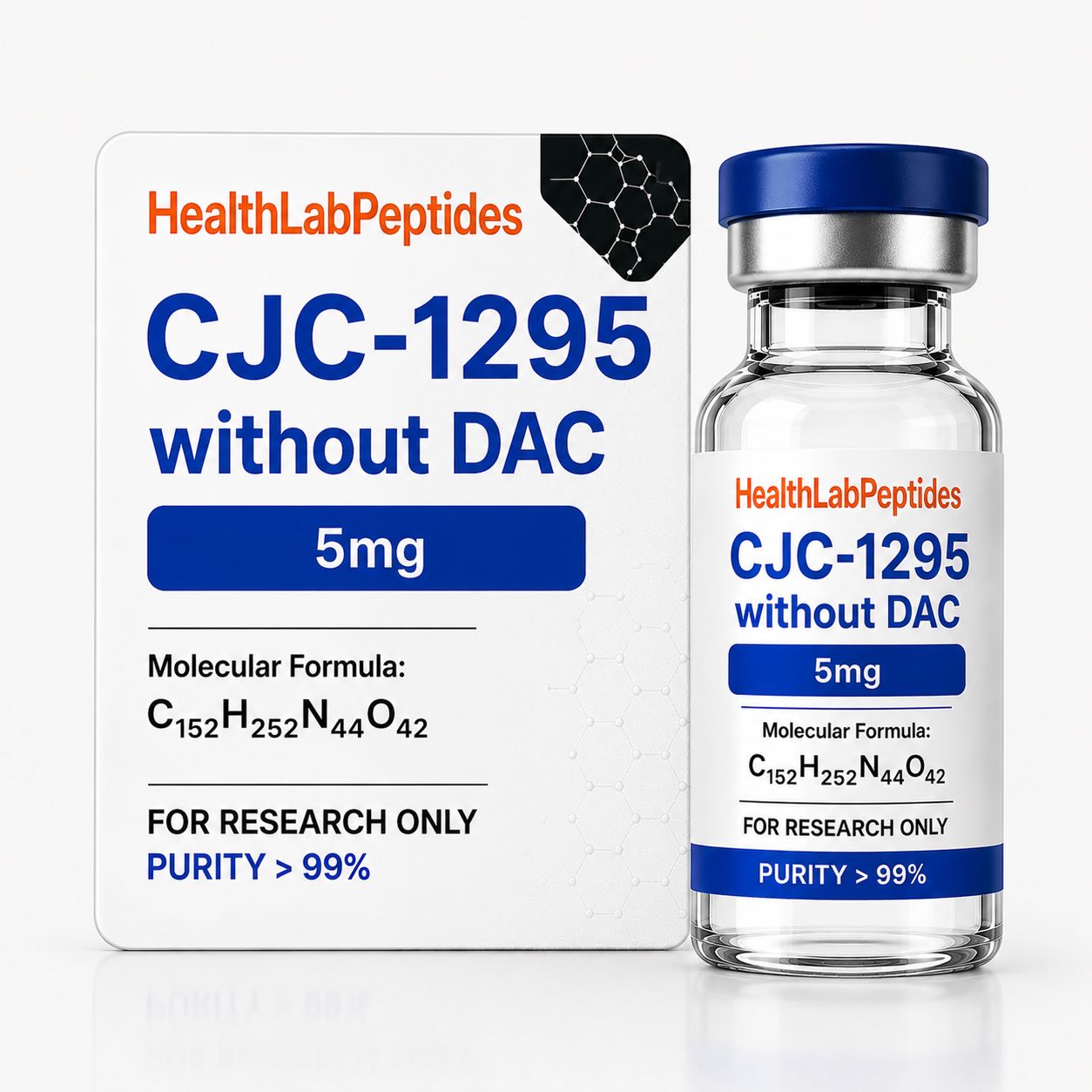
Research suggests that peptide aggregation can create concentration-dependent assay behavior that resembles selective biochemical activity. For U.S. laboratory teams, the practical question is not whether an instrument produces a number, but whether that number survives controls for identity, matrix, normalization, and analytical interference. Researchers reviewing CJC-1295 Without DAC Research Peptide should treat the material as Research Use Only and define the measurement claim before collecting data.
Why smooth curves can still be artifactual
Colloids and higher-order assemblies can sequester proteins, alter surfaces, scatter light, change apparent fluorescence, or reduce free analyte. Aggregation depends on concentration, ionic strength, pH, mixing, incubation time, temperature, and the presence of proteins or surfactants, so behavior can differ sharply between buffer and cellular media.
For this laboratory question, the CJC-1295 Without DAC Research Peptide product reference belongs directly in the experimental context: confirm lot identity, matrix recovery, and the exact in-vitro endpoint before comparing results.
Build the experiment around a falsifiable question
Assess physical state across the same concentration range and matrix used in the biological assay. Predefine how visible precipitation, turbidity, particle signals, or non-monotonic responses affect interpretation. A useful design separates the proposed biological event from assay mechanics. Include a vehicle control, a method blank where appropriate, a positive control with a known direction of response, and a negative control that challenges specificity. Predefine the primary endpoint and the rule for excluding failed wells or runs before viewing group labels.
Control the largest sources of false signal
Freeze-thaw history, container material, order of addition, local high concentrations, and inadequate mixing may seed aggregates. A clear solution is not proof of monomeric state. Record passage number, confluence, plate position, incubation interval, instrument settings, acquisition order, and operator. Randomization across plates and balanced processing order matter because drift can imitate a concentration trend. When fluorescence or luminescence is used, test the research material in a cell-free detection mixture to identify quenching, autofluorescence, or direct reporter effects.
Use orthogonal evidence
Use size-exclusion chromatography, light scattering, analytical ultracentrifugation, microscopy, or another justified physical method. Repeat key activity experiments under a condition that changes aggregation propensity without disrupting the target system. Orthogonal does not simply mean repeating the same chemistry on another instrument. It means using a measurement with a materially different failure mode. Browse the HealthLab Peptides research catalog only after defining the assay, acceptance criteria, and documentation needed for the study.
A controlled comparison may include the Ipamorelin 10 mg Research Peptide as a separate RUO research material, provided concentration, timing, analytical recovery, and assay conditions are matched rather than assumed equivalent.
- Verify research-material identity and lot traceability.
- Establish matrix recovery and linearity across the intended range.
- Include at least one specificity-challenging control.
- Normalize to a denominator justified by the biological question.
- Report independent experiments, not only technical replicate wells.
Interpretation boundaries
Correlation between particle formation and apparent activity is a warning signal, while loss of activity under aggregation-disrupting conditions strengthens the artifact hypothesis. A statistically separated group is not automatically a mechanism, and an in-vitro response is not evidence of clinical utility. Report effect size, uncertainty, individual experiment values, and failed-quality-control events. Avoid translating cell or biochemical findings into human-use language.
Related RUO comparisons
Depending on the hypothesis, researchers may compare the workflow with Ipamorelin 10 mg Research Peptide or GHRP-2 10 mg Research Peptide. Such comparisons should be matched for analytical recovery and experimental context; nominal concentration alone does not establish equivalent exposure or activity.
A reproducible reporting checklist
Report matrix composition, order of addition, equilibration time, concentration range, visual observations, particle-method settings, and whether activity samples were tested directly. Archive raw files, analysis scripts, plate maps, calibration results, reagent lots, and deviations. State exactly what the assay demonstrates and what it cannot resolve. This discipline makes a research-peptide article useful to laboratories without implying therapeutic, dosing, or consumer use.
Where the hypothesis requires a third product-specific comparator, the GHRP-2 10 mg Research Peptide should be evaluated with the same blanks, positive controls, interference checks, and independent replication.
Research Use Only disclaimer: This material is provided solely for lawful laboratory research and in-vitro analytical discussion. The compounds discussed are not medicines, foods, cosmetics, or consumer products and are not intended for human or veterinary use, ingestion, injection, diagnosis, treatment, cure, mitigation, or prevention of any disease. Nothing here is medical advice or a dosing, reconstitution, or administration guide. Qualified researchers are responsible for institutional review, applicable law, validated methods, appropriate controls, and safe laboratory handling.


