

Research suggests that peptide molecules influence diverse signaling pathways in controlled experimental systems, but the phrase research peptides is not a single biological category and does not establish a common outcome. Peptides can act as ligands, receptor-associated modulators, structural signals, or experimental probes depending on their sequence and the model under study. This article examines receptor engagement, cell-culture measurements, growth-factor pathways, matrix-related signaling, and the difference between mechanistic observations and unsupported consumer claims. Although some searches combine peptides with bodybuilding or exercise terminology, laboratory research findings do not authorize performance, recovery, or medical claims for research-only materials. For essential definitions, see the research overview of peptides and amino-acid chains.
Peptides are not one mechanism
Peptide is a structural category describing molecules composed of linked amino-acid residues. Some are very short sequences; others are larger polypeptides with complex folding and distinct receptor interactions. Because different sequences may interact with different targets, it is misleading to present all peptides as if they share a common function. A tripeptide such as GHK is different from an 83-residue growth-factor analog, and both are different from peptides discussed in hormone secretion research. An evidence-based overview starts with the specific molecular identity, the relevant experiment, and the endpoint being measured. It does not start with a claim about generalized benefit.
Receptor interactions and ligand specificity
A receptor responds to particular molecular interactions and, in many cases, changes the activity of intracellular signaling pathways. Peptide studies may evaluate binding affinity, receptor conformation, downstream messengers, or longer-term cellular outcomes. Those measurements are related but not equivalent. A ligand that changes a signal in one assay may have different apparent behavior in a cell line with a different receptor expression profile. Researchers should identify the receptor and distinguish direct measurements from inferred downstream effects. The peptide hormone-receptor communication guide provides further scientific context.
Growth-hormone-related peptide signaling
Some research peptides are investigated in relation to growth-hormone-releasing hormone signaling and its associated receptors. Experimental questions can concern receptor binding, cyclic AMP-associated pathways, transcriptional responses, and endocrine-cell models. Describing those mechanisms is not the same as establishing suitability for human administration or an improvement in athletic performance. The relevance of a result depends on model, tested molecule, reference controls, and measured outcome. A product name alone cannot establish a complete mechanism. Researchers should also distinguish native hormones, hormone analogs, and receptor-targeted investigational compounds rather than treating them as interchangeable materials.
Tesa as a laboratory catalog example
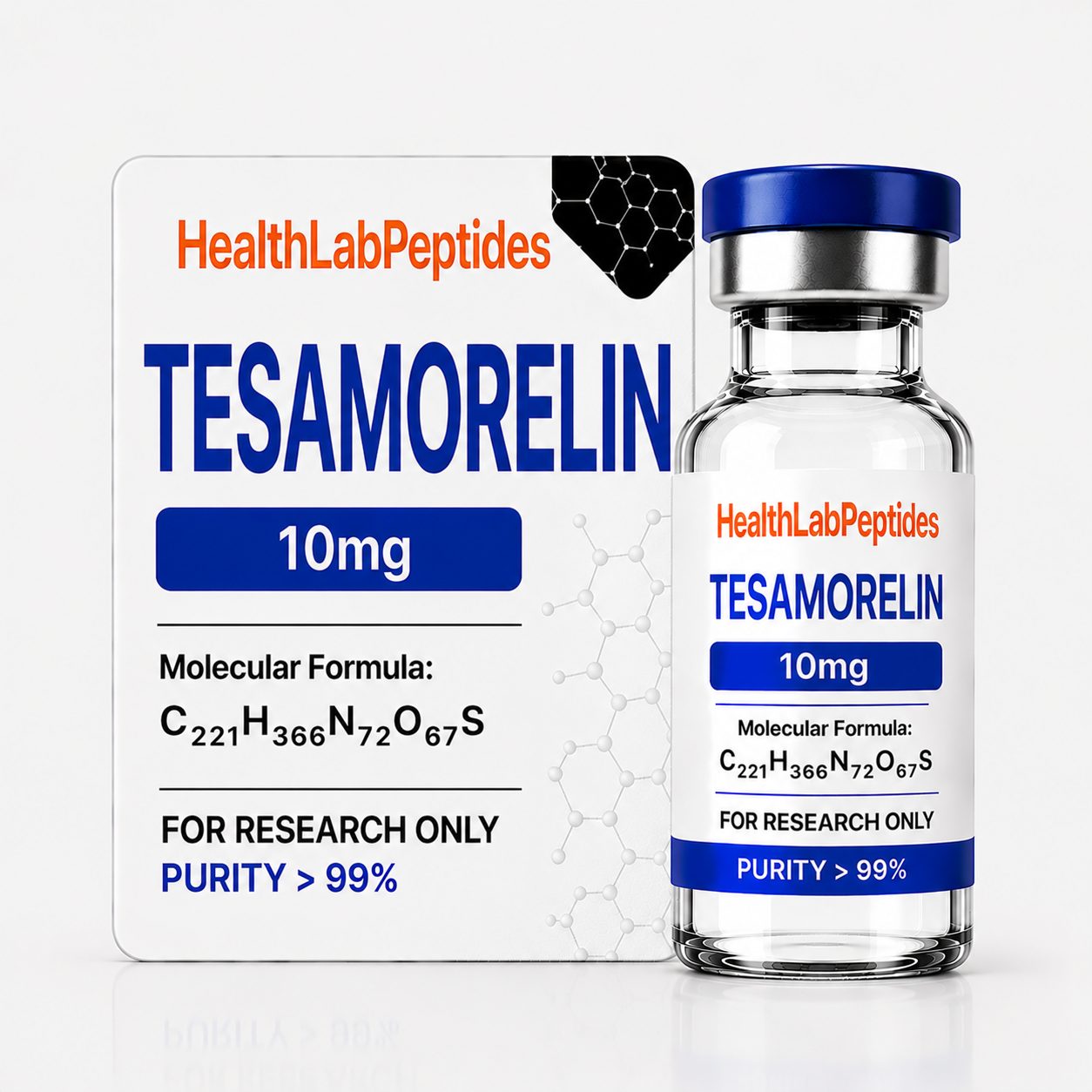
Tesa is a shortened catalog designation used for Tesamorelin in some HealthLab materials. In a laboratory context, an associated article should identify that name without implying that an unapproved research product shares the regulatory status or indications of a prescription medicine. The Tesa 10 mg research-material listing identifies a specific item in the catalog. It is not an invitation to use the material for metabolic, athletic, appearance-related, or therapeutic purposes. Experimental receptor signaling and clinical claims must remain distinct, even when a molecular category appears in both discussions.
Insulin-like growth factor signaling
IGF-related research is a separate molecular category involving growth-factor receptors and binding proteins. Work on Long Arg3 IGF-I has explored receptor activation in cell-culture systems (PMID 17172665) and altered interactions with IGF-binding proteins. Those findings concern a defined molecular analog under particular experimental conditions. They do not establish a human muscle-growth outcome or an acceptable personal-use protocol. The distinction is especially important because popular discussions may combine growth-hormone and IGF-related phrases as if they describe one pathway. Researchers should keep the signaling questions and experimental materials separate.
Extracellular-matrix research with copper-binding peptides
GHK-Cu has been studied in fibroblast systems in connection with collagen-associated measurements and extracellular-matrix remodeling. A foundational study indexed under PMID 3169264 investigated collagen synthesis in cell cultures, while work indexed under PMID 11045606 addressed matrix metalloproteinase-related endpoints. These studies illustrate how peptide research can focus on a biochemical output rather than an endocrine receptor. They do not show that every copper peptide produces identical results or that a research sample is appropriate for human tissue use. Laboratory observations remain model dependent.
Neurobiology experiments require different endpoints
Some named peptides are investigated in neuronal cultures and animal models involving gene expression or protein markers. Semax research, for instance, includes experimental transcriptomics in rat brain models (PMID 32580520) and selected neurotrophin-associated measurements. A change in a nervous-system marker does not establish improved memory, focus, or mental performance in a person. Similarly, a study on cell signaling in one organ system cannot be assumed to apply to another. Research communication should identify the tissue, measurement method, and limitations before comparing results across neurobiology, endocrinology, and matrix science.
Cell culture, tissue models, and animal experiments
Cell-culture experiments provide substantial control over the test environment but omit many interactions present in intact tissues. Ex-vivo preparations preserve certain tissue features while remaining outside their normal physiological setting. Animal experiments add more interacting systems but introduce species differences and other experimental variables. Each model is appropriate for different questions. A receptor-binding assay may help test molecular specificity, while a cell-culture experiment can examine pathway-associated changes. Results cannot be generalized beyond the tested model without further evidence. A useful article specifies the research level rather than describing all findings as if they were clinical.
What an experimental readout can and cannot prove
Biochemical studies may use fluorescence, gene-expression profiling, antibody-based assays, or chromatography to detect changes. These measurements depend on assay validation and possible sources of interference. A statistically significant difference does not automatically imply a large effect, meaningful organism-level change, or clinically relevant outcome. Researchers should distinguish whether an endpoint was directly measured, indirectly inferred, or only hypothesized. The sample size, biological replication, uncertainty, and choice of controls influence the strength of the conclusion. High-quality research writing preserves those distinctions.
Why study quality matters more than popular terminology
Search traffic can reflect public interest rather than the strength of the scientific evidence. Articles with words such as recovery, healing, bodybuilding, anti-aging, or cognitive enhancement may attract attention but can misrepresent the status of experimental compounds if they imply tested human outcomes. An accurate research page should meet the reader’s need for a clear explanation of a molecule and its evidence without encouraging personal use. This is consistent with Google’s emphasis on substantial, trustworthy content rather than keyword repetition. Informational precision is more valuable than exaggerated headlines.
Comparing molecular classes in a research library
A well-organized peptide research library can group articles by molecular identity and study endpoint. Growth-factor signaling, receptor-ligand structure, fibroblast extracellular-matrix work, neurobiology transcription assays, and metabolic receptor studies are useful research categories. They should not be grouped merely because they share sales or lifestyle keywords. Internal links can help readers navigate between scientifically related questions, but the anchor text should accurately describe the destination. The tissue-signaling laboratory overview is relevant when the question concerns matrix biology, not as evidence of therapeutic repair.
Laboratory documentation and analytical identity
Researchers need the exact molecular name, sequence when appropriate, batch identifier, and characterization records relevant to the study. A Certificate of Analysis can document selected quality attributes of a batch, but it should not be interpreted as proof of medical approval, sterility, or suitability for administration. Changes in storage conditions, analytical procedure, or sample form may complicate comparisons across studies. Material traceability supports reproducibility, while laboratory controls and validation support a causal interpretation. Neither is a license to make consumer health claims.
Why different peptide pathways should not be combined casually
A signaling response associated with one peptide in a cell line cannot be assumed to complement a result reported for another peptide in an animal model. A combination hypothesis would require direct study of the defined materials together, with controls that separate individual and interaction effects. Similarly, a pathway overlap does not establish safety, synergy, or a desired physiological result. Research combinations should be discussed as experimental designs rather than stacks for performance, wellness, or treatment. Scientific caution is particularly important when molecules with unrelated receptor targets are discussed in a single catalog.
Research questions that can be answered without overclaiming
Useful questions include whether a molecular sequence was confirmed; whether an assay measured receptor binding or downstream signaling; whether a finding replicated across model systems; how binding proteins affect a particular growth-factor analog; and whether a matrix-associated transcript corresponds to a protein-level measurement. These questions are specific enough to support meaningful analysis. Broad questions about what a peptide will do for a person cannot be answered from preclinical evidence alone. A high-quality research article should clearly state which question each cited study actually investigated.
Selected experimental literature
Representative references include Voorhamme and Yandell, Molecular Biotechnology (2006), PMID 17172665, on Long Arg3 IGF-I in cell culture; Maquart and colleagues, FEBS Letters (1988), PMID 3169264, on GHK-Cu fibroblast collagen observations; a GHK-Cu matrix metalloproteinase study, PMID 11045606; and a Semax experimental transcriptomics paper, PMID 32580520, DOI 10.3390/genes11060681. The publications examine distinct molecules and assays. They cannot be combined into a general claim about all research peptides or any application outside laboratory research.
Conclusion: Follow the experiment, not the marketing label
Peptide signaling research is valuable precisely because it spans different molecular structures, receptors, and measurable cellular pathways. Those differences should remain clear in educational material. The presence of a compound in an animal or cell-culture paper does not support generalized human health, performance, or therapeutic claims. Research readers benefit from accurate molecular names, useful internal links, study-specific findings, and explicit limits on inference. This article is intended to support that scientific understanding without encouraging personal or veterinary use.
For Research Use Only
For Research Use Only. Not for human consumption, medical, or veterinary use. No dosing, administration, or treatment guidance is provided. These statements have not been evaluated by the FDA. This product is not intended to diagnose, treat, cure, or prevent any disease.


