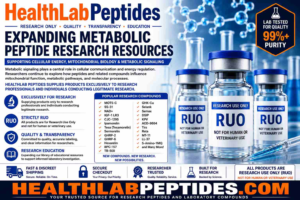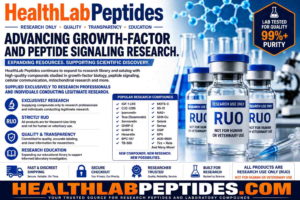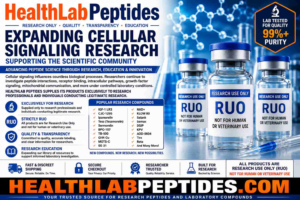


Research suggests: peptides are small but powerful biological molecules that help control how cells communicate, respond, and function. They are widely studied because they play a central role in many signaling pathways throughout the body.
What Are Peptides?
Peptides are short chains of amino acids linked together. They are smaller than proteins but made from the same basic building blocks. In biochemistry and molecular biology, peptides are considered essential for regulating biological activity.
They act as:
- Cellular messengers
- Signaling molecules
- Regulators of biological processes
- Building blocks for larger proteins
How Peptides Function
Peptides work by binding to specific receptors on cells. Once attached, they trigger signals inside the cell that influence how it behaves. This process allows the body to control different systems with precision.
Peptides are involved in:
- Hormone-related signaling
- Brain and nerve communication
- Immune system responses
- Cellular activity and regulation
Natural and Lab-Created Peptides
Natural Peptides
These are produced inside the body and help maintain normal biological function. They are constantly being made and broken down as part of everyday processes.
Lab-Created Peptides
These are synthesized in controlled environments for research. Scientists use them to study how specific amino acid sequences affect cells and signaling pathways.
Common Peptides Studied in Research
Several compounds are frequently examined for how they interact with biological systems:
- IGF-1 LR3 → https://healthlabpeptides.com/product/igf-1-lr3-1mg-research-peptide/
- IGF-1 DES → https://healthlabpeptides.com/product/igf-des-0-1mg-peptide/
- BPC-157 → https://healthlabpeptides.com/product/bpc-157-5mg-peptide/
- TB-500 → https://healthlabpeptides.com/product/tb500-5mg-peptide/
- CJC-1295 → https://healthlabpeptides.com/product/cjc-1295-without-dac-ipa-research-peptide-10mg/
- Ipamorelin → https://healthlabpeptides.com/product/ipamorelin-research-peptide-10mg/
- Tesamorelin → https://healthlabpeptides.com/product/tesamorelin-peptide-5mg/
- Semax → https://healthlabpeptides.com/product/semax-peptide-5mg/
- Selank → https://healthlabpeptides.com/product/selank-peptide-5mg/
These are studied in laboratory settings to better understand cellular communication and signaling.
Why Peptides Matter in Research
Peptides are useful in research because they allow scientists to focus on specific biological signals without the complexity of full proteins. This makes them easier to study and manipulate.
Researchers use peptides to explore:
- Receptor interactions
- Signal pathways
- Cellular responses
- Protein behavior
This research is important in areas like neuroscience and metabolic science.
Frequently Asked Questions
What are peptides made of?
Peptides are made from amino acids linked together in a chain.
Are peptides natural?
Yes, many peptides are naturally produced in the body.
How are peptides different from proteins?
Peptides are shorter and simpler, while proteins are longer and more complex.
Why are peptides important?
Peptides help regulate how cells communicate and function.
Conclusion
Peptides are small but essential molecules that help control many biological processes. Whether naturally produced or created for research, they are key to understanding how the body works at a molecular level.
RUO Disclaimer:
All products from HealthLab Peptides are intended for RUO (Research Use Only) purposes. Not for human or veterinary use. HealthLab Peptides makes no claims regarding medical, health, or therapeutic benefits.