

Research suggests: Retatrutide is a lipidated unimolecular agonist investigated at GIPR, GLP-1R, and glucagon receptor GCGR, with expanding regulated clinical evidence in 2026. This article critically examines retatrutide research in 2026: how to separate published phase 3 evidence from topline announcements by distinguishing source evidence, model-dependent findings, and what the study did not establish. Begin with the corresponding HealthLab research overview for related chemical and biological context. All material is presented for lawful laboratory research education only.
A company announcement and a peer-reviewed trial differ
A sponsor may release a headline result before the full study is published with sufficient methodological detail for independent critical appraisal. A press announcement can accurately describe a topline outcome but may not provide all estimands, subgroup analyses, missing-data methods, or detailed adverse-event information. Peer-reviewed papers usually contain a more complete account, although publication does not erase the need to examine limitations. Research readers should label each source by evidence type and date rather than treat all public claims as equivalent.
The October 2026 critical review
A Pharmaceutics review published October 9, 2026, PMID 42942810, assessed molecular engineering, pharmaceutical considerations, and emerging phase 3 evidence for retatrutide. The authors explicitly distinguished fully published peer-reviewed trial reports from sponsor topline disclosures. That separation is more informative than a single statement that several trials succeeded. The review also discussed unresolved safety and comparative-effectiveness questions. It is a scholarly synthesis, not an approval of independent laboratory Reta materials for human use.
A published phase 3 trial has an identifiable design
The TRANSCEND-T2D-1 randomized trial was reported in the Lancet in 2026, PMID 42250575. It used a defined investigational formulation, population, comparison, and follow-up interval to assess prespecified clinical endpoints. The details matter because claims about a study’s outcome depend on which measure was analyzed and how discontinuations were handled. This paper is evidence about the specific regulated clinical trial, not about a HealthLab research-only vial. It cannot establish pharmaceutical quality or medical suitability for a different source.
What an estimand means in clinical research
An estimand specifies the effect a study seeks to estimate, including the population, outcome, time point, and how events such as treatment discontinuation are handled. Two analyses may report different numerical estimates without being inconsistent if they address different estimands. Sponsor communications may highlight a particular estimate, so a reader should locate the definition before comparing numbers across trials. When full protocols and statistical analyses are not public, some comparisons necessarily remain provisional. This is a scientific reporting limitation, not a reason to invent certainty.
A useful comparison appears in the linked HealthLab scientific analysis, which explores another aspect of the experimental literature. Findings from different preparations, cohorts, assays, or source publications must not be combined without qualification. A shared keyword does not establish equivalent methods, and differing outcomes may reflect separate scientific questions rather than a true contradiction. The original studies should be checked before a conclusion is repeated.
Adverse events and uncertainties belong in the headline analysis
The October 2026 review identified concerns including gastrointestinal adverse events, sensory symptoms, heart-rate changes, and the interpretation of body-composition measures. An accurate research overview should include such uncertainties alongside reported endpoints. It would be misleading to present only favorable outcomes and omit risks or unresolved longer-term questions. Study populations, attrition, and exposure duration are relevant to adverse-event interpretation. Clinical evidence about a defined product should never be represented as safety evidence for a separate research chemical.
Triple receptor structure is a different level of evidence
Retatrutide is investigated at GIPR, GLP-1R, and GCGR, but receptor activation in cell assays is not identical to a trial outcome in a population. Structural and signaling studies can help explain a mechanistic hypothesis, whereas randomized trials address different questions with different uncertainties. A single peptide’s molecular identity does not prove all three receptors contribute equally to any observed clinical endpoint. This is why receptor assays and phase 3 evidence should be linked but not merged.
Regulatory status and the independent research vial
As of this article’s November 2026 research context, the cited review described retatrutide as investigational and emphasized the need for regulatory review and longer-term evidence. The HealthLab Reta listing is a separate research material rather than a licensed medicine. Neither peer-reviewed trial results nor company announcements validate a commercial RUO sample for injection, treatment, or personal use. This page reports the evidence types and their limitations for scientific literacy, without offering a clinical recommendation or protocol.
Research methodology and evidence quality
Important references include Mateescu et al., Pharmaceutics (published October 9, 2026), PMID 42942810, DOI 10.3390/pharmaceutics18101277; TRANSCEND-T2D-1, Lancet (2026), PMID 42250575. The reader should examine the material used, comparison group, methodology, statistical treatment, and limits of the observation. A molecular signal is narrower than an organism-level outcome, and a clinical trial on a regulated formulation is different from chemical characterization of an RUO reagent. An isolated favorable result should be reported alongside any negative or uncertain findings. Reproducibility, independent evidence, and transparent controls determine the strength of the inference.
Why the experimental endpoint must be named
Scientific reports can measure transcript abundance, protein modification, receptor behavior, chemical identity, imaging results, or clinical endpoints. These measurements answer different questions, and one cannot substitute for another. Descriptions should state whether a result was directly observed or interpreted through a proposed mechanism. The subject’s commercial relevance is not evidence of biological efficacy. Where a direct causal chain is incomplete, the article should explain the uncertainty rather than imply that the most attractive interpretation is proven.
Related HealthLab research product and keywords
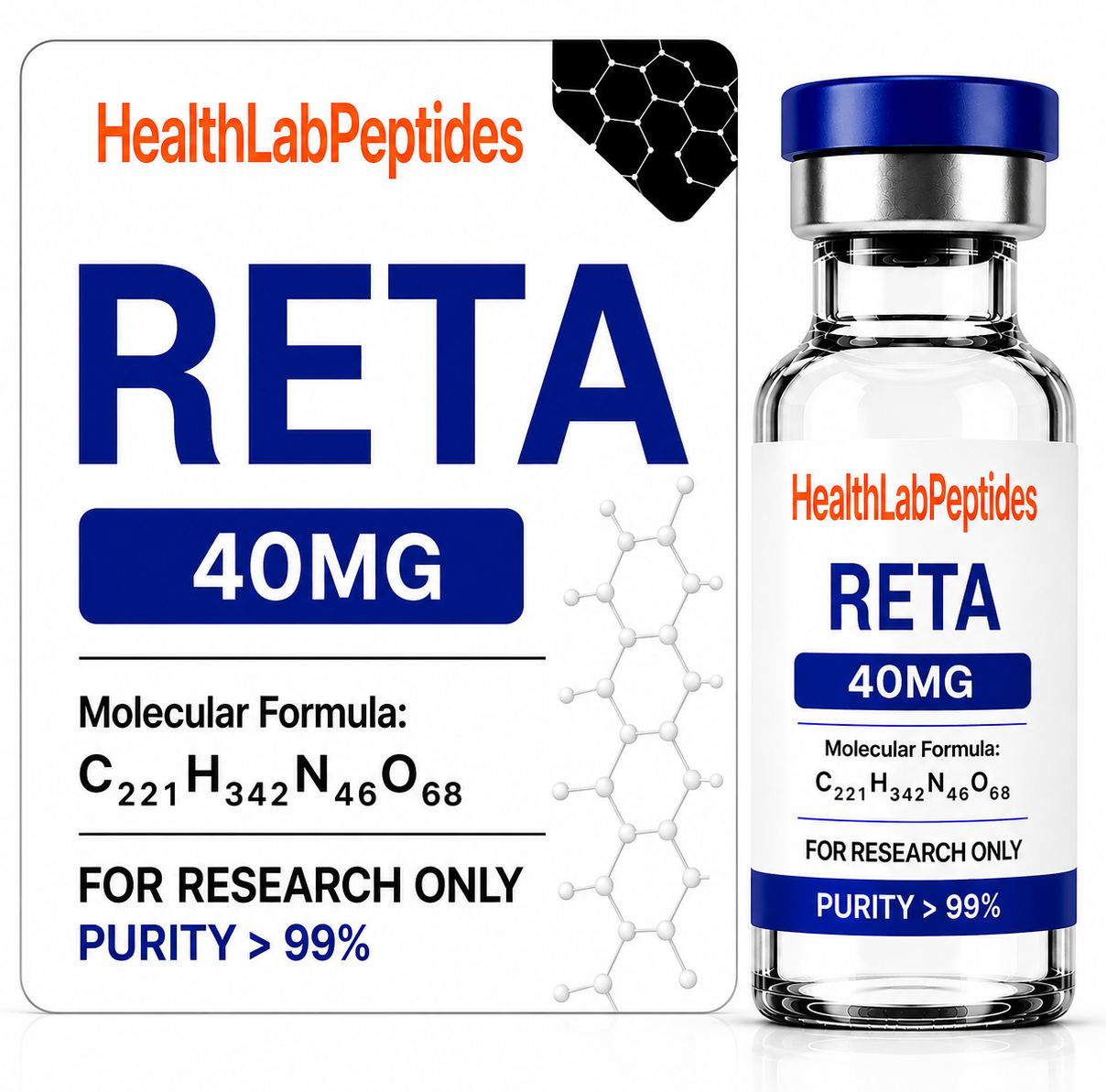
The Reta 40 mg research material listing corresponds to the laboratory compound discussed here. It identifies a catalog item and label quantity only, not a use regimen. Batch documentation such as a Certificate of Analysis can substantiate specified analytic characteristics to the extent tested, but cannot transfer clinical evidence from another preparation or establish FDA approval. Product keywords appear naturally to help readers locate the relevant molecular research while preserving the separation between scientific reporting and consumer-use claims.
What remains unestablished
The cited work does not demonstrate that any separately marketed HealthLab vial is safe for personal use or produces a predictable health, performance, cosmetic, or treatment effect. Cell and animal findings are model specific, and even regulated human studies are population- and product-specific. Scientific articles can responsibly discuss an investigational program while reporting adverse events and null results. A useful review identifies what further replication, characterization, or controlled investigation would be needed rather than asserting that outstanding questions have already been answered.
Reader questions and references
The key questions are whether the original study used the exact material being discussed, what model generated the evidence, what controls were included, and whether the outcome matched the article’s claim. Sources: Mateescu et al., Pharmaceutics (published October 9, 2026), PMID 42942810, DOI 10.3390/pharmaceutics18101277; TRANSCEND-T2D-1, Lancet (2026), PMID 42250575. The conclusion should remain proportional to that evidence. This research-only resource reports what investigators observed and where the limits lie, without providing administration instructions or making promises for the independent catalog product.
Research Use Only
Research Use Only / Not for human or veterinary use. No dosing, reconstitution, injection, treatment, administration, or other consumer-use instructions are included. HealthLab products are not represented as FDA-approved medicines.


