

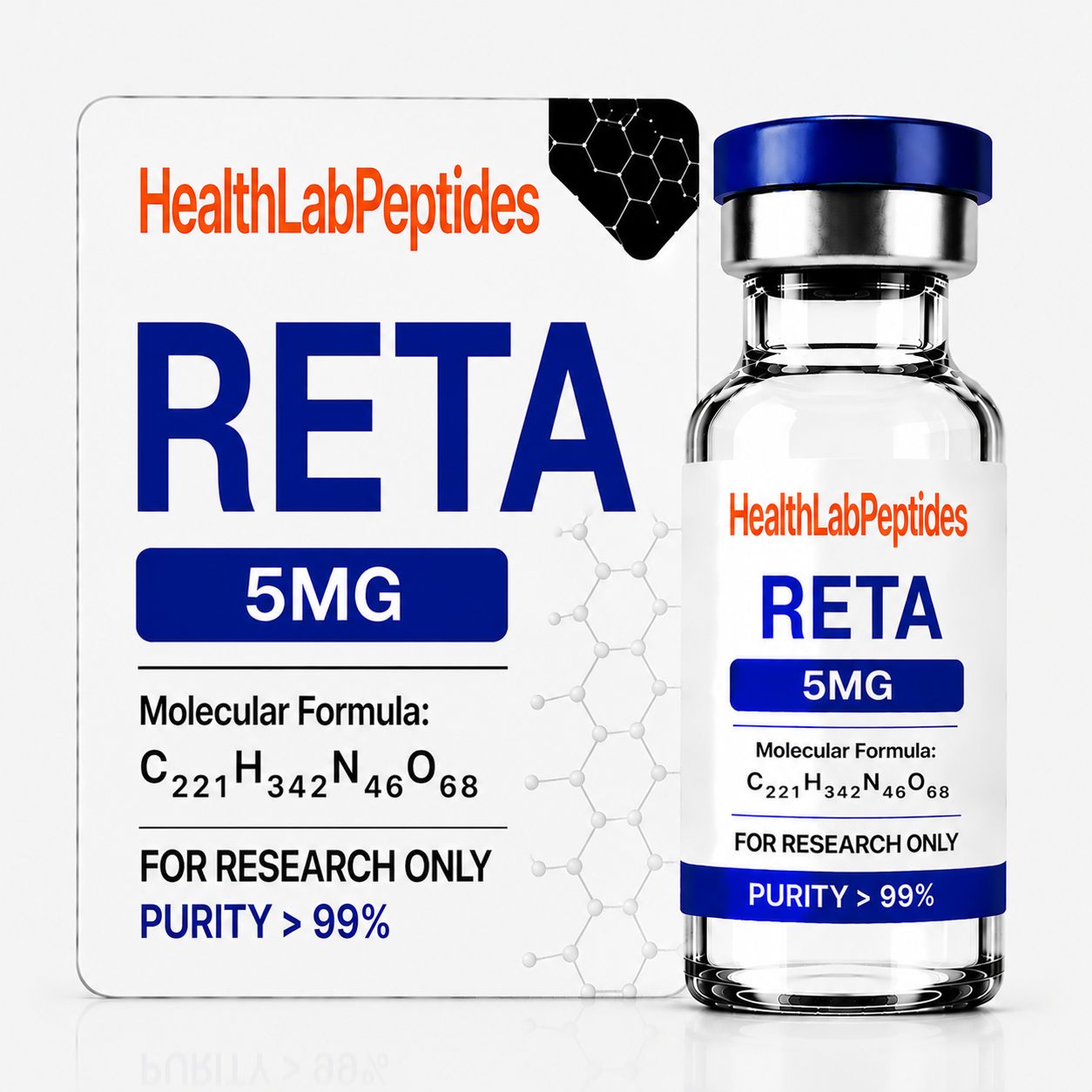
Research suggests:
Research suggests: retatrutide, identified in scientific publications as LY3437943, is one modified peptide designed for experimental activity at three receptor systems: glucagon receptor (GCGR), glucose-dependent insulinotropic polypeptide receptor (GIPR), and glucagon-like peptide-1 receptor (GLP-1R). A triple-agonist description identifies a molecular design and set of measurable receptor interactions, not a guarantee of a particular biological or clinical effect. A 2022 discovery paper described distinct potency patterns in cell assays, and later structural work examined how the peptide interacts with each receptor. This article separates receptor binding, cyclic AMP responses, cryo-electron microscopy, and animal or human research evidence. See the retatrutide molecular signaling overview for broader context.
One molecule, three receptor targets
Retatrutide is not a simple mixture of three different hormones. It is an engineered peptide whose molecular structure allows investigators to study interactions with the three named receptor classes. Each receptor has its own amino-acid sequence, structural features, and signaling context. Because receptor expression and assay response can vary, a compound can exhibit different potencies across them. A result at one receptor does not automatically describe its behavior at another. This distinction is central to interpreting the word triple without implying that three identical biological responses occur simultaneously in every system.
The glucagon receptor as a distinct research subject
GCGR is a G-protein-coupled receptor associated with glucagon-related signaling and distinct from GIPR and GLP-1R. Laboratory investigators may examine ligand binding, cAMP accumulation, G-protein coupling, or receptor-associated structural states. A result showing GCGR activation in an engineered cell line does not establish a human weight, energy, or metabolic outcome. Such outcomes require different evidence, and laboratory research materials should not be marketed as producing them. When comparing retatrutide with a molecule that does not engage GCGR, the assay and comparator definitions matter as much as the receptor’s name.
GIPR and GLP-1R cannot be averaged together
Although GIPR and GLP-1R both appear in incretin-related science, they are separate receptors. A compound may be more potent in one cell assay at GIPR than at GLP-1R, depending on the experimental context. Such a difference does not mean that one receptor is inherently more important to every organism-level effect. Researchers must specify whether they measured binding affinity, maximal signaling response, or another endpoint. A balanced clinical headline can conceal an imbalanced cellular pharmacology profile. Precise comparison requires examining the receptor-specific data rather than blending all three into one score.
The 2022 discovery and pharmacology paper
Coskun and colleagues published “LY3437943, a novel triple glucagon, GIP, and GLP-1 receptor agonist for glycemic control and weight loss: From discovery to clinical proof of concept” in Cell Metabolism (2022), PMID 35985340, DOI 10.1016/j.cmet.2022.07.013. Their work included molecular and cell-based assays for all three receptor systems, animal models, and early clinical-development data. It described balanced activity at GCGR and GLP-1R in selected measurements and greater potency at GIPR under its particular conditions. These findings belong to the tested peptide and assays, not to independent HealthLab research vials or to a general category of triple peptides.
What cAMP assays measure
Cyclic AMP is a second messenger generated in many G-protein-coupled receptor signaling experiments. Researchers can quantify cAMP after ligand exposure and compare responses across receptor-expressing cells. A cAMP concentration–response relationship reveals part of the receptor’s functional pharmacology, but not every downstream pathway. The result is influenced by cell type, receptor density, assay timing, and detection method. Thus, the word potency should be accompanied by the measured endpoint and comparison ligand. A cAMP result cannot independently establish organism-level safety or usefulness.
EC50 is not a consumer-use amount
EC50 describes the concentration associated with half of a defined maximal response in a particular assay. It is a property of the experimental concentration–response relationship, not a dose for human administration. Its value can shift when receptor expression, assay format, or surrounding protein concentration changes. Comparing EC50 values across different laboratories may be misleading if their conditions differ. The 2022 retatrutide study used carefully described cell systems to characterize receptor activity, but the reported values should not be treated as instructions or predictions for a separate research product.
Why receptor density matters
A cell expressing many copies of a receptor may produce an amplified downstream signal, which can complicate comparison of intrinsic ligand activity. Lower-density receptor systems can sometimes help researchers obtain more interpretable functional comparisons. However, no engineered cell line perfectly reproduces an intact tissue. The 2022 discovery paper discussed receptor density when describing its cellular assay design. That detail is important because molecular pharmacology depends on the experimental background. Readers should examine the original methods before interpreting relative potency claims.
Binding assays and functional assays are different
A receptor-binding experiment measures aspects of ligand interaction with a target, while a functional experiment measures a cellular process associated with activation. High binding affinity does not guarantee a particular maximum functional response, and functional readouts may be influenced by receptor reserve or downstream amplification. Measuring both can strengthen a mechanistic account, but the findings should remain separate in the article. A scientific conclusion needs to identify which relationship was directly demonstrated and which remains an interpretation of multiple measurements.
The 2024 structural perspective
A later study, “Structural insights into the triple agonism at GLP-1R, GIPR and GCGR manifested by retatrutide” (PMCID PMC11255275), examined receptor-bound complexes using cryo-electron microscopy. Structural information helps researchers see how a peptide occupies the receptor environment and how contact patterns differ across targets. It does not directly provide a clinical outcome or prove that a research vial has an approved use. The structural comparisons complement the earlier cell-signaling experiments, while answering a distinct question: which molecular contacts and conformations were observed in the prepared complexes?
What cryo-electron microscopy can establish
Cryo-electron microscopy can reveal molecular structures from carefully prepared complexes, including receptor and G-protein assemblies. It offers information about spatial relationships that a single cAMP assay cannot provide. Yet structural snapshots have their own preparation and interpretation limits. The molecule’s orientation or contacts in one structure do not mean every receptor behaves in the same way in all living tissues. Researchers should interpret structural and functional data as complementary. A credible overview does not treat an image of a receptor complex as proof that a compound produces a specific human health outcome.
The glucagon receptor’s role in preclinical comparisons
The 2022 discovery report included animal models intended to investigate how the three receptor activities contributed to different experimental responses. Such work can help distinguish the contribution of a receptor in a particular mouse model. However, removing or blocking a receptor in one animal setting does not establish the magnitude of its contribution in every species or clinical situation. Researchers should carefully identify the model and the measured endpoint. The word glucagon-associated should not be converted into a general promise about fat loss, energy expenditure, or body composition from RUO material.
Retatrutide versus Tirz are not equivalent compounds
Tirz is a shortened name for tirzepatide, which is associated with GIPR and GLP-1R research, whereas retatrutide additionally targets GCGR. Their structures and pharmacological profiles differ. The Reta-versus-Tirz research comparison
Clinical development does not validate an RUO sample
Clinical publications on investigational retatrutide address defined formulations and participants under regulated protocols. A trial is not simply an extension of a cell-culture experiment, and its outcomes must be interpreted within the design. The existence of clinical research does not establish clinical equivalence for material supplied by another company. Nor can an article about a receptor structure be used to claim safety or treatment effects for a research-only catalog product. Scientific evidence and commercial material quality are separate matters that must be made explicit.
Interpreting a three-target study
Researchers should examine which receptor was expressed, whether ligand binding or functional responses were measured, how comparator ligands were selected, and what statistical uncertainty was reported. A three-target molecule presents additional interpretive complexity because each receptor may have different cell backgrounds or assay sensitivities. Independent orthogonal methods can strengthen conclusions. A single statement that the peptide has three actions is less informative than a detailed account of receptor-specific experimental evidence. Rigorous SEO should make these distinctions easy to find and understand.
The HealthLab catalog material
The Reta 5 mg laboratory research listing
Frequently asked research questions
Is retatrutide a three-peptide mixture? No, it is one engineered peptide investigated at three receptors. Which receptors? GCGR, GIPR, and GLP-1R. Does a cAMP assay determine clinical effectiveness? No. Is an EC50 value a human dose? No. What does cryo-EM add? Structural information about prepared receptor complexes. Does a clinical development paper approve a research material? No. Molecular, clinical, and regulatory questions must remain separate.
Research sources and conclusion
Coskun and colleagues, Cell Metabolism (2022), PMID 35985340, DOI 10.1016/j.cmet.2022.07.013; and “Structural insights into the triple agonism at GLP-1R, GIPR and GCGR manifested by retatrutide,” PMCID PMC11255275. These sources demonstrate why receptor-specific functional and structural findings matter. The legitimate scientific conclusion is that retatrutide exhibits distinct interactions across three receptor systems in defined experiments. No personal-use, treatment, or commercial research-product efficacy claim follows from that evidence.
Research Use Only
Research Use Only / Not for human or veterinary use. This page contains no dosing, treatment, injection, reconstitution, or personal-use guidance. HealthLab research material is not presented as an FDA-approved medicine.



 TB-500 Research Material — 5mg