

Research suggests: Selank is a synthetic heptapeptide associated with the tuftsin-derived peptide research program. This article examines selank and tuftsin research: time-dependent immune gene expression in cell models, preserving the distinction between named molecules, the methods used to investigate them, and what the measured findings can support. The existing HealthLab research guide provides related context. Neither the publication nor the research-only catalog listing is a recommendation for human or veterinary administration.
A structural relationship is not identical activity
Tuftsin and Selank share a sequence-related research history, but Selank contains an additional peptide region and should be treated as a distinct molecular species. The presence of a shared motif does not prove the same receptor binding or immunological effect. A paper focused on tuftsin cannot automatically serve as evidence for a Selank sample. The structure can motivate a hypothesis while direct experimental comparisons establish whether the same pathways are involved. Precise chemical naming is important for attributing gene-expression findings.
The 2014 immune-gene time-course paper
Kolomin and colleagues published a study in Molecular Immunology examining the temporal dynamics of inflammation-related gene expression under experimental Selank conditions. This focus differs from later studies of neuronal GABA-associated transcription. The key scientific question is how a selected set of transcripts behaves in a defined model and time window. Changes may not occur at the same time or in the same direction across all genes. A legitimate review keeps the conditions and limitations of that cell-based evidence visible.
Why measuring RNA is not measuring immunity
Messenger RNA abundance can indicate a change in transcriptional regulation, but it does not directly quantify the functional activity of an immune-cell population. A gene may be transcribed without producing a proportional change in protein, and multiple signaling systems can influence the same transcript. Therefore a differential-expression result is not proof that a peptide strengthens immunity or treats an infection. The term immune gene expression describes an experimental marker, not a consumer outcome.
Temporal dynamics matter more than a single positive result
A time-course experiment can reveal early and later patterns that a one-time measurement would miss. Changes in selected genes may reflect initial signaling followed by feedback or other cellular adjustments. When a report describes multiple time points, the timing is part of the result rather than incidental metadata. The word temporary in the publication’s title signals the importance of this dimension. Researchers should avoid taking the largest individual change and presenting it as a persistent, universal effect.
For another perspective, the related HealthLab scientific article addresses a different experiment, comparison, or molecular question. A careful reader should compare materials and endpoints, not simply compound names. Some results concern purified proteins, some concern cells or animals, and others describe a regulated clinical formulation. These forms of evidence answer different questions and should not be combined into a claim about a separate research product.
Cell and tissue context determine interpretation
Different immune and neuronal models contain distinct signaling proteins and basal transcriptional states. A Selank-associated observation in a selected cell system does not establish the same response in rat frontal cortex or human tissue. Comparisons with the 2016 GABA-related gene study may help generate hypotheses, but their outcomes should not be pooled as though they shared one method. A credible article identifies the cell source, comparison, and measured transcript before making mechanistic statements.
How to distinguish correlation from mechanism
An overlap between Selank-associated transcripts and genes in an inflammatory pathway does not necessarily identify the peptide’s direct molecular target. Pathway annotations combine many genes that can be regulated by different upstream stimuli. More targeted perturbations, binding assays, or independent protein measurements would be needed to strengthen causal explanations. A summary should therefore use terms such as associated with and examined in a model, not definitively activates immunity or reduces disease.
Keeping negative and uncertain findings visible
Selective reporting of gene-expression responses risks exaggerating a compound’s apparent scope. It is important to document what did not change, the statistical method used for multiple comparisons, and the limits of measuring transcripts instead of functional outcomes. The 2014 study is useful as a model-specific molecular investigation. It is not evidence that an independent Selank laboratory vial provides cognitive, immune, or therapeutic effects in people.
Study methods and strength of evidence
Key research publications: Kolomin et al., Molecular Immunology (2014), PMID 24291245, DOI 10.1016/j.molimm.2013.11.002; Volkova et al., Front Pharmacol (2016), DOI 10.3389/fphar.2016.00031. A well-supported interpretation needs the source’s study model, molecular identification, controls, sampling or observation window, and uncertainty. Molecular methods may demonstrate binding or altered biochemical markers while leaving direct causation unresolved. Clinical reports provide more organism-level context but remain product- and population-specific. Repeated testing under independent conditions can strengthen confidence; it cannot eliminate the need to separate the original formulation from an unrelated RUO catalog material.
What is measured versus what is assumed
An assay can quantify a response without demonstrating every intermediate mechanistic step. A single transcript, protein marker, hormone value, or mass-spectrometric peak should not be interpreted as a full description of a biological pathway. The evidence is strongest when the paper directly tests alternatives and includes appropriately chosen comparators. Negative findings are not inconvenient details; they help define the actual extent of a mechanism. Broad statements about health benefits, performance, recovery, or anti-aging do not follow from these narrow laboratory observations.
HealthLab research-material identification
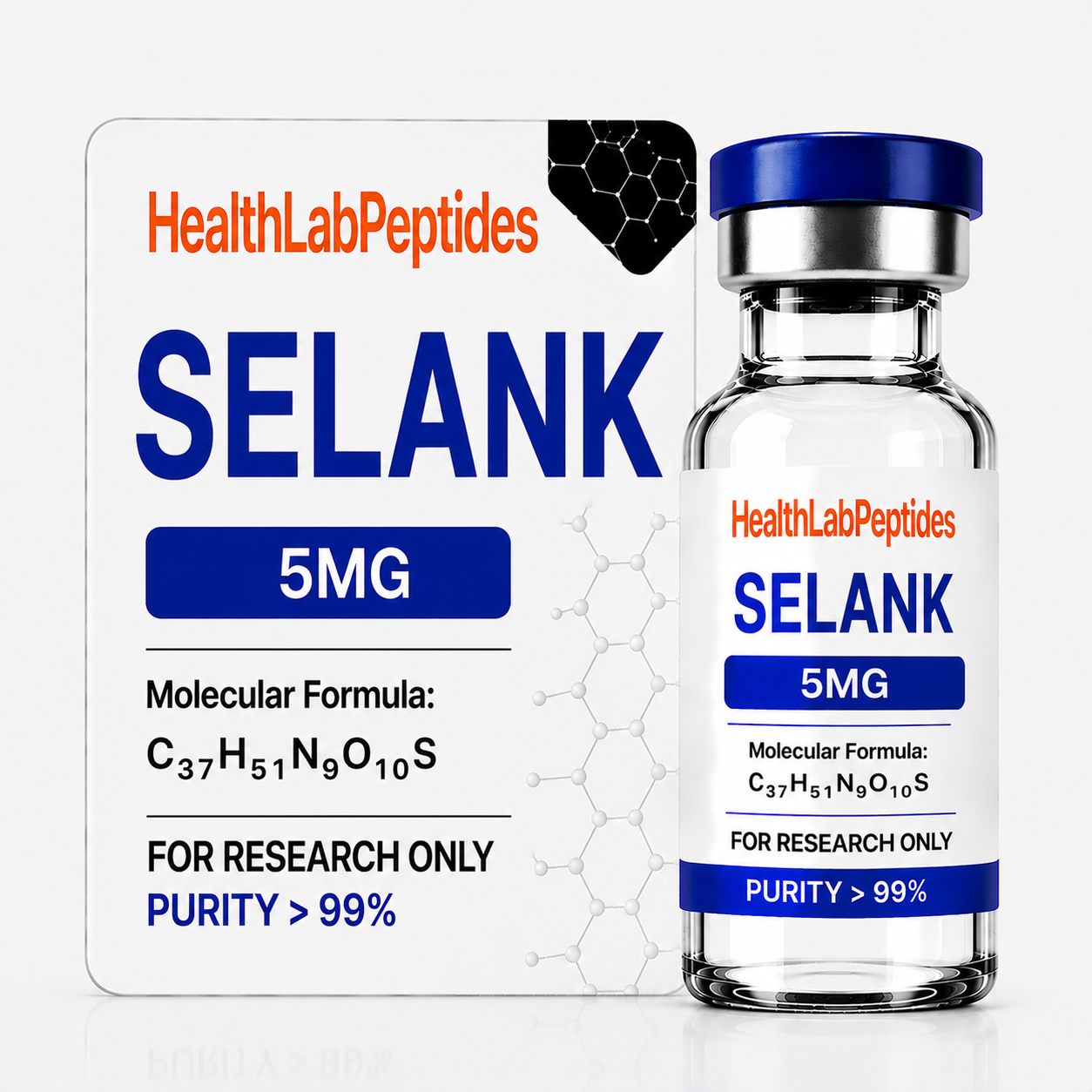
The Selank 5 mg research-material product page names the related catalog item and its labeled quantity. That amount is identifying information, not an experimental or medical protocol. A Certificate of Analysis, when available, documents only the tested attributes of a specific batch. It does not establish safety, FDA approval, or clinical equivalence. The product link supports lawful laboratory navigation, while the literature cited here supports educational discussion of the molecule’s research history.
Common scientific questions
Which molecular species was tested? What comparison was used, and what did the study actually measure? Could a change in the cell system, tissue type, instrument, or time point lead to a different result? Were uncertainty and contradictory findings reported? Does the original literature refer to an approved pharmaceutical product, a preclinical preparation, or an analytical standard? Asking these questions prevents an informative experimental result from becoming an unsupported consumer recommendation.
References and conclusion
Sources: Kolomin et al., Molecular Immunology (2014), PMID 24291245, DOI 10.1016/j.molimm.2013.11.002; Volkova et al., Front Pharmacol (2016), DOI 10.3389/fphar.2016.00031. The most reliable conclusion is the one that remains closest to the actual experiment. This research topic is valuable because it helps connect a defined molecular question to verifiable evidence while acknowledging what remains unsettled. The original literature does not show that an independent HealthLab laboratory vial is equivalent to a regulated medicine or suitable for treatment, consumption, or administration. The article includes relevant product keywords for scientific discoverability, not to imply personal-use efficacy.
Research Use Only
Research Use Only / Not for human or veterinary use. No dosing, injection, administration, reconstitution, treatment, or personal-use guidance is included. HealthLab research materials are not presented as FDA-approved medicines or as providing human health effects.


