

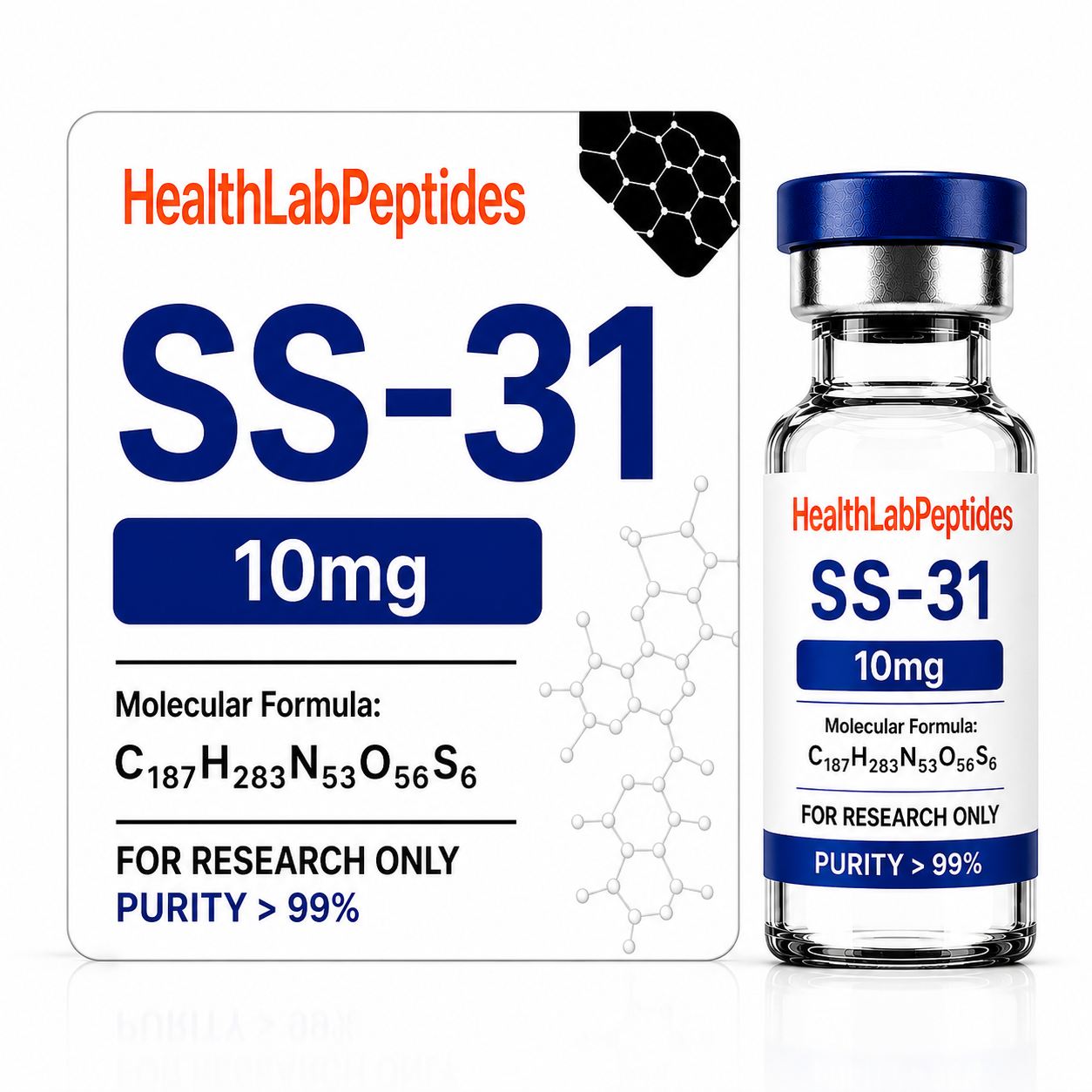
Research suggests: SS-31 is a synthetic tetrapeptide investigated for interactions with cardiolipin-containing mitochondrial membrane preparations. This article examines ss-31 and cytochrome c research: separating electron transfer from peroxidase activity, preserving the distinction between named molecules, the methods used to investigate them, and what the measured findings can support. The existing HealthLab research guide provides related context. Neither the publication nor the research-only catalog listing is a recommendation for human or veterinary administration.
Cytochrome c has more than one biochemical context
Cytochrome c is a heme-containing protein associated with mitochondrial electron transfer, but in particular lipid environments it can also participate in reactions that resemble peroxidase activity. These are not identical enzymatic endpoints. A study of the interaction between cytochrome c and cardiolipin asks whether the surrounding lipid environment changes the protein’s behavior. An observed effect in a purified preparation should not be simplified into a general promise of improved energy. The location of the protein, the lipid composition, and the test method matter.
Why cardiolipin belongs in the experiment
Cardiolipin is an anionic phospholipid enriched in certain mitochondrial inner-membrane contexts. It can interact with cytochrome c and alter the protein’s physical and biochemical state. Model membranes containing cardiolipin therefore provide a way to investigate lipid–protein interactions under defined conditions. However, an isolated liposome does not reproduce all components of a native mitochondrial membrane. When analyzing SS-31, the comparison between cardiolipin-containing and cardiolipin-free membranes helps test whether the lipid composition is relevant to the observed interaction.
The 2014 biophysical study
Birk and colleagues studied SS-31 with cardiolipin-containing liposomes and bicelles using approaches including spectroscopy, nuclear magnetic resonance, and enzyme-related measurements. They reported that SS-31 interacted with cardiolipin-containing preparations and influenced selected cytochrome c functions. The strength of the paper lies in the distinction between lipid binding and the downstream biochemical endpoints. It does not establish that a research vial improves mitochondrial function in humans or treats any condition. The preparations and endpoints must remain explicit in every summary.
Electron transport is not peroxidase activity
The investigators distinguished electron-carrier function from cardiolipin-associated peroxidase activity. A protein may retain one biochemical function while another is altered in a particular assay. The paper described effects consistent with protection of the electron-transfer activity while limiting peroxidase-associated behavior in its test systems. This is mechanistic evidence rather than a broad claim of tissue recovery. A scientifically useful article explains the distinct readouts instead of saying that all mitochondria were repaired or energized by a peptide.
For another perspective, the related HealthLab scientific article addresses a different experiment, comparison, or molecular question. A careful reader should compare materials and endpoints, not simply compound names. Some results concern purified proteins, some concern cells or animals, and others describe a regulated clinical formulation. These forms of evidence answer different questions and should not be combined into a claim about a separate research product.
Why liposome composition and charge matter
A peptide’s interaction with a lipid bilayer can depend on the relative amount and type of negatively charged lipid. The reported cardiolipin-specific observations were generated using defined artificial membrane systems. A change in membrane composition can therefore alter the response without implying that the peptide itself has changed identity. Researchers comparing studies should inspect the lipid species, protein preparation, and detection method. A nominally similar result from another membrane model may not establish the same mechanism.
From model membranes to isolated mitochondria
The 2014 study included mitoplast- and mitochondrial-associated experiments in addition to simpler model membrane measurements. This extends the biological context, but the hierarchy of evidence still matters. A biochemical response in isolated mitochondria is not a human clinical outcome, and a tissue-model finding cannot validate a different formulation from a research supplier. Different stages can support a mechanistic hypothesis while leaving questions of reproducibility and organism-level significance unresolved.
Why this is not a universal mitochondrial benefit claim
The phrase mitochondrial support may seem attractive as a product keyword, but it replaces specific measurements with an unsupported conclusion. The legitimate scientific findings concern SS-31, cardiolipin, cytochrome c, electron transfer, and peroxidase-related assays. Any discussion of outcomes in animal models must name the species and conditions. The compound’s appearance in experimental and clinical-development literature does not create human-use authorization for a separate RUO sample.
Study methods and strength of evidence
Key research publications: Birk et al., British Journal of Pharmacology (2014), PMID 24134698, DOI 10.1111/bph.12468; related JASN paper (2013), PMID 23813215. A well-supported interpretation needs the source’s study model, molecular identification, controls, sampling or observation window, and uncertainty. Molecular methods may demonstrate binding or altered biochemical markers while leaving direct causation unresolved. Clinical reports provide more organism-level context but remain product- and population-specific. Repeated testing under independent conditions can strengthen confidence; it cannot eliminate the need to separate the original formulation from an unrelated RUO catalog material.
What is measured versus what is assumed
An assay can quantify a response without demonstrating every intermediate mechanistic step. A single transcript, protein marker, hormone value, or mass-spectrometric peak should not be interpreted as a full description of a biological pathway. The evidence is strongest when the paper directly tests alternatives and includes appropriately chosen comparators. Negative findings are not inconvenient details; they help define the actual extent of a mechanism. Broad statements about health benefits, performance, recovery, or anti-aging do not follow from these narrow laboratory observations.
HealthLab research-material identification
The SS-31 10 mg research-material product page names the related catalog item and its labeled quantity. That amount is identifying information, not an experimental or medical protocol. A Certificate of Analysis, when available, documents only the tested attributes of a specific batch. It does not establish safety, FDA approval, or clinical equivalence. The product link supports lawful laboratory navigation, while the literature cited here supports educational discussion of the molecule’s research history.
Common scientific questions
Which molecular species was tested? What comparison was used, and what did the study actually measure? Could a change in the cell system, tissue type, instrument, or time point lead to a different result? Were uncertainty and contradictory findings reported? Does the original literature refer to an approved pharmaceutical product, a preclinical preparation, or an analytical standard? Asking these questions prevents an informative experimental result from becoming an unsupported consumer recommendation.
References and conclusion
Sources: Birk et al., British Journal of Pharmacology (2014), PMID 24134698, DOI 10.1111/bph.12468; related JASN paper (2013), PMID 23813215. The most reliable conclusion is the one that remains closest to the actual experiment. This research topic is valuable because it helps connect a defined molecular question to verifiable evidence while acknowledging what remains unsettled. The original literature does not show that an independent HealthLab laboratory vial is equivalent to a regulated medicine or suitable for treatment, consumption, or administration. The article includes relevant product keywords for scientific discoverability, not to imply personal-use efficacy.
Research Use Only
Research Use Only / Not for human or veterinary use. No dosing, injection, administration, reconstitution, treatment, or personal-use guidance is included. HealthLab research materials are not presented as FDA-approved medicines or as providing human health effects.


