

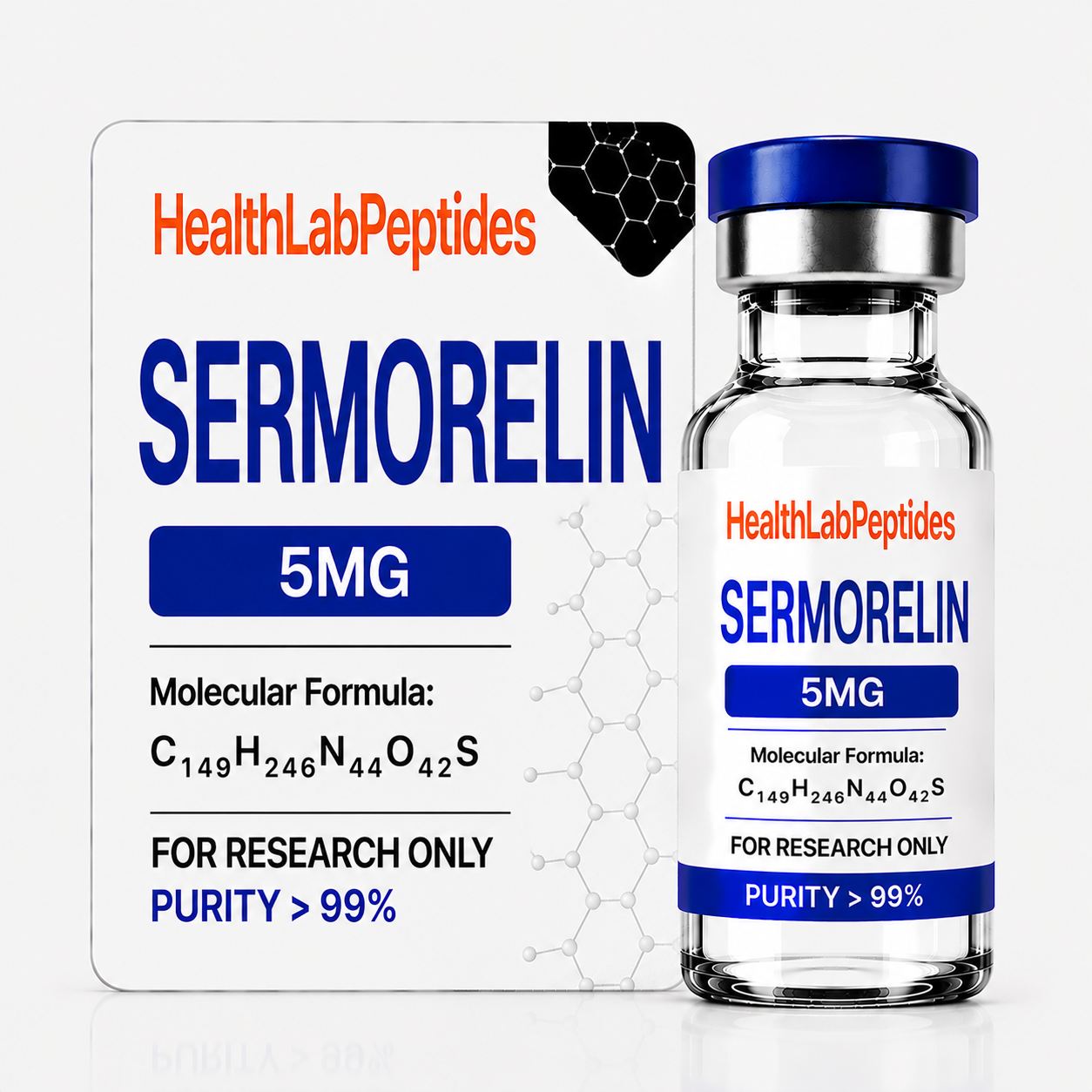
Research suggests that GHRH-receptor studies are easier to interpret when receptor engagement, cAMP signaling, and downstream cellular responses are treated as separate levels. Sermorelin is a synthetic form corresponding to the N-terminal 29 amino acids of growth hormone-releasing hormone. Its laboratory context is the GHRH receptor system; this discussion makes no claim about clinical or consumer outcomes.

Map the measurement to the pathway
GHRH receptors are G-protein-coupled receptors, and cAMP is one proximal signaling readout often used to study receptor activity. A cAMP signal demonstrates a response in the selected assay; it does not independently establish receptor abundance, longer-term transcription, or any integrated biological outcome. A report should name the receptor species, expression system, reporter chemistry, time window, and normalization strategy.
Primary research on PEG-modified GHRH analogues tested receptor binding and activation and reported different potencies among conjugates (PMID 14499707). A separate study reported cAMP-dependent down-regulation of GHRH-receptor mRNA under its experimental conditions (PMID 9048609). Together these papers illustrate why early signaling and later receptor-expression measurements should not be collapsed into one result.
Designing a useful comparison
Researchers can compare a test ligand with a suitable reference condition, evaluate whether a receptor-negative model changes the signal, and consider whether a second endpoint supports the same interpretation. A result can differ across models because receptor density, coupling proteins, and feedback mechanisms differ. These differences should be reported rather than averaged away.
See also HealthLab’s pages on Sermorelin research material, CJC-1295 analogue research, and cell-assay controls.
Takeaway
A cAMP assay supports a statement about that signaling readout in that model. Broader conclusions require additional evidence and should remain proportional to the measurements made.
For Research Use Only (RUO). Not for human or veterinary use, consumption, or administration. Not for diagnostic or therapeutic use.
Time and feedback matter in receptor assays
cAMP is often used as a proximal readout for G-protein-coupled receptor signaling, but a single endpoint can hide the shape of the response. Receptor engagement may lead to a transient rise, adaptation, or a later change in gene expression. In a study of GHRH signaling, receptor mRNA regulation was examined following stimulation, illustrating that receptor abundance can itself be an experimental variable over time (PMID: 9048609).
When reading a Sermorelin experiment, ask whether it measures receptor expression, second messenger accumulation, or a downstream endpoint. Record the time point and cell model, and avoid treating an early signaling result as a long-term cellular outcome. These distinctions make comparisons with the other GHRH-receptor research guide more useful.
Research use only: This material and discussion are intended solely for controlled laboratory research and in vitro use. Not for human or veterinary use, consumption, injection, diagnosis, treatment, or prevention of disease. No dosing or administration guidance is provided.


