

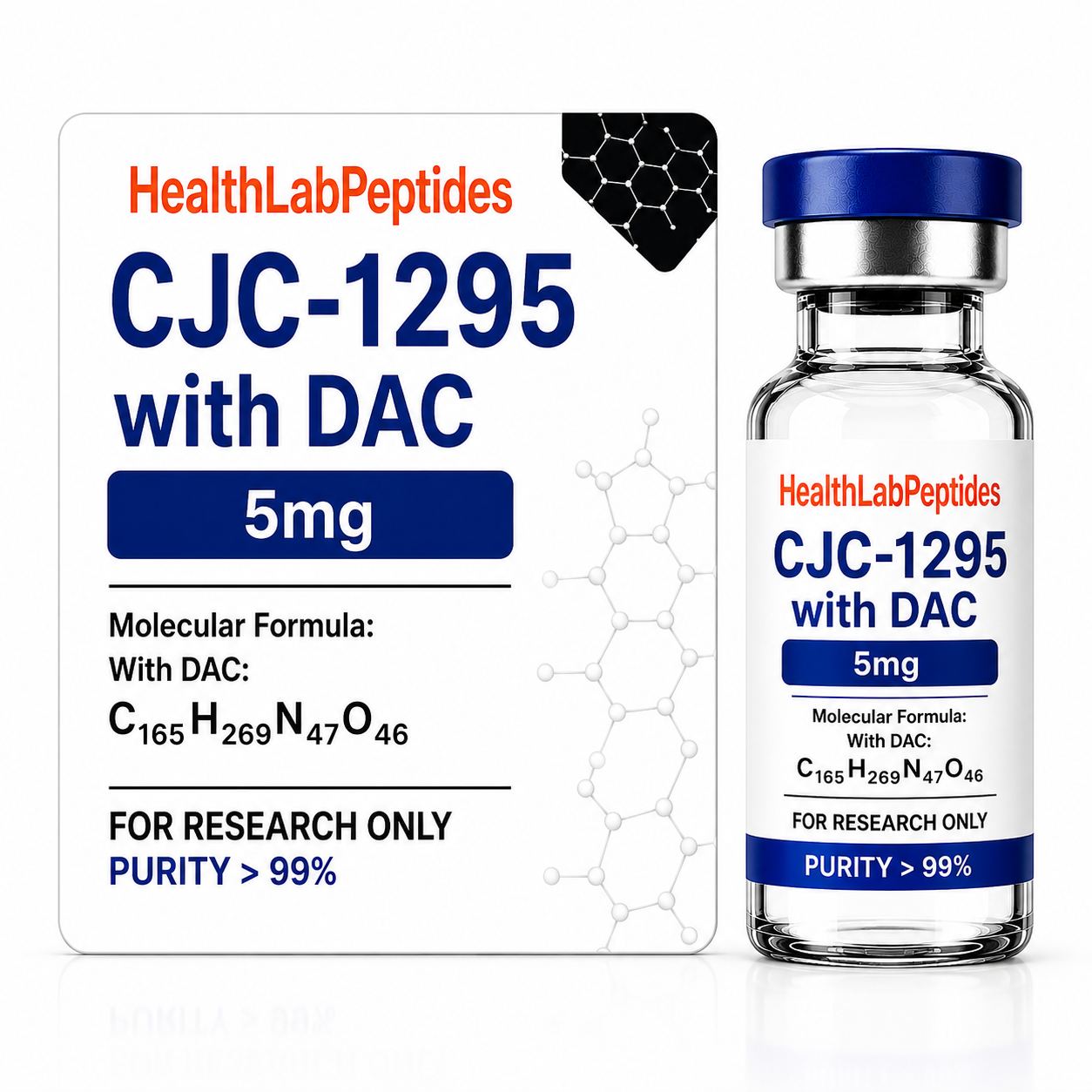
Research suggests that the term CJC-1295 is used inconsistently in online catalogs, even though the distinction between a modified 29-residue growth hormone-releasing hormone analog and an albumin-binding drug-affinity-complex derivative is chemically important. Historically, CJC-1295 referred to a specific long-acting conjugation-capable molecule. The name CJC-1295 without DAC is commonly used commercially for a related modified GRF(1–29) sequence without the albumin-reactive extension. These are not automatically interchangeable materials. This article compares the molecular architecture, the role of albumin, laboratory evidence, and the importance of verifying chemical identity. For broader receptor background, see CJC-1295: Research Mechanisms and Growth Hormone Signaling. All product references concern legitimate research and not human or veterinary use.
Understanding the parent GHRH sequence
Growth hormone-releasing hormone (GHRH) is a hypothalamic peptide that interacts with a specific receptor associated with pituitary hormone signaling. The active N-terminal region of human GHRH has been studied extensively, and the fragment GRF(1–29) retains important receptor-associated activity in certain experimental settings. Such a fragment is not chemically identical to the full-length parent peptide. Modifying selected amino-acid residues can change stability or receptor-associated measurements under controlled conditions. Researchers comparing publications must identify which sequence was evaluated instead of assuming that all substances called CJC, GRF, or GHRH have the same structure.
What modified GRF(1–29) means
A sequence frequently sold under the name CJC-1295 without DAC is described as a tetrasubstituted form of GRF(1–29). The commonly cited modifications are D-Ala at position two, Gln at position eight, Ala at position fifteen, and Leu at position twenty-seven. These are sequence differences from the native corresponding fragment. They can be important to chemical stability and assay behavior, but a substitution list does not by itself prove any particular whole-organism outcome. The complete molecular structure and exact material used in a study should be documented before the findings are attributed to a catalog product.
The original meaning of DAC
DAC is an abbreviation for drug affinity complex, a chemical strategy designed to support association with endogenous proteins. In the original CJC-1295 development program, the tetrasubstituted GRF core was extended with a lysine linker bearing a maleimide-containing group. That chemical extension was intended to react with an available sulfhydryl on serum albumin, forming a covalent conjugate. The key point is structural: a peptide with the reactive extension and one without it are chemically different. The naming distinction affects analytical mass, possible binding behavior, and which published observations can reasonably be associated with a given research sample.
Albumin is a carrier protein, not the GHRH receptor
Serum albumin is an abundant blood protein with multiple binding and transport functions. It should not be confused with the growth hormone-releasing hormone receptor involved in signaling. A compound that forms an albumin-linked conjugate presents a separate biochemical question from the free peptide interacting with a signaling receptor. Albumin association can change how a molecule is handled in experimental systems. This does not mean that every albumin-binding analog behaves identically or that a research vial has proven clinical properties. Different experiments may investigate the conjugation chemistry, receptor activity, and biological disposition as distinct endpoints.
The maleimide and cysteine-34 relationship
In the original long-acting derivative, the reactive maleimide group was intended to form a covalent bond with the free thiol associated with cysteine-34 of albumin. The mechanism provides a chemically specific rationale for the drug-affinity-complex term. Researchers can characterize such reactions using appropriate analytical techniques, but observing a conjugate under particular conditions does not establish the product’s efficacy or safety in all organisms. It is also important not to mistake generic binding to albumin for the specific covalent chemistry described in the original compound design. Chemical words require the same precision as receptor terminology.
A 2005 albumin-bioconjugation research program
The original CJC-1295 work grew out of investigations of growth hormone-releasing factor derivatives capable of conjugating with albumin. Jetté and colleagues published animal and molecular work on a long-acting GHRH analog in Endocrinology in 2005. Their experimental context involved a chemically modified molecule rather than an unspecified modern product described without DAC. The research provides a mechanistic foundation for understanding why the conjugation strategy was developed. It does not prove that an unrelated research material is equivalent to the studied preparation or is appropriate for administration to people.
The 2006 human research paper and its limits
Teichman and colleagues published a randomized, placebo-controlled clinical pharmacology investigation in the Journal of Clinical Endocrinology & Metabolism in 2006, PMID 16352683. The study examined a defined long-acting CJC-1295 compound and reported prolonged pharmacodynamic and pharmacokinetic measures under regulated research conditions. This work is important historically, but its observations must not be attributed automatically to the molecule commonly sold as CJC-1295 without DAC. The trial involved a specified formulation and study protocol. Clinical research on an investigational preparation does not confer FDA approval or human-use suitability on a separate laboratory catalog item.
A follow-up investigation of hormone pulsatility
A related study, PMID 17018654, examined characteristics of growth hormone pulsatility after exposure to the long-acting investigational analog in a research setting. Pulsatility is a temporal measurement rather than a simple binary finding that a hormone was or was not present. The paper illustrates why time-dependent physiological endpoints cannot be compared directly with a purified receptor assay. The results concern a particular molecule and study population. They should not be translated into consumer performance claims, personal protocols, or assertions that all GRF analogs have the same duration or biological behavior.
Why serum exposure is not a universal property
An experimentally determined persistence measure depends on the chemical entity, model, route and conditions used in the original scientific investigation. It is incorrect to assign a duration from an albumin-conjugating derivative to a related peptide lacking that extension. Even for the original material, experimental values should not be treated as universally transferable to a different sample or use context. Chemical identity is the first requirement for a meaningful comparison. The central educational purpose of distinguishing DAC from non-DAC materials is to avoid attributing a result to the wrong molecular structure.
GHRH receptor signaling versus GHS-R1a signaling
The GHRH receptor and the growth hormone secretagogue receptor GHS-R1a are different molecular targets. Modified GRF analogs are investigated in relation to the GHRH receptor, whereas compounds such as GHRP-6 or hexarelin are typically discussed in secretagogue-receptor research. These pathways can be mentioned together in endocrine publications but should not be collapsed into one mechanism. The GHRP-6 pituitary cell-signaling article
Why combinations require separate evidence
Online discussion sometimes pairs modified GRF(1–29) with other research peptides and describes the resulting mixture as synergistic. That claim requires direct experimental evidence from the actual combination and appropriate individual-compound controls. A result from a GHRH receptor experiment cannot establish an interaction with a molecule studied at GHS-R1a. An experiment should identify the component structures, relevant receptors, and selected endpoints rather than assume a benefit based on receptor names. Research articles should not provide instructions for combining, administering, or otherwise using these materials outside lawful laboratory work.
Analytical identity is more than the product title
The titles CJC-1295 with DAC and CJC-1295 without DAC help readers navigate a catalog, but a rigorous scientific comparison goes further. Relevant records identify the amino-acid sequence, modifications, conjugation-capable group, and analytic measurements actually available for the batch. A mass-spectrometry or chromatography result can support an identity question within its validated scope. It cannot establish clinical safety or interchangeability with a previously studied pharmaceutical preparation. Catalog names should never be used to bridge gaps in molecular evidence.
The with-DAC and without-DAC catalog listings
HealthLab lists CJC-1295 with DAC 5 mg research material separately from CJC-1295 without DAC 5 mg research material. The separate listings matter because the names refer to a chemistry distinction, not a choice of human-use regimen. Both are offered exclusively for legitimate laboratory purposes. A certificate of analysis may document selected properties of a specific lot, but no catalog description should imply that the material meets the regulatory standards of an approved human medicine.
The difference between a conjugation experiment and a receptor assay
A conjugation experiment investigates whether a reactive moiety associates with albumin under controlled chemical conditions. A receptor assay investigates the molecular interactions and signaling attributable to a ligand in a defined biological preparation. These endpoints answer different questions and should be reported separately. An albumin-binding result does not prove the magnitude of receptor signaling, and a receptor response does not prove that a compound has the intended conjugation properties. Scientific summaries become more useful when they explain this separation rather than simply calling one material stronger than another.
How to read a CJC-1295 study correctly
Start by confirming whether the publication studied tetrasubstituted GRF alone or the DAC-conjugation-capable derivative. Examine the material’s structure, receptor or carrier-protein focus, and study model. Determine whether the endpoint concerns analytical chemistry, cell signaling, animal physiology, or a regulated human investigation. Next, consider the controls, sample size, and reported limitations. Evidence from one category should not silently be transferred into another. This method is more reliable than keyword comparisons that use the generic label CJC-1295 without identifying which molecule produced the result.
Frequently asked questions
Does DAC mean a different amino-acid sequence? The original albumin-conjugating derivative includes a distinct linker and reactive group beyond the modified GRF core. Is albumin the GHRH receptor? No, these proteins have different roles. Are CJC-1295 and modified GRF identical names? The naming is inconsistent across commercial sources; exact chemistry matters. Did the 2006 trial evaluate every modern catalog material? No. Does research documentation establish human-use approval? No. Should different molecules be grouped together because they share a search term? No.
Selected historical research sources
Teichman and colleagues, Journal of Clinical Endocrinology & Metabolism (2006), PMID 16352683, on prolonged pharmacodynamic and pharmacokinetic measurements of a defined investigational analog; a related pulsatility study, PMID 17018654; and original albumin-bioconjugation investigations reported by Jetté and colleagues in Endocrinology (2005). These sources concern the original drug-affinity-complex design and its studied properties. They do not show that modern without-DAC catalog samples have the same molecular identity or clinical evidence.
Conclusion: Precise naming is part of research quality
The most important question about CJC-1295 with and without DAC is not which label sounds more advanced. It is which chemical entity was actually studied and what type of assay supported the finding. The tetrasubstituted GRF core and the albumin-conjugation-capable derivative require distinct descriptions. Accurate catalog navigation, evidence attribution, and research-only labeling help prevent a mismatch between an article and the molecule it discusses. No clinical or personal-use outcome is claimed for HealthLab research materials.
For Research Use Only
For Research Use Only. Not for human consumption, medical, or veterinary use. No dosing, administration, injection, reconstitution, treatment, or consumer-use instructions are provided. These statements have not been evaluated by the FDA. The research materials discussed are not intended to diagnose, treat, cure, or prevent any disease.


