

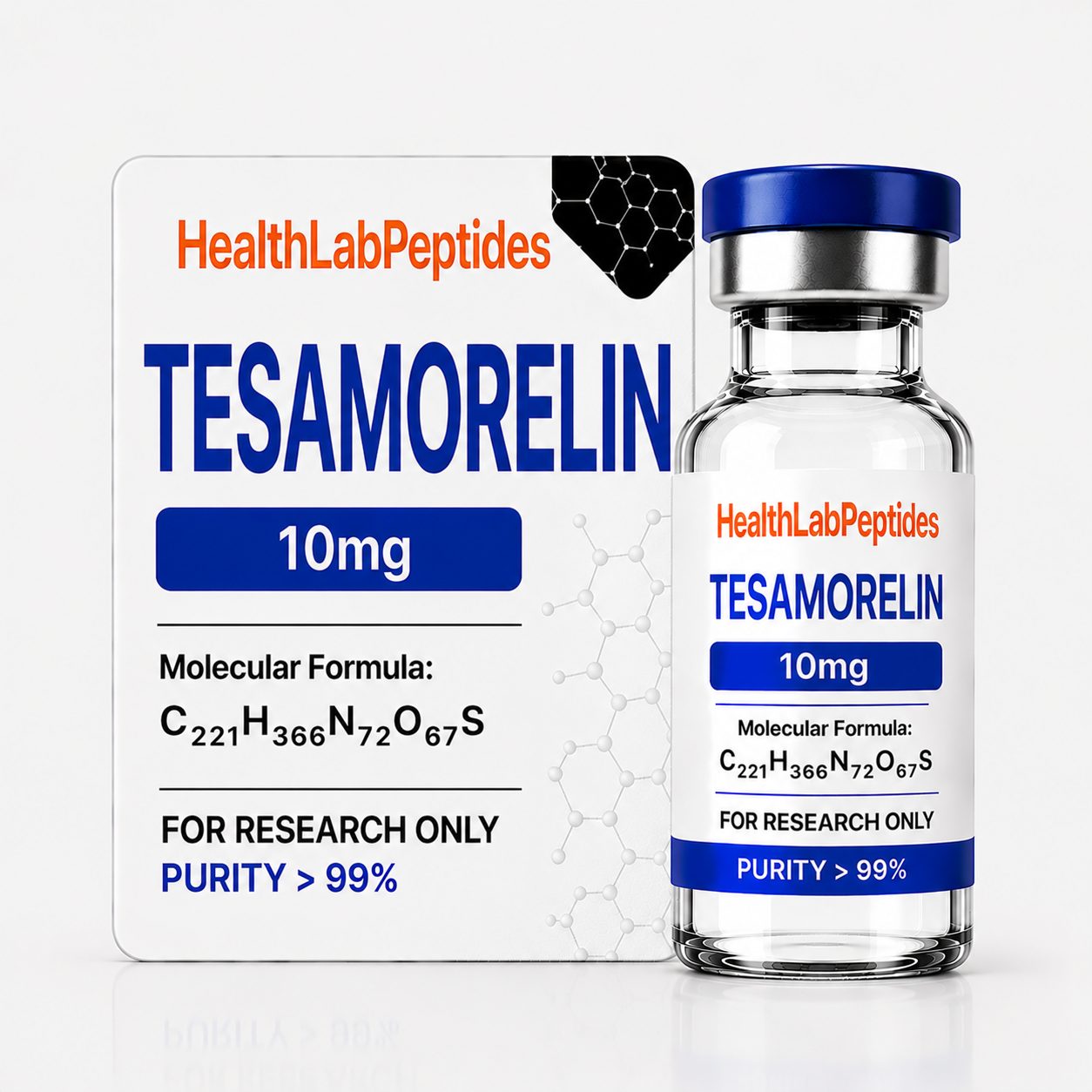
Research suggests: Tesamorelin is a modified growth hormone-releasing hormone analog with a distinct regulated clinical evidence history. This article examines tesamorelin research: what randomized trials and extension studies can actually establish, preserving the distinction between named molecules, the methods used to investigate them, and what the measured findings can support. The existing HealthLab research guide provides related context. Neither the publication nor the research-only catalog listing is a recommendation for human or veterinary administration.
A randomized study is different from a receptor assay
A GHRH receptor assay measures selected molecular responses in a controlled cell system. A randomized clinical study evaluates a specific investigational or approved product under a protocol with participants and defined outcomes. The two forms of evidence can inform one another but should not be treated as interchangeable. Tesamorelin’s development literature includes both molecular pharmacology and clinical investigations. A laboratory supplier may describe this history accurately without implying that its independent research vial is a clinical formulation.
The 2010 clinical extension study
Falutz and colleagues published a randomized, placebo-controlled investigation with an extension phase involving a defined tesamorelin formulation and HIV-associated abdominal fat accumulation. The report included both initial and extended follow-up components under a specified protocol. An extension study can provide observations about continued outcomes and adverse events, but the design and changes in assigned groups matter. A result from the original randomized phase is not identical in evidentiary strength to every observation collected later. Distinguishing the phases prevents overclaiming.
Why comparators matter
A randomized comparison attempts to separate the studied compound’s effects from changes that may also occur in participants assigned to a control group. Appropriate blinding and predefined outcomes improve causal interpretation. Yet every trial still has limits based on selection criteria, sample size, follow-up, and the product tested. The 2010 design addressed a particular clinical population; it does not establish that all people or all tesamorelin-named research materials behave identically. The article must retain the source population and context even when discussing methodology.
Outcome measures are not interchangeable
Clinical protocols may evaluate imaging-derived adipose-tissue measures, laboratory biomarkers, or adverse-event reports. These are distinct endpoints. A study that changes one measured marker does not automatically establish a meaningful improvement in every other physiological category. In an extension phase, attrition and treatment changes can complicate interpretation. A rigorous report identifies which outcomes were prespecified and which were exploratory. It should not use an isolated finding as a sales promise for an unapproved laboratory reagent.
For another perspective, the related HealthLab scientific article addresses a different experiment, comparison, or molecular question. A careful reader should compare materials and endpoints, not simply compound names. Some results concern purified proteins, some concern cells or animals, and others describe a regulated clinical formulation. These forms of evidence answer different questions and should not be combined into a claim about a separate research product.
The importance of adverse-event reporting
The safety portion of a study needs to be evaluated according to the number of participants, duration of observation, completeness of follow-up, and the type of event reported. An absence of a particular adverse event in a limited trial is not proof of universal safety. Likewise, a report of an event does not automatically identify a molecular mechanism. Clinical conclusions require a product-specific assessment. None of these findings authorize using a separately supplied research vial outside a regulated medical context.
The 2012 non-HIV trial as a different context
Another randomized controlled investigation, PMID 23015655, evaluated tesamorelin in a different population with reduced GH secretion. Its endpoints and selection criteria were not identical to the HIV-associated study. Comparing their published observations can be informative but requires attention to those differences. The studies should not be pooled without a scientific rationale, and results should not be turned into blanket benefits for weight, appearance, or performance. They belong to the medical evidence record of the tested formulations.
Why FDA status belongs to a specific finished product
Tesamorelin-containing medicines have product-specific regulatory histories, quality systems, and approved uses. These do not transfer to independently sourced materials sold for research. An article about trial design is appropriate scientific education when it preserves that distinction and avoids administration details. The user-facing HealthLab catalog link identifies a research material only. The page does not provide dosing, injection, or treatment advice or make efficacy claims for that item.
Study methods and strength of evidence
Key research publications: Falutz et al., Journal of Acquired Immune Deficiency Syndromes (2010), PMID 20101189, DOI 10.1097/QAI.0b013e3181cbdaff; related randomized study PMID 23015655. A well-supported interpretation needs the source’s study model, molecular identification, controls, sampling or observation window, and uncertainty. Molecular methods may demonstrate binding or altered biochemical markers while leaving direct causation unresolved. Clinical reports provide more organism-level context but remain product- and population-specific. Repeated testing under independent conditions can strengthen confidence; it cannot eliminate the need to separate the original formulation from an unrelated RUO catalog material.
What is measured versus what is assumed
An assay can quantify a response without demonstrating every intermediate mechanistic step. A single transcript, protein marker, hormone value, or mass-spectrometric peak should not be interpreted as a full description of a biological pathway. The evidence is strongest when the paper directly tests alternatives and includes appropriately chosen comparators. Negative findings are not inconvenient details; they help define the actual extent of a mechanism. Broad statements about health benefits, performance, recovery, or anti-aging do not follow from these narrow laboratory observations.
HealthLab research-material identification
The Tesa 10 mg research-material product page names the related catalog item and its labeled quantity. That amount is identifying information, not an experimental or medical protocol. A Certificate of Analysis, when available, documents only the tested attributes of a specific batch. It does not establish safety, FDA approval, or clinical equivalence. The product link supports lawful laboratory navigation, while the literature cited here supports educational discussion of the molecule’s research history.
Common scientific questions
Which molecular species was tested? What comparison was used, and what did the study actually measure? Could a change in the cell system, tissue type, instrument, or time point lead to a different result? Were uncertainty and contradictory findings reported? Does the original literature refer to an approved pharmaceutical product, a preclinical preparation, or an analytical standard? Asking these questions prevents an informative experimental result from becoming an unsupported consumer recommendation.
References and conclusion
Sources: Falutz et al., Journal of Acquired Immune Deficiency Syndromes (2010), PMID 20101189, DOI 10.1097/QAI.0b013e3181cbdaff; related randomized study PMID 23015655. The most reliable conclusion is the one that remains closest to the actual experiment. This research topic is valuable because it helps connect a defined molecular question to verifiable evidence while acknowledging what remains unsettled. The original literature does not show that an independent HealthLab laboratory vial is equivalent to a regulated medicine or suitable for treatment, consumption, or administration. The article includes relevant product keywords for scientific discoverability, not to imply personal-use efficacy.
Research Use Only
Research Use Only / Not for human or veterinary use. No dosing, injection, administration, reconstitution, treatment, or personal-use guidance is included. HealthLab research materials are not presented as FDA-approved medicines or as providing human health effects.


