

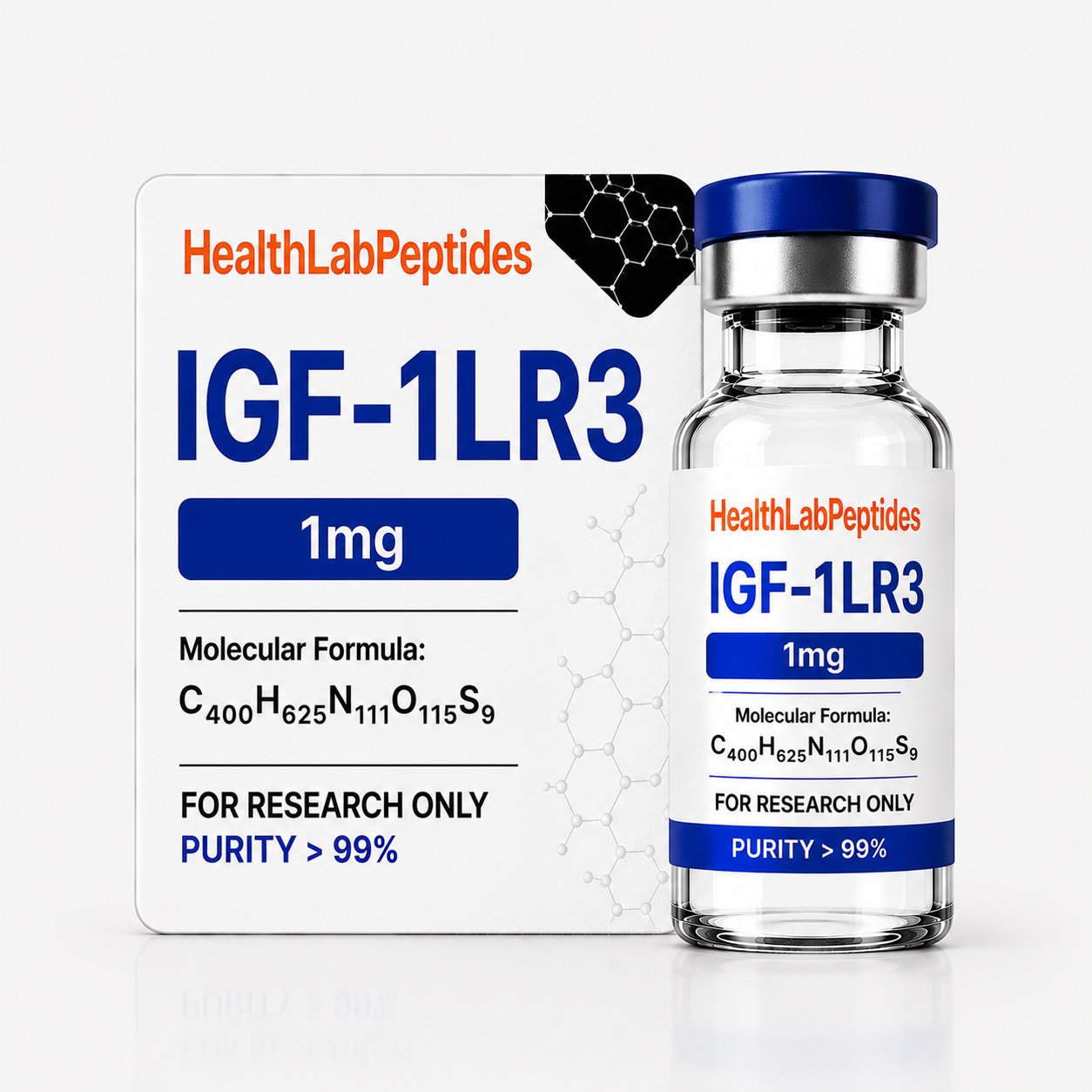
Research suggests: IGF-1 LR3 is an engineered insulin-like growth factor I analog studied in the context of ligand binding, receptor signaling, and IGF-binding proteins. This article critically examines igf-1 lr3 research: why igfbp-3 can change receptor assay interpretation by distinguishing source evidence, model-dependent findings, and what the study did not establish. Begin with the corresponding HealthLab research overview for related chemical and biological context. All material is presented for lawful laboratory research education only.
IGF binding proteins shape the apparent result
Insulin-like growth factor binding proteins regulate the availability of IGF ligands in many experimental contexts. In a culture containing IGFBPs, the measured response to a ligand can be influenced by how strongly the ligand binds those extracellular proteins. This means receptor activity cannot always be compared fairly simply by adding equal nominal amounts of two analogs. IGF-1 LR3 is engineered to differ from native IGF-I, but its exact interactions and experimental behavior must be independently documented. A descriptive product name does not determine the amount of free active ligand in every assay.
Why a 2001 IGFBP-3 study is relevant
An Endocrinology study in 2001, PMID 11145572, examined IGFBP-3 effects on IGF receptor signaling in MCF-7 breast carcinoma cells. The investigators tested IGF-I and other analogs with weak or very low affinity for IGFBPs, including des(1–3)IGF-I. Importantly, the paper did not directly characterize HealthLab IGF-1 LR3 material. Its scientific relevance is the general methodological finding that IGFBP-3 may influence receptor-associated responses through more than merely holding ligand away from its receptor.
Binding-protein affinity is not the whole story
The 2001 work reported that IGFBP-3 could suppress certain type I IGF receptor phosphorylation responses even for analogs with reduced binding to IGFBPs. Such a result complicates any simple assumption that decreasing IGFBP affinity eliminates all binding-protein-related regulation. The mechanism involves more than a straightforward calculation of how much ligand remains free. It is therefore important to separate a chemical modification’s intended binding property from measured receptor signaling. A claim that IGF-1 LR3 always bypasses IGFBP-3 control would require direct evidence in a matched system.
Receptor autophosphorylation as a molecular marker
The type I IGF receptor is a receptor tyrosine kinase. Studies may use receptor autophosphorylation or kinase-related measurements as indications of activation in a particular cell model. These outcomes are not identical to long-term cell growth, muscle physiology, or organism-level changes. The 2001 paper measured selected early signaling events. A change in those markers cannot independently establish treatment efficacy or an anabolic effect in people. The timing and choice of comparison groups are essential for interpretation.
A useful comparison appears in the linked HealthLab scientific analysis, which explores another aspect of the experimental literature. Findings from different preparations, cohorts, assays, or source publications must not be combined without qualification. A shared keyword does not establish equivalent methods, and differing outcomes may reflect separate scientific questions rather than a true contradiction. The original studies should be checked before a conclusion is repeated.
Why an MCF-7 cell line has limited scope
MCF-7 is a human breast-carcinoma cell line, so its receptor expression and cellular environment differ from those of many other experimental models. It may express growth-factor-associated components that influence a measured response. A finding in such a line can generate important mechanistic hypotheses, but it cannot be assumed to reproduce in skeletal muscle or other tissues. The source’s tissue context should be preserved in an SEO article rather than replaced with an unqualified claim about growth.
IGF-DES and LR3 are different experimental materials
Des(1–3)IGF-I lacks three N-terminal residues. IGF-1 LR3 has a different engineered sequence with a longer N-terminal modification and another substitution. A study that evaluates the truncated analog cannot automatically be cited as a direct LR3 result. Both are relevant to questions about IGFBP interaction, but they require separate chemical characterization and independent comparison experiments. Using their names interchangeably would undermine the scientific integrity of the article.
Why the result argues for stronger controls
A reliable design measures receptor-associated responses with proper controls for ligand identity, binding-protein abundance, and cell background. One should also account for the possibility that IGFBP-3 affects receptor-related processes independently of simply binding extracellular IGF. The 2001 findings illustrate why a negative assumption can be informative: removing one binding interaction does not necessarily remove every regulatory pathway. An evidence-based article identifies what the primary study directly showed and where LR3-specific conclusions remain to be established.
Research methodology and evidence quality
Important references include Endocrinology (2001), PMID 11145572, DOI 10.1210/endo.142.1.7915; Ballard et al. (1996), PMID 8930132. The reader should examine the material used, comparison group, methodology, statistical treatment, and limits of the observation. A molecular signal is narrower than an organism-level outcome, and a clinical trial on a regulated formulation is different from chemical characterization of an RUO reagent. An isolated favorable result should be reported alongside any negative or uncertain findings. Reproducibility, independent evidence, and transparent controls determine the strength of the inference.
Why the experimental endpoint must be named
Scientific reports can measure transcript abundance, protein modification, receptor behavior, chemical identity, imaging results, or clinical endpoints. These measurements answer different questions, and one cannot substitute for another. Descriptions should state whether a result was directly observed or interpreted through a proposed mechanism. The subject’s commercial relevance is not evidence of biological efficacy. Where a direct causal chain is incomplete, the article should explain the uncertainty rather than imply that the most attractive interpretation is proven.
Related HealthLab research product and keywords
The IGF-1 LR3 1 mg research material listing corresponds to the laboratory compound discussed here. It identifies a catalog item and label quantity only, not a use regimen. Batch documentation such as a Certificate of Analysis can substantiate specified analytic characteristics to the extent tested, but cannot transfer clinical evidence from another preparation or establish FDA approval. Product keywords appear naturally to help readers locate the relevant molecular research while preserving the separation between scientific reporting and consumer-use claims.
What remains unestablished
The cited work does not demonstrate that any separately marketed HealthLab vial is safe for personal use or produces a predictable health, performance, cosmetic, or treatment effect. Cell and animal findings are model specific, and even regulated human studies are population- and product-specific. Scientific articles can responsibly discuss an investigational program while reporting adverse events and null results. A useful review identifies what further replication, characterization, or controlled investigation would be needed rather than asserting that outstanding questions have already been answered.
Reader questions and references
The key questions are whether the original study used the exact material being discussed, what model generated the evidence, what controls were included, and whether the outcome matched the article’s claim. Sources: Endocrinology (2001), PMID 11145572, DOI 10.1210/endo.142.1.7915; Ballard et al. (1996), PMID 8930132. The conclusion should remain proportional to that evidence. This research-only resource reports what investigators observed and where the limits lie, without providing administration instructions or making promises for the independent catalog product.
Research Use Only
Research Use Only / Not for human or veterinary use. No dosing, reconstitution, injection, treatment, administration, or other consumer-use instructions are included. HealthLab products are not represented as FDA-approved medicines.


