
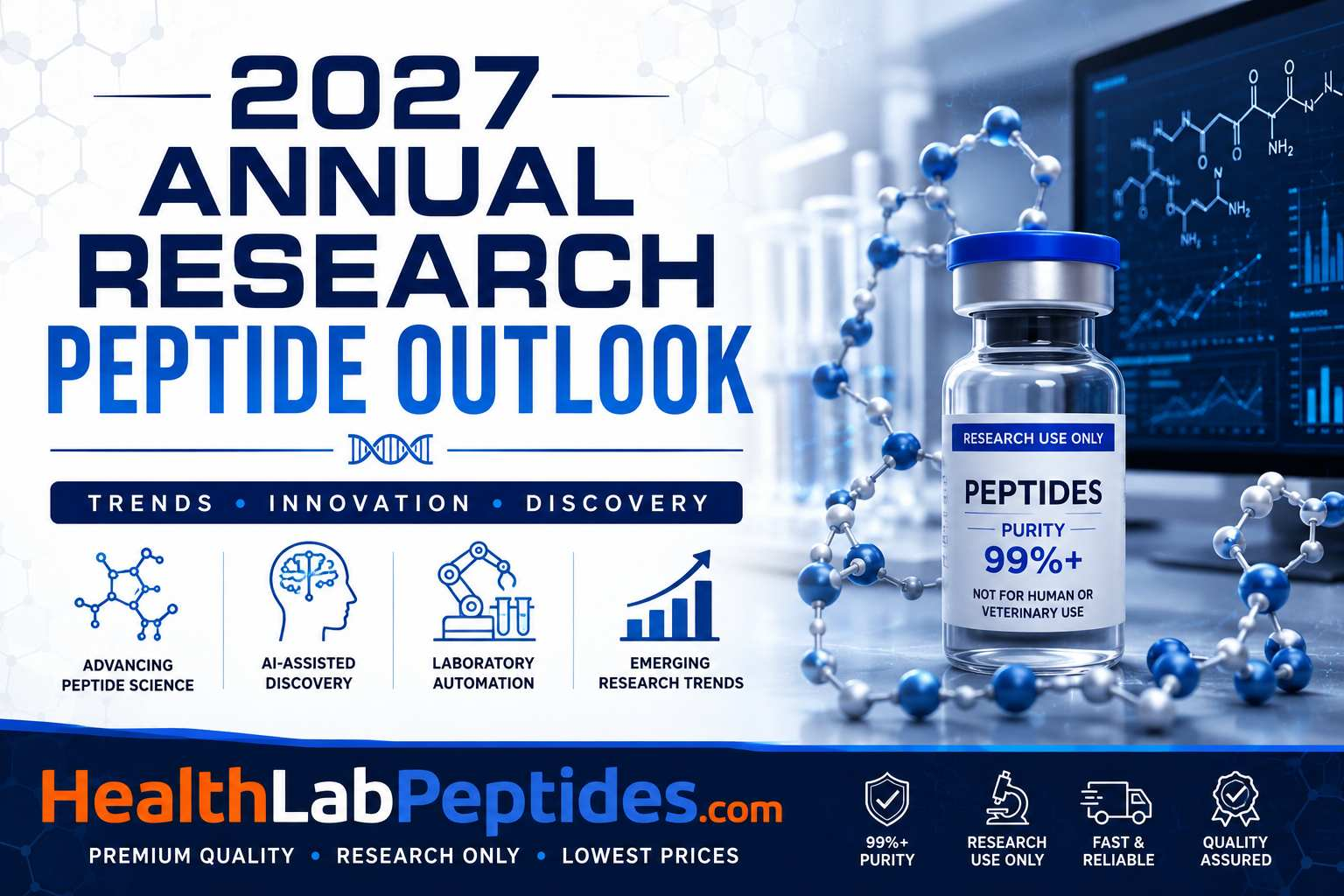
Research Suggests: Peptide Science Is Entering a New Era of Discovery
Research suggests the peptide research landscape is evolving faster than at any point in its history. Improvements in molecular biology, artificial intelligence, computational chemistry, transcriptomics, proteomics, and structural biology are allowing researchers to investigate peptides with unprecedented precision. At the same time, laboratories continue expanding research involving MOTS-c, SS-31, NAD+, CJC-1295 (No DAC), Ipamorelin, BPC-157, and TB-500 as scientists seek to better understand complex biological signaling networks. New advances in peptide engineering, AI-assisted discovery, and delivery technologies are expected to continue shaping the field over the coming years. (Frontiers)
Unlike previous decades, peptide research is no longer focused on individual molecules alone. Modern laboratories increasingly investigate entire signaling networks, examining how endocrine, metabolic, mitochondrial, immune, and neurological pathways interact rather than treating each system independently. This systems-level approach is changing how researchers design experiments and interpret biological data. (Frontiers)
Executive Summary
Several themes are expected to define peptide research through 2027:
- Continued expansion of mitochondrial biology research
- Greater emphasis on multi-pathway signaling
- AI-assisted peptide discovery
- Increased use of multi-omics technologies
- Continued interest in growth hormone signaling
- Expansion of neuroregulatory peptide research
- New methods for peptide stabilization and delivery
- Improved laboratory analytical techniques
- Growing interest in peptide engineering beyond naturally occurring sequences (Frontiers)
Rather than representing isolated trends, these developments are converging into a broader shift toward integrated biological research.
The Evolution of Peptide Research
Only a decade ago, many laboratories investigated peptides one at a time. Individual compounds were often assigned to a single biological function, and experiments focused on isolated molecular targets.
Today’s research environment looks very different.
Scientists increasingly recognize that biological systems communicate through extensive signaling networks involving hormones, cytokines, metabolites, receptors, enzymes, transcription factors, and peptides. This has encouraged researchers to design experiments that examine interactions across multiple pathways simultaneously.
Instead of asking:
“What does this peptide do?”
Researchers increasingly ask:
“How does this peptide influence an entire signaling network?”
That change represents one of the most significant developments in modern peptide science.
Growth Hormone Research Remains a Major Focus
Growth hormone biology continues to receive significant scientific attention.
Laboratories regularly investigate:
- Ipamorelin
- CJC-1295 (No DAC)
- Tesamorelin
- IGF-1 LR3
- Hexarelin
- GHRP-2
- GHRP-6
- Sermorelin
Researchers continue comparing these compounds to better understand receptor activation, endocrine communication, and downstream signaling pathways.
One of the most important shifts involves integrating endocrine research with metabolism, mitochondrial biology, and cellular signaling instead of studying hormone pathways independently.
Mitochondrial Biology Has Become a Research Priority
Perhaps no category has grown faster than mitochondrial research.
Scientists now recognize mitochondria as dynamic signaling hubs that regulate much more than ATP production.
Current investigations frequently include:
Researchers continue exploring how these compounds contribute to studies of energy regulation, cellular adaptation, and metabolic communication.
The growing interest in mitochondrial biology is also influencing research involving aging, exercise physiology, and systems biology. (Frontiers)
Multi-Peptide Research Is Becoming More Common
Another important trend is the movement away from studying peptides individually.
Instead, laboratories increasingly investigate coordinated peptide systems.
Examples include:
Researchers are interested in understanding how multiple signaling pathways interact rather than evaluating each peptide independently.
This systems-based philosophy is expected to continue expanding throughout 2027.
Artificial Intelligence Is Changing Peptide Research
AI is rapidly becoming one of the most influential technologies in peptide science.
Researchers are now using machine learning to:
- Predict peptide structures
- Improve peptide stability
- Identify receptor interactions
- Analyze proteomics datasets
- Design novel peptide sequences
- Prioritize experimental candidates
Rather than replacing laboratory experimentation, AI is helping scientists make better decisions about which compounds and pathways deserve further investigation. (arXiv)
Looking Ahead
The themes emerging today suggest peptide science is becoming increasingly interdisciplinary. Researchers are connecting endocrine signaling, mitochondrial biology, neuroscience, immunology, and systems biology into a more unified understanding of cellular communication.
In Part 2, we’ll explore:
- The rise of neuroregulatory peptides
- Advances in metabolic peptide research
- New laboratory technologies
- Peptide engineering
- Predictions for 2027–2030
- The future of peptide discovery
HealthLabPeptides.com Research Use Only (RUO) Disclaimer
All products offered by HealthLabPeptides.com are intended strictly for Research Use Only (RUO). They are not intended for human consumption, veterinary use, therapeutic use, or diagnostic purposes. These products have not been evaluated by the U.S. Food and Drug Administration (FDA) and are not intended to diagnose, treat, cure, or prevent any disease. HealthLabPeptides.com makes no medical or therapeutic claims regarding its products. Information provided is for educational and scientific discussion only.
Research Suggests: Neuroregulatory Peptides Continue Expanding Scientific Interest
Research suggests neuroscience has become one of the fastest-growing areas of peptide research. Rather than studying only neurotransmitters, researchers now investigate how regulatory peptides influence cellular communication throughout the nervous system. Compounds such as Semax, Selank, DSIP, and Pinealon continue to attract scientific interest because of their involvement in laboratory studies examining neuronal signaling, peptide-mediated communication, and molecular regulation. These investigations increasingly overlap with systems biology as researchers seek to understand how the nervous system interacts with endocrine, immune, and metabolic pathways.
Metabolic Research Continues to Evolve
Research involving metabolic peptides remains one of the most active areas of laboratory investigation.
Scientists continue exploring:
- Reta
- Tirz
- Semaglutide
- MOTS-c
- NAD+
These compounds are frequently investigated in laboratory models designed to better understand receptor biology, cellular metabolism, energy regulation, and molecular signaling.
An important trend is the growing effort to understand how metabolic signaling interacts with mitochondrial function rather than treating these systems independently.
Multi-Omics Is Transforming Peptide Research
Perhaps the largest technological change affecting peptide science is the widespread adoption of multi-omics.
Instead of relying on a single analytical technique, researchers now combine multiple technologies during the same experiment.
These include:
- Transcriptomics
- Proteomics
- Metabolomics
- Lipidomics
- Epigenomics
- Single-cell sequencing
When combined, these technologies provide a far more complete picture of biological activity than any single method alone.
Researchers are now able to observe how peptides influence thousands of molecular events simultaneously.
AI-Assisted Discovery Will Continue Accelerating
Artificial intelligence is expected to become increasingly integrated into peptide research.
Current applications include:
- Predicting peptide structures
- Identifying receptor binding patterns
- Screening peptide libraries
- Optimizing synthetic peptide design
- Modeling molecular interactions
- Prioritizing experimental candidates
Instead of replacing laboratory experiments, AI is helping researchers make those experiments more efficient by identifying promising compounds before laboratory testing begins.
Improved Peptide Engineering
Scientists are also designing entirely new peptide analogs rather than studying only naturally occurring molecules.
Research focuses include:
- Increased stability
- Enhanced receptor selectivity
- Modified amino acid sequences
- Novel delivery systems
- Improved resistance to enzymatic degradation
These advances are expected to continue expanding the number of experimental peptides available for scientific investigation.
Laboratory Automation Is Becoming Standard
Automation continues changing how peptide research is performed.
Many laboratories now utilize:
- Robotic liquid handling
- Automated peptide synthesis
- High-throughput screening
- Digital laboratory management
- AI-assisted image analysis
These technologies increase efficiency while allowing researchers to analyze larger experimental datasets.
Collaboration Across Scientific Disciplines
One of the defining characteristics of modern peptide science is collaboration.
Researchers specializing in:
- Molecular biology
- Biochemistry
- Structural biology
- Computational chemistry
- Artificial intelligence
- Immunology
- Endocrinology
- Neuroscience
are increasingly working together to investigate shared biological questions.
This interdisciplinary approach is expected to accelerate future discoveries.
Predictions for 2027–2030
Several developments are likely to shape peptide research during the next few years.
Greater Emphasis on Network Biology
Rather than studying individual receptors, researchers will increasingly investigate complete signaling networks.
Expansion of Computational Biology
Machine learning will continue improving peptide discovery and experimental design.
More Specialized Research Peptides
New synthetic analogs designed for specific laboratory applications are expected to become more common.
Continued Growth of Mitochondrial Biology
Research involving SS-31, MOTS-c, and NAD+ is expected to remain a major focus.
Growth Hormone Research Will Continue
Compounds such as Ipamorelin, CJC-1295 (No DAC), Tesamorelin, Hexarelin, GHRP-2, and GHRP-6 are expected to remain important tools for endocrine research.
Cellular Communication Will Remain Central
Laboratory investigations involving BPC-157, TB-500, GHK-Cu, and KLOW 80 continue supporting research into complex signaling pathways that coordinate biological systems.
What This Means for Research Laboratories
The pace of peptide research is unlikely to slow.
Laboratories that embrace interdisciplinary research, advanced computational tools, and integrated biological analysis will be well positioned to contribute to future discoveries.
Researchers are increasingly moving beyond isolated experiments toward comprehensive investigations that examine how multiple biological systems communicate simultaneously.
Final Thoughts
Research suggests peptide science is entering one of its most productive periods. Advances in artificial intelligence, molecular biology, structural analysis, and laboratory automation are allowing researchers to investigate biological communication with greater precision than ever before.
As scientists continue exploring endocrine signaling, mitochondrial biology, neuroregulation, immune pathways, and metabolic communication, peptides will remain valuable tools for understanding how complex biological systems function.
The coming years are expected to produce new peptide analogs, improved analytical technologies, and deeper insights into cellular signaling networks. While many questions remain unanswered, the direction of modern research is clear: peptide science is becoming increasingly interconnected, data-driven, and multidisciplinary.
For laboratories seeking high-quality Research Use Only (RUO) compounds and educational resources, HealthLabPeptides.com remains committed to supporting the scientific community with an expanding catalog of research peptides and informative content.
HealthLabPeptides.com Research Use Only (RUO) Disclaimer
All products offered by HealthLabPeptides.com are intended strictly for Research Use Only (RUO). They are not intended for human consumption, veterinary use, therapeutic use, or diagnostic purposes. These products have not been evaluated by the U.S. Food and Drug Administration (FDA) and are not intended to diagnose, treat, cure, or prevent any disease. HealthLabPeptides.com makes no medical or therapeutic claims regarding its products. Information provided is for educational and scientific discussion only.