
Slug: cjc-1295-research-peptide-guide
Meta Description: Buy premium CJC-1295 Research Use Only (RUO) peptides from HealthLabPeptides.com. Explore growth hormone signaling, GHRH research, laboratory applications, and high-purity research compounds.
Table of Contents
- What Is CJC-1295?
- Understanding Growth Hormone-Releasing Hormone
- Why Researchers Study CJC-1295
- CJC-1295 Without DAC vs. CJC-1295 DAC
- Growth Hormone Research Continues to Expand
- Related Research Peptides
- Modern Laboratory Technologies
- Future Directions in CJC-1295 Research
- Frequently Asked Questions
- Conclusion
Research Suggests: CJC-1295 Continues to Be One of the Most Studied Growth Hormone Research Peptides
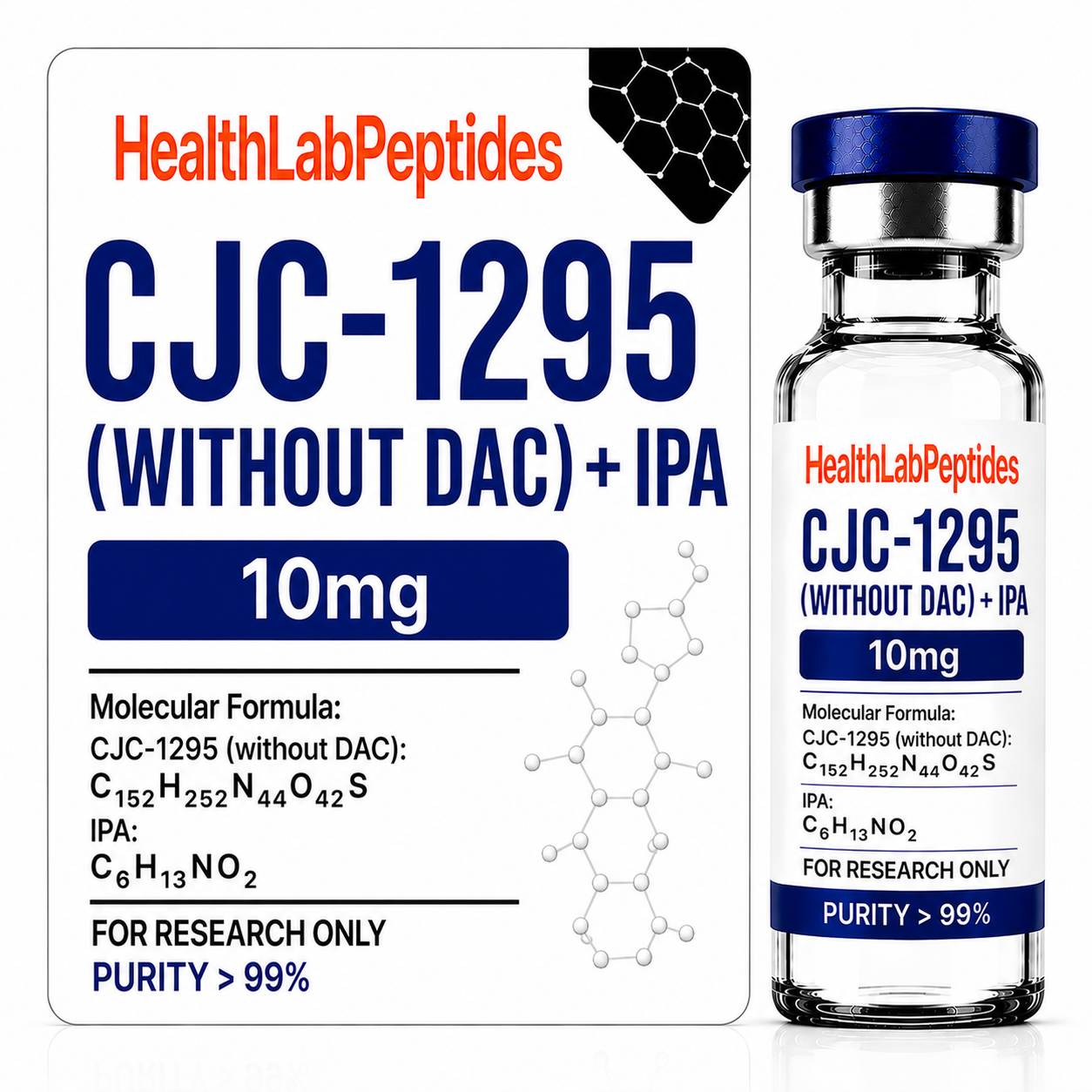
Research suggests that CJC-1295 (No DAC) remains one of the most widely investigated peptides in endocrine research because of its interaction with growth hormone-releasing hormone (GHRH) receptors. Scientists frequently compare CJC-1295 with Ipamorelin, Tesamorelin, and IGF-1 LR3 to better understand growth hormone signaling and downstream molecular communication. As laboratory technologies continue advancing, CJC-1295 remains an important research tool for investigating endocrine physiology and cellular regulation.
What Is CJC-1295?
CJC-1295 is a synthetic peptide developed for laboratory research involving the growth hormone-releasing hormone pathway. Rather than acting directly on growth hormone itself, researchers investigate CJC-1295 because of its interaction with GHRH receptors, making it useful for studying how endocrine signaling influences cellular communication.
Two primary forms are commonly discussed in research:
- CJC-1295 Without DAC
- CJC-1295 DAC (Drug Affinity Complex)
While both compounds interact with GHRH pathways, their pharmacokinetic properties differ, providing researchers with opportunities to investigate different experimental models.
Understanding Growth Hormone-Releasing Hormone
Growth hormone secretion is regulated through a highly coordinated signaling system involving the hypothalamus, pituitary gland, and numerous feedback mechanisms.
Researchers investigate CJC-1295 to better understand:
- GHRH receptor activation
- Endocrine communication
- Growth hormone signaling
- Cellular communication
- Hormonal regulation
- Molecular signaling networks
Rather than focusing solely on hormone production, modern laboratories examine how these signaling systems integrate with metabolism, mitochondrial biology, and cellular adaptation.
Why Researchers Continue Studying CJC-1295
One reason CJC-1295 has remained an important research peptide is its versatility.
Scientists continue investigating its relationship with:
- Endocrine physiology
- Growth factor signaling
- Cellular communication
- Molecular regulation
- Gene expression
- Hormonal feedback systems
- Protein synthesis research
- Metabolic signaling
As peptide research evolves, investigators increasingly examine how endocrine pathways communicate with numerous other biological systems.
CJC-1295 Without DAC vs. CJC-1295 DAC
Researchers often compare the two primary forms of CJC-1295 to better understand their characteristics.
CJC-1295 Without DAC
The version without Drug Affinity Complex is frequently selected for laboratory models requiring shorter periods of receptor interaction.
Researchers commonly investigate:
- Receptor activation
- Signal duration
- Endocrine communication
- Growth hormone physiology
CJC-1295 DAC
Adding the Drug Affinity Complex extends peptide persistence during laboratory investigations.
Scientists may compare both versions to evaluate how different exposure times influence molecular signaling pathways.
Neither version is intended for human use, and both remain strictly Research Use Only compounds.
Related Research Peptides
Growth hormone biology represents only one area of peptide science.
Researchers frequently compare CJC-1295 with other laboratory peptides.
Ipamorelin
Ipamorelin continues to be one of the most common peptides investigated alongside CJC-1295 because it targets a different receptor involved in growth hormone signaling.
Studying both peptides allows scientists to better understand complementary endocrine pathways.
Tesamorelin
Researchers also investigate Tesamorelin when studying GHRH receptor biology.
Although structurally different, Tesamorelin contributes valuable information regarding endocrine regulation and peptide-mediated signaling.
IGF-1 LR3
Downstream signaling often becomes another area of investigation.
Scientists studying endocrine biology frequently include IGF-1 LR3 to better understand insulin-like growth factor pathways.
Mitochondrial Research
Modern peptide science increasingly recognizes that endocrine signaling interacts with cellular energy regulation.
Researchers therefore investigate compounds including:
These laboratory investigations continue expanding our understanding of mitochondrial communication.
Cellular Communication
Scientists frequently compare endocrine peptides with compounds involved in cellular organization.
Examples include:
Although these peptides investigate different biological systems, together they help researchers understand the complexity of molecular communication.
Modern Laboratory Technologies
Today’s peptide laboratories have access to sophisticated analytical tools capable of measuring biological responses with remarkable precision.
Common techniques include:
- RNA sequencing
- Transcriptomics
- Proteomics
- Metabolomics
- High-resolution microscopy
- Mass spectrometry
- Artificial intelligence-assisted pathway analysis
These technologies allow investigators to observe interactions that previously could not be measured.
Future Directions
Research involving CJC-1295 continues evolving alongside advances in endocrine biology.
Future laboratory investigations will likely focus on:
- Molecular signaling networks
- Growth factor regulation
- Hormonal communication
- Cellular adaptation
- Integrated biological systems
Rather than studying isolated pathways, scientists increasingly investigate how endocrine signaling interacts with mitochondrial biology, metabolism, and cellular communication.
Frequently Asked Questions
What is CJC-1295?
CJC-1295 is a synthetic research peptide investigated for its interaction with growth hormone-releasing hormone receptors.
What is the difference between CJC-1295 DAC and No DAC?
Researchers primarily distinguish the two versions by their pharmacokinetic characteristics and experimental applications.
What peptides are commonly studied with CJC-1295?
Researchers frequently investigate:
- Ipamorelin
- Tesamorelin
- IGF-1 LR3
- MOTS-c
- SS-31
- NAD+
- GHK-Cu
- BPC-157
- TB-500
- KLOW 80
Conclusion
Research suggests that CJC-1295 continues to play an important role in endocrine research because of its relationship with growth hormone-releasing hormone signaling. As scientific technologies improve, researchers are gaining a deeper understanding of how endocrine pathways integrate with broader molecular communication networks.
Whether investigated alongside growth factor peptides, mitochondrial compounds, or cellular signaling peptides, CJC-1295 remains one of the foundational research tools in modern peptide science.
Explore CJC-1295 (No DAC) and additional Research Use Only peptides at HealthLabPeptides.com.
Categories
- Growth Hormone Peptides
- Research Peptides
- Endocrine Research
Tags
CJC-1295, CJC-1295 No DAC, Growth Hormone Peptides, GHRH, Ipamorelin, Tesamorelin, IGF-1 LR3, Research Peptides, Endocrine Research, Molecular Biology, Cellular Signaling, NAD+, MOTS-c, SS-31, GHK-Cu, BPC-157, TB-500, KLOW 80, Reta, Tirz, RUO
HealthLabPeptides.com Research Use Only (RUO) Disclaimer
All products offered by HealthLabPeptides.com are intended strictly for laboratory Research Use Only (RUO). They are not intended for human consumption, veterinary use, therapeutic use, or diagnostic purposes. These products have not been evaluated by the U.S. Food and Drug Administration (FDA) and are not intended to diagnose, treat, cure, or prevent any disease. HealthLabPeptides.com makes no medical or therapeutic claims regarding its products. Information provided is for educational and scientific discussion only.