
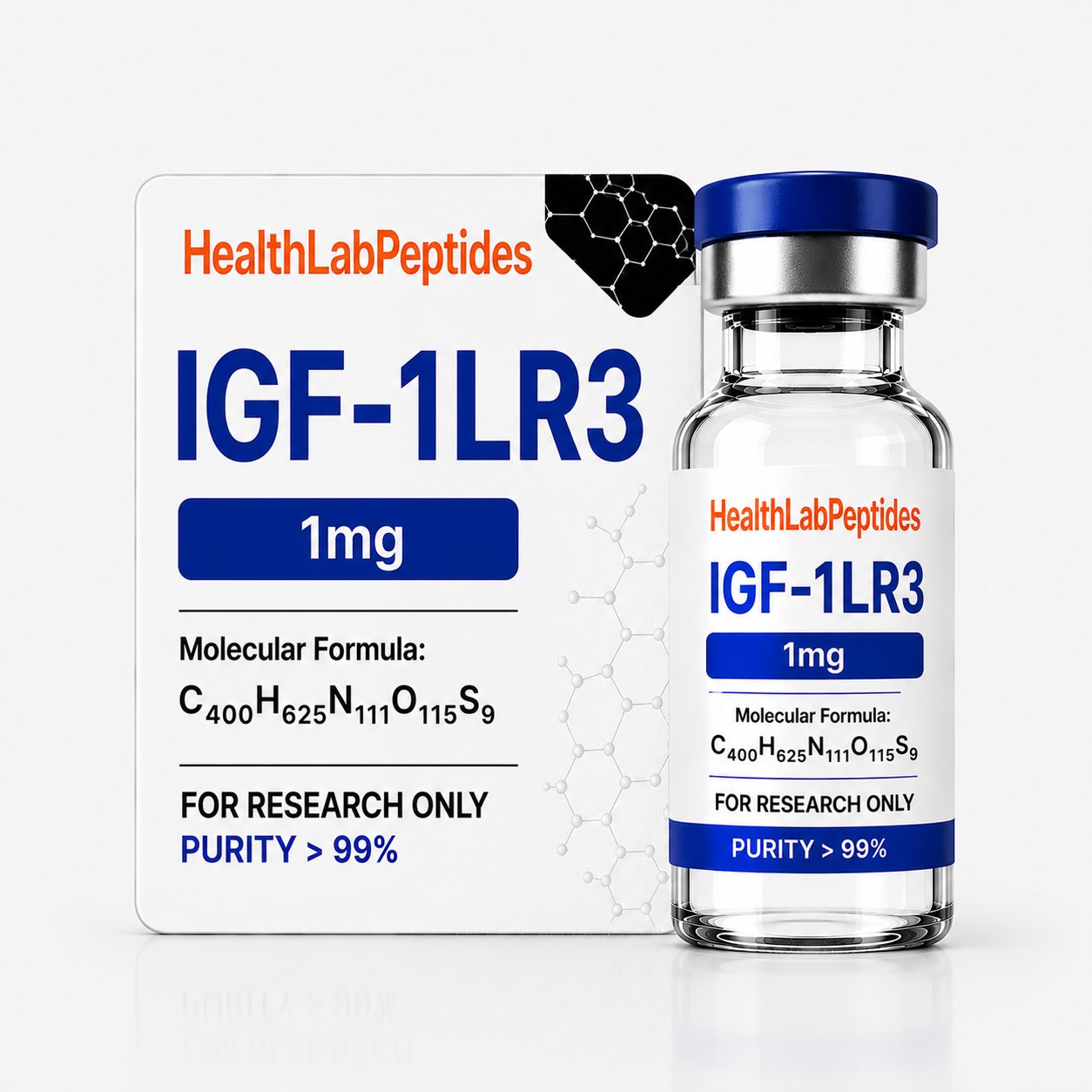
Research suggests that growth factor biology continues to be one of the most active areas of peptide research, with scientists investigating how signaling molecules regulate cellular communication, proliferation, and metabolic activity. Among the most recognized compounds in this field is IGF-1 LR3, a long-acting analog of insulin-like growth factor-1 that is frequently studied alongside Ipamorelin, CJC-1295 (No DAC), and Tesamorelin to better understand endocrine signaling and growth factor pathways in laboratory settings.
Unlike peptides that primarily interact with growth hormone receptors, IGF-1 LR3 is investigated because of its relationship with insulin-like growth factor receptors and the downstream signaling pathways that influence cellular growth, metabolism, and protein synthesis. Its extended activity compared with native IGF-1 has made it a valuable research compound for scientists studying complex molecular communication under controlled laboratory conditions.
Growth factor research rarely exists in isolation. Investigators frequently compare IGF-1 LR3 with peptides that target entirely different biological systems to better understand how multiple signaling networks work together. For example, MOTS-c and SS-31 continue to expand scientific understanding of mitochondrial biology and cellular energy regulation, while GHK-Cu remains widely studied for gene expression and extracellular matrix biology.
Researchers also continue investigating tissue-related signaling using BPC-157 and TB-500. Multi-peptide formulations such as KLOW 80 further demonstrate the growing scientific interest in studying multiple peptide pathways within a single experimental model.
Recent advances in transcriptomics, proteomics, metabolomics, and molecular imaging have transformed peptide research. These technologies enable scientists to evaluate how growth factor signaling interacts with mitochondrial function, endocrine regulation, and cellular communication at an unprecedented level of detail. Rather than focusing on one biological pathway, researchers are increasingly investigating how multiple molecular systems coordinate normal cellular activity.
As peptide science continues to evolve, IGF-1 LR3 remains an important laboratory tool for exploring growth factor biology and molecular signaling. Ongoing research is expected to further expand scientific understanding of how growth factor pathways integrate with broader cellular communication networks.
Explore IGF-1 LR3 and a growing collection of Research Use Only compounds at HealthLabPeptides.com.
HealthLabPeptides.com Research Use Only (RUO) Disclaimer
All products offered by HealthLabPeptides.com are intended strictly for laboratory Research Use Only (RUO). They are not intended for human consumption, veterinary use, therapeutic use, or diagnostic purposes. These products have not been evaluated by the U.S. Food and Drug Administration (FDA) and are not intended to diagnose, treat, cure, or prevent any disease. HealthLabPeptides.com makes no medical or therapeutic claims regarding its products. Information provided is for educational and scientific discussion only.