

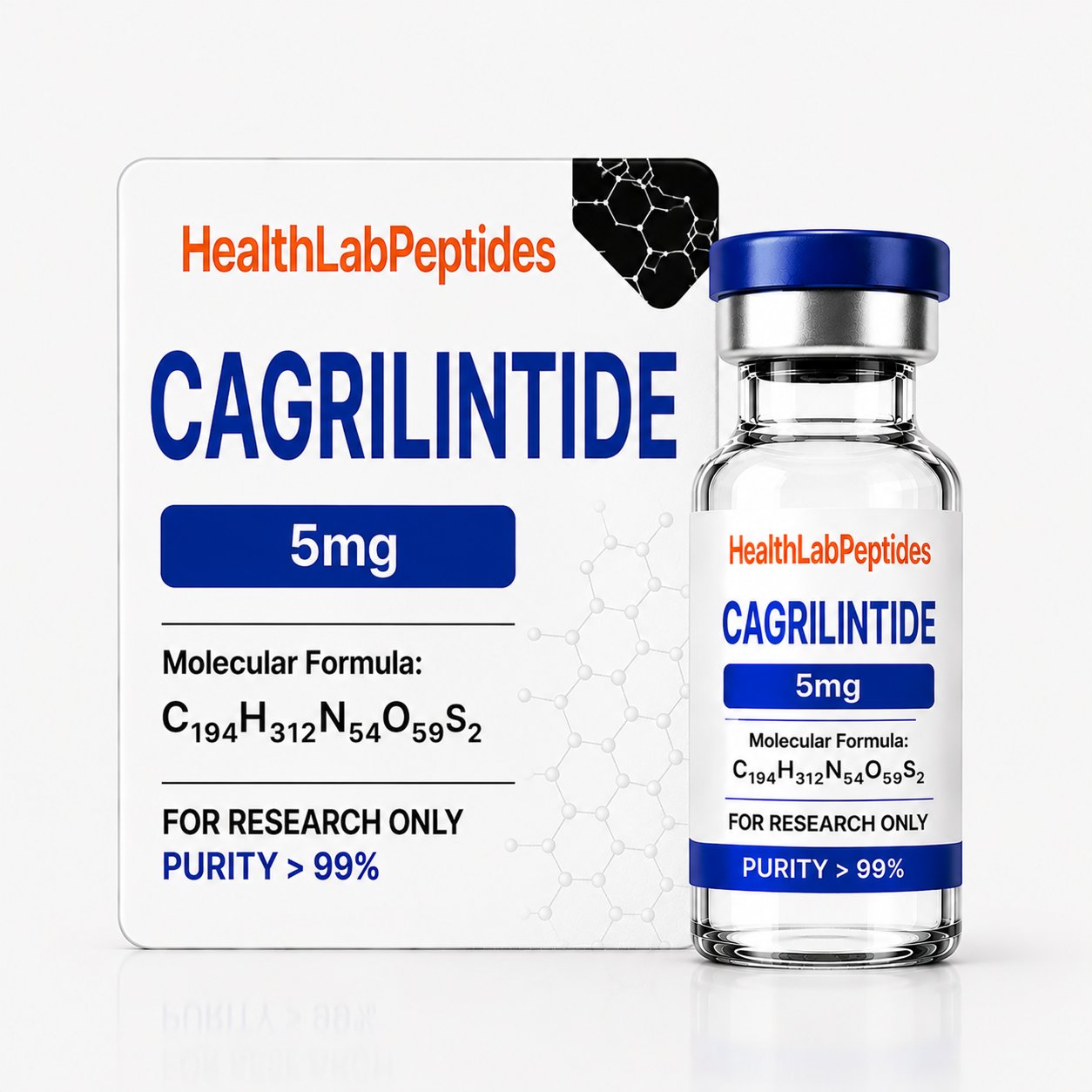
Research suggests that cagrilintide is an engineered long-acting analog of amylin, a pancreatic peptide hormone, and that its molecular development offers a useful example of peptide design, receptor-associated signaling, and structure–activity research. The original version of this page incorrectly described it as a proven diabetes treatment. That claim should not be made for a HealthLab research-only material. This article instead examines amylin peptide chemistry, experimental receptor systems, analog design, and the difference between published clinical research and laboratory procurement. Research readers can compare the basic definitions with the HealthLab peptide research overview. Nothing here recommends a medical, veterinary, dietary, or personal-use application.
What is cagrilintide as a molecular research subject?
Cagrilintide is a synthetic, chemically modified peptide designed to mimic selected features of amylin while changing stability-related and pharmacological properties. Amylin is also called islet amyloid polypeptide, and it is studied in the context of endocrine physiology. The term analog means the molecule has been engineered in relation to another molecular structure; it does not mean the two materials are identical. Molecular research should specify which analog was actually tested, its relevant chemical modifications, and the experimental setting. The distinction matters because publications about native amylin, pramlintide, and cagrilintide concern related but different chemical entities.
Amylin and its place in endocrine research
Amylin is produced by pancreatic beta cells and participates in several hormone-associated signaling systems. In research settings, investigators study its molecular structure, aggregation properties, receptor interactions, and physiological regulation. Experimental discussions often overlap with glucagon-like peptide-1 receptor science, but the molecules and their receptor systems are distinct. A laboratory result involving one peptide cannot be presumed to establish an effect of another. Researchers should define which pathway is being tested instead of combining broad endocrine labels into a claim about general metabolic benefits. The peptide hormone-receptor research guide provides broader context.
Amylin aggregation and the design challenge
A key structural feature of native human amylin is its tendency to form amyloid fibrils in certain environments. Such aggregation creates important considerations for molecular design and analytical experiments. Drug-discovery researchers have explored ways of modifying amylin-like sequences to alter stability and the behavior of analogs under defined conditions. That chemistry is distinct from any clinical effect. An experiment demonstrating less aggregation or greater stability in a selected assay does not automatically establish improved efficacy, safety, or suitability of an unapproved research material.
Primary source: Development of a long-acting analog
Kruse and colleagues described the development of cagrilintide in the Journal of Medicinal Chemistry in 2021 (PMID 34288673, DOI 10.1021/acs.jmedchem.1c00565). The paper discussed molecular modifications, structure–activity relationships, and the selection of a lipidated analog for further investigation. This is an appropriate primary reference for the chemical origin of the compound. It should not be represented as proof that a commercial research vial is a regulated prescription medicine. The most directly supported conclusions concern the molecular development pathway and the experimental comparisons described in that publication.
Why lipidation changes the scientific question
Lipidation is a chemical modification in which a lipid-containing component is associated with a peptide. Researchers investigate how such modifications influence experimental properties, including interactions with proteins, stability, and the disposition of a designed molecule in a specified model. No single modification has a universal effect; behavior depends on the entire structure and surrounding system. In cagrilintide research, it is useful to discuss lipidation as part of the molecular-design process. It is misleading to convert that feature into claims that a research-only material has predictable duration, dosage, or human-use characteristics.
Receptor-associated signaling
Amylin-related receptor research involves complexes that include calcitonin receptor components and receptor activity-modifying proteins. These assemblies may have different ligand-binding and signaling behavior, depending on experimental preparation. Research assays can measure ligand interactions or downstream cellular readouts, but their interpretation depends on the cell system, receptor expression, controls, and analytic validation. A change in receptor-associated signaling is not proof of clinical treatment or a reliable outcome in a human organism. Scientific summaries should distinguish direct receptor evidence from more distant physiological hypotheses.
Structural differences from native amylin
Native hormones and modified peptide analogs differ in specific amino-acid and chemical features that can affect laboratory measurements. A researcher should not assume that every statement about amylin applies unchanged to cagrilintide. Likewise, the terms amylin analog, receptor agonist, and modified peptide describe different aspects of a molecule. A complete description names the chemical entity and identifies what the study actually measured. These distinctions are particularly useful when comparing different publications or catalog descriptions that use similar endocrine terminology.
Clinical literature versus RUO material
Published clinical investigations have studied cagrilintide as a potential investigational medicine, including combinations examined in formal trials. Those studies involve defined research protocols and regulated products. They do not authorize HealthLab research materials for patient use or establish that a commercial research vial meets a medicinal product’s specifications. The existence of clinical data does not mean that the research catalog version has FDA approval. For scientific communication, the responsible approach is to identify the context of a trial and avoid translating findings into consumer health, disease-treatment, or weight-management claims for laboratory products.
Comparing cagrilintide with GLP-1 receptor analogs
Amylin-related signaling and GLP-1 receptor signaling are distinct research subjects, even though they may appear together in studies of endocrine physiology. The receptors, molecular structures, and measured endpoints differ. A meaningful scientific comparison should identify each compound’s receptor-associated experimental system, not infer interchangeability from shared headlines or terminology. Combining concepts in a clinical trial does not by itself establish synergy in a separate laboratory mixture. Internal navigation between these subjects can help researchers compare the mechanisms without suggesting that research products should be combined or used personally.
Why “diabetes breakthrough” is not an appropriate research-product title
Scientific publications may address clinical endocrine disorders, but that does not justify describing a commercial RUO material as a breakthrough treatment. The earlier version of this article overstated the evidence and implied therapeutic efficacy. In a research-only context, accurate titles and paragraphs need to describe the actual subject: molecular structure, amylin-receptor biology, and experimental evidence. Keywords associated with obesity, diabetes, weight management, or metabolic treatment should not become promotional claims. Informational search relevance is better achieved by answering the laboratory question accurately and acknowledging uncertainty.
Evidence categories: Chemistry, cells, animals, and trials
A chemical structure–activity study may compare analogs for measured molecular properties. Cell experiments can investigate receptor-associated pathways. Animal models include more interacting systems but introduce species-specific limitations. Clinical studies concern specific tested formulations and protocols. These sources do not have the same evidentiary meaning. An article that draws on each must tell readers what was studied, not merge results into a single unqualified benefit claim. Researchers should also consider the reproducibility of findings and possible differences among experimental materials.
How to evaluate an amylin analog study
First, confirm the identity of the tested molecule and whether the study concerns native amylin, pramlintide, cagrilintide, or another analog. Second, identify the experimental model and its controls. Third, determine whether the endpoint concerns aggregation, ligand binding, downstream signaling, animal physiology, or a regulated clinical result. Fourth, check whether conclusions remain within the data and whether alternative explanations were considered. When studies are compared, differences in assays or models should be made explicit. These steps make a research review more useful than an unsupported sequence of promotional assertions.
Research material identification and documentation
HealthLab’s Cagrilintide 5 mg laboratory material listing identifies an item offered for lawful in-vitro and analytical research. The catalog entry is not a prescription-drug listing and should not imply FDA approval. A certificate of analysis may describe specific analytical findings for a batch, but it cannot establish clinical safety or authorize administration. Researchers should keep chemical identity, batch documentation, assay evidence, and regulatory status as separate categories of information. This distinction is essential whenever a research compound is also investigated in a medical drug-development program.
Questions often asked in cagrilintide research
Is cagrilintide native amylin? No; it is an engineered analog. Why is aggregation discussed? Native human amylin’s aggregation behavior is an important structural and drug-design challenge. What does lipidation mean? It denotes a chemical modification studied for its influence on molecular properties. Do published trials make a research vial appropriate for personal use? No. Can an amylin analog be assumed to behave like a GLP-1 analog? No; molecular and receptor differences must be studied directly.
Research literature
The foundational chemical-design publication is Kruse et al., “Development of Cagrilintide, a Long-Acting Amylin Analogue,” Journal of Medicinal Chemistry (2021), PMID 34288673, DOI 10.1021/acs.jmedchem.1c00565. A later review of the clinical-development literature is indexed under PMID 36883831, DOI 10.1097/CRD.0000000000000513. The first supports discussion of analog design, while the second surveys a different evidence category. Neither establishes that HealthLab research material is a medicine or a clinically interchangeable formulation.
Conclusion: Accurate science and clear limits
Cagrilintide belongs in an educational research library as a defined amylin analog with documented molecular-design history and receptor-related scientific questions. The strongest explanation distinguishes peptide chemistry from physiological and clinical investigations, identifies the exact model, and avoids unapproved treatment claims. The appropriate use of this page is to support a reader’s understanding of laboratory peptide science without presenting a research material as a medical product.
For Research Use Only
For Research Use Only. Not for human consumption, medical, or veterinary use. No dosing, administration, injection, reconstitution, disease-treatment, or personal-use instructions are provided. These statements have not been evaluated by the FDA. This product is not intended to diagnose, treat, cure, or prevent any disease.


