

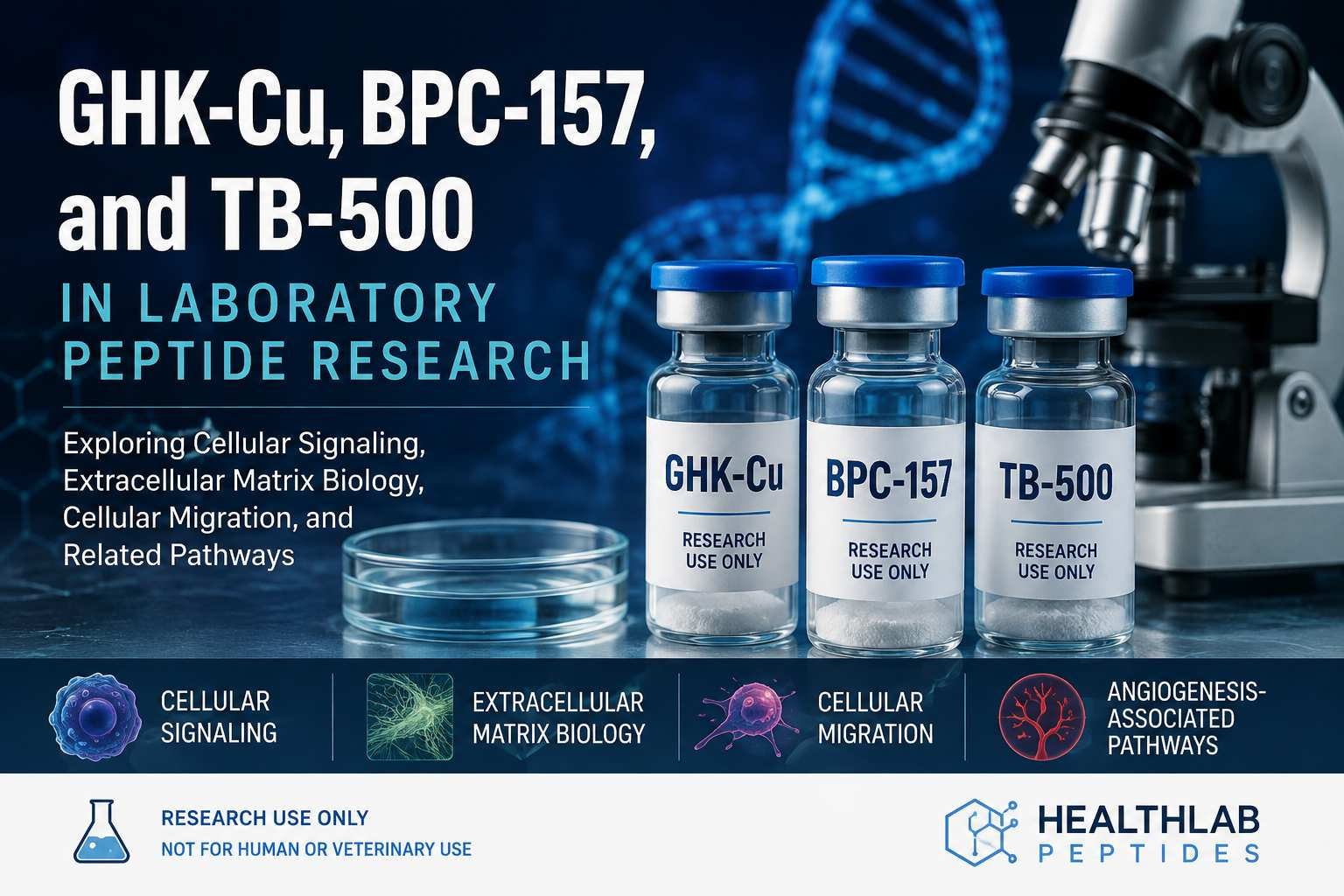
Research suggests: GHK-Cu warrants careful investigation using well-controlled laboratory methods. This guide explains the relevant research questions, measurement limitations, and experimental controls.
Research suggests: Understanding the research question
Research suggests: GHK-Cu is a subject of laboratory investigation in metal-peptide coordination chemistry. A useful scientific article must separate chemical identity, measured signaling, and broader biological interpretation. The presence of a peptide in an experiment does not by itself establish the mechanism responsible for a reported observation. Researchers should begin by identifying the exact compound, experimental model, analytical endpoint, and comparator before drawing conclusions.
Why chemical identity matters
Research suggests: peptide identity and sample quality are foundational to reproducible laboratory work. Sequence, molecular mass, counterions, solvent conditions, and the possibility of degradation or impurities can affect interpretation. Laboratories should distinguish manufacturer descriptions from independent analytical evidence. A nominal concentration is not necessarily the concentration of intact analyte remaining at the time of measurement. Documentation of batch identity and sample preparation is therefore central to any comparison.
Laboratory methods and meaningful controls
Research suggests: spectroscopic characterization, elemental analysis, and controlled cellular assays can help investigators examine metal-peptide coordination chemistry, but each technique has a defined measurement scope. Negative controls, vehicle controls, assay blanks, biological replicates, and appropriately selected reference materials should be planned before data collection. Investigators should measure copper stoichiometry and consider pH, competing ligands, and culture-medium composition when interpreting results. Reporting uncertainty and the full set of experimental conditions makes the work easier to evaluate and reproduce.
Interpreting results without overstating the evidence
Research suggests: Free copper, peptide alone, and copper-complexed peptide are not interchangeable experimental conditions. Laboratory findings may depend on cell line, species, receptor abundance, exposure conditions, measurement timing, and the statistical treatment of replicates. Results obtained in isolated cells, biochemical preparations, or animal models cannot automatically be extrapolated to humans. Researchers should distinguish exploratory hypotheses from independently replicated observations and avoid presenting a single study as a settled scientific conclusion.
Common research-design pitfalls
Research suggests: apparent contradictions between studies can reflect different assay platforms rather than genuine disagreement about molecular biology. One experiment may quantify binding, another second-messenger signaling, and a third a downstream gene-expression change. Those are related but distinct outcomes. Investigators should report how concentrations were established, whether the assay has a validated dynamic range, how missing observations were handled, and whether multiple comparisons were considered. Correlation, pathway activation, and causal attribution should not be conflated.
How to evaluate published evidence
Research suggests: evidence quality improves when methods are transparent, analytical identity is verified, and independent laboratories reproduce findings. Readers should examine the model system, sample size, blinding where relevant, control selection, endpoint definition, and whether conclusions extend beyond the actual measurements. Reviews are helpful for orienting a topic, but primary publications remain important for checking experimental detail. Uncertainty should be described rather than hidden behind broad claims.
Related research at HealthLab Peptides
Research suggests: contextual reading across neighboring laboratory topics can clarify how assay design affects interpretation. See research-only peptide standards, cellular signaling research, and metabolic peptide research resources. These links provide broader background and are not evidence of a particular compound’s efficacy.
Research limitations and conclusion
Research suggests: GHK-Cu remains best discussed through precisely defined laboratory questions about metal-peptide coordination chemistry. Robust interpretation requires chemical verification, appropriately designed controls, transparent statistics, and careful distinction between model-specific findings and general claims. This educational overview does not establish safety, clinical efficacy, or suitability for any human or veterinary application.
Research Use Only. Content is provided for in-vitro and laboratory education. Not for human or veterinary use. No therapeutic, diagnostic, or performance claims are made.


