
Research suggests that metabolic signaling has become an increasingly important area of laboratory investigation as researchers examine cellular energy regulation, mitochondrial communication, molecular signaling, and the complex pathways involved in metabolism. As scientific interest in these systems continues to develop, HealthLab Peptides is expanding its research-only catalog and educational resources to support researchers investigating metabolic and cellular biology.
HealthLab Peptides supplies its products exclusively to research professionals and individuals conducting legitimate research. All products are sold strictly for RUO and are not for human or veterinary use.
Metabolic Research Extends Beyond a Single Biological Pathway
Metabolism involves an interconnected network of biochemical processes rather than one isolated mechanism.
Researchers investigate how cells generate and use energy, communicate metabolic information, respond to environmental conditions, and coordinate activity between different cellular systems.
This has created scientific interest in research compounds associated with mitochondrial biology, cellular signaling, energy metabolism, and related molecular pathways.
HealthLab Peptides continues organizing its expanding research peptide catalog around these specialized areas so researchers can more easily identify compounds relevant to different laboratory investigations.
Mitochondrial Biology and Metabolic Research
Mitochondria occupy a central position in many areas of metabolic research.
Although mitochondria are widely recognized for their involvement in cellular energy production, researchers increasingly investigate them as components of larger signaling and communication networks.
This has contributed to laboratory interest in compounds such as MOTS-C and SS-31.
MOTS-C belongs to an unusual class of mitochondrial-derived peptides that researchers study in experimental models involving mitochondrial and metabolic signaling.
SS-31 represents another area of mitochondrial investigation, with laboratory research examining its interactions with mitochondrial structures and related cellular processes.
Studying these compounds can help researchers investigate different aspects of mitochondrial biology without assuming that individual research materials share identical mechanisms.
NAD+ Remains Important in Cellular-Energy Research
NAD+ is another widely studied molecule associated with metabolic and cellular-energy research.
Unlike many compounds within the HealthLab Peptides research catalog, NAD+ is not a peptide. It is a coenzyme involved in numerous biochemical reactions.
Researchers investigate NAD+ because of its fundamental relationship with cellular metabolism, enzymatic activity, redox reactions, and other biological processes.
Its scientific importance demonstrates why modern peptide research frequently intersects with broader molecular biology.
Researchers investigating peptide signaling may also encounter mitochondrial compounds, coenzymes, growth factors, and other laboratory materials as experimental questions become increasingly specialized.
Metabolic Signaling Connects Multiple Research Categories
One of the most interesting aspects of metabolic biology is its relationship with other cellular systems.
Metabolic signaling can intersect with mitochondrial communication, receptor biology, cellular-energy pathways, endocrine signaling, and growth-factor research.
For example, compounds such as CJC-1295, Ipamorelin, Tesa, and Sermorelin are investigated within research areas different from mitochondrial-derived peptides. Nevertheless, these areas can all contribute to broader laboratory questions involving cellular signaling.
HealthLab Peptides is developing its educational library around these relationships rather than presenting every research compound as an isolated subject.
Researchers interested in the fundamentals of peptide science can begin with What Are Peptides? A Simple Research Overview before exploring more specialized categories.
Increasing Specialization Within Peptide Research
Modern peptide research now encompasses considerably more than a small collection of commonly recognized compounds.
Laboratories investigate mitochondrial peptides, growth-factor signaling, cellular communication, metabolic pathways, neuroregulatory peptides, and numerous other molecular systems.
Individual compounds can therefore occupy very different positions within experimental research.
IGF-1 LR3, for example, is investigated in relation to growth-factor biology and IGF-related signaling.
Researchers interested in this field can explore HealthLab Peptides’ IGF-1 LR3 research information.
Meanwhile, BPC-157, TB-500, GHK-Cu, Selank, Semax, DSIP, KPV, and other compounds represent additional areas of laboratory investigation.
This diversity is one reason HealthLab Peptides continues expanding the organizational structure of its research library.
Building a More Connected Scientific Library
A large research catalog becomes more useful when researchers can understand how individual compounds relate to broader areas of science.
HealthLab Peptides is therefore developing educational articles that connect research materials with biological pathways, mechanisms under investigation, and related scientific subjects.
A researcher reading about mitochondrial biology may discover information involving cellular-energy research. That subject may lead toward metabolic signaling, which can then connect with other areas of molecular communication.
This creates a more interconnected research resource than a conventional collection of individual product pages.
HealthLab Peptides has also published material examining the broader history and development of the field, including Peptide Drug Discovery: A Summary of the Scientific Efforts and Achievements That Changed Modern Medicine.
Research Compounds Across Multiple Areas of Investigation
The HealthLab Peptides catalog now represents numerous areas of laboratory research.
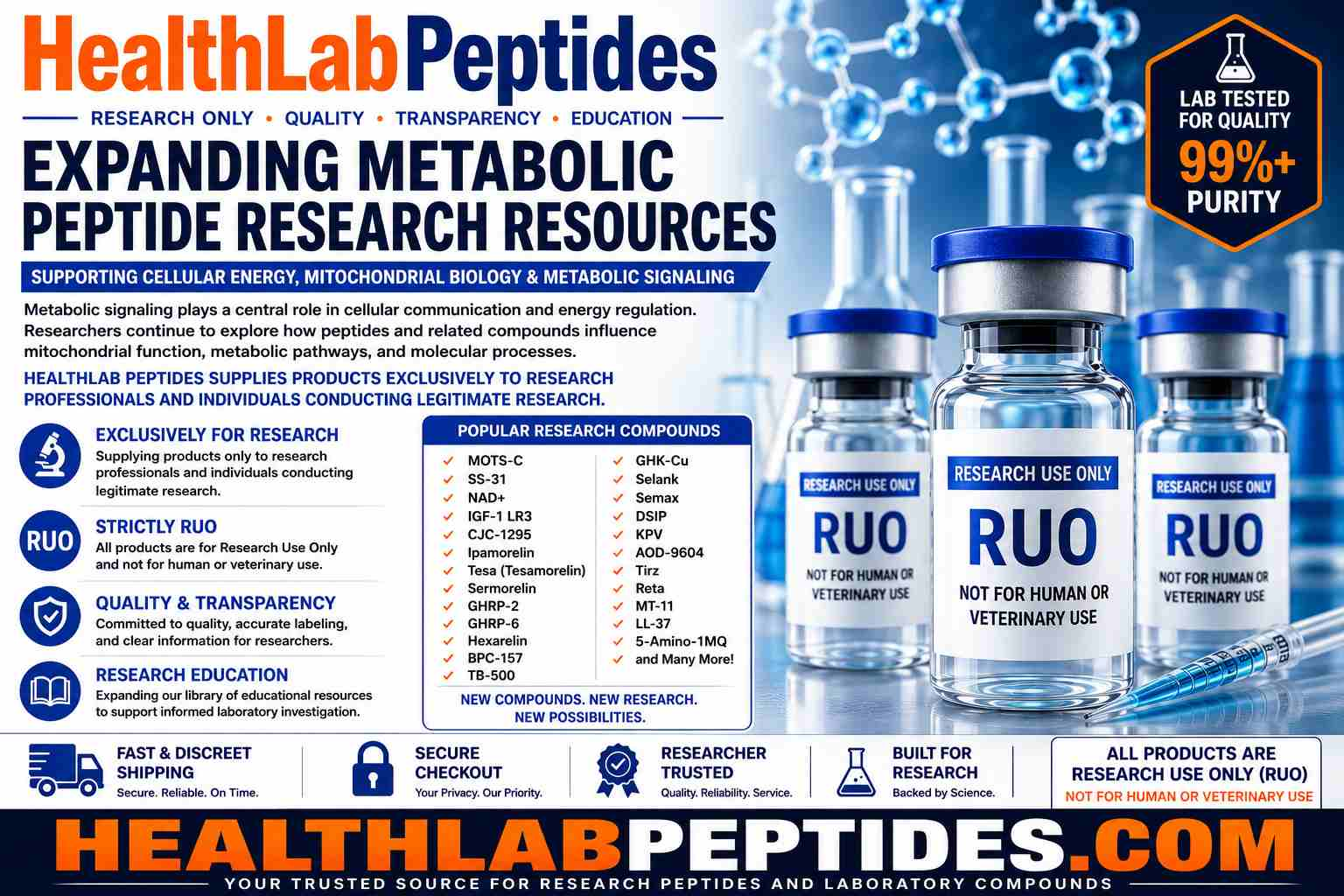
Research materials include MOTS-C, SS-31, NAD+, IGF-1 LR3, CJC-1295, Ipamorelin, Tesa, Sermorelin, BPC-157, TB-500, GHK-Cu, Selank, Semax, DSIP, KPV, AOD-9604, Tirz, Reta, and additional compounds.
These materials are not presented as having identical biological functions.
Instead, their inclusion demonstrates the range of experimental subjects currently investigated across peptide science, cellular biology, metabolic research, mitochondrial science, and molecular signaling.
As new research areas develop, HealthLab Peptides intends to continue adding educational resources that provide researchers with clearer scientific context.
Maintaining Strict Research-Only Standards
The growing visibility of peptide and metabolic research makes clear research-only positioning especially important.
HealthLab Peptides supplies products exclusively to research professionals and individuals conducting legitimate research.
All products are designated strictly for RUO and are not intended for human consumption, self-administration, veterinary use, medical treatment, or therapeutic purposes.
Educational content published through HealthLabPeptides.com discusses laboratory research, experimental mechanisms, scientific literature, and areas of biological investigation.
It does not constitute medical advice and should not be interpreted as instructions or recommendations for personal use.
Continued Expansion of Metabolic Research Resources
HealthLab Peptides expects metabolic and mitochondrial biology to remain important areas within its growing research library.
Future educational resources can examine mitochondrial-derived peptides, cellular-energy systems, metabolic signaling, molecular communication, and the relationships between these subjects and other areas of peptide research.
The company will also continue expanding educational coverage of individual research compounds while improving connections between related scientific categories.
Major company announcements, research-library developments, and catalog updates will continue to appear through the HealthLab Peptides News & Press Releases section.
About HealthLab Peptides
HealthLab Peptides is an online supplier specializing in research peptides and related laboratory compounds. The company maintains an expanding research-only catalog alongside educational resources covering peptide science, metabolic signaling, mitochondrial biology, cellular research, growth-factor pathways, and molecular mechanisms.
HealthLab Peptides supplies its products exclusively to research professionals and individuals conducting legitimate research. All products are strictly RUO and are not for human or veterinary use. Products and educational information are not intended to diagnose, treat, cure, or prevent any disease. HealthLab Peptides makes no medical or therapeutic claims, and its educational content does not constitute medical advice.