
Research suggests that cellular signaling remains one of the most important areas of modern peptide research as scientists investigate how molecular messengers interact with receptors, enzymes, growth factors, and intracellular pathways. As laboratory interest continues to expand, HealthLab Peptides is developing a broader research-only catalog and educational library designed to support researchers studying these complex biological systems.
HealthLab Peptides supplies its products exclusively to research professionals and individuals conducting legitimate research. All products are sold strictly for RUO and are not for human or veterinary use.
Cellular Signaling Connects Many Areas of Peptide Research
Cells constantly receive and transmit biochemical information. These signaling systems allow researchers to investigate how cells respond to changes in their environment and communicate with surrounding tissues.
Peptides are particularly interesting in this field because many naturally occurring peptides participate in signaling pathways.
Laboratory researchers may investigate receptor interactions, intracellular signaling cascades, growth-factor pathways, metabolic signaling, mitochondrial communication, or cellular responses to experimental conditions.
Rather than existing as completely separate research categories, these subjects frequently overlap.
HealthLab Peptides is therefore continuing to organize its growing scientific library around both individual compounds and the larger biological systems researchers investigate.
Researchers can explore the broader HealthLab Peptides research catalog to see compounds representing numerous areas of laboratory investigation.
Expanding Research Into Growth-Factor Signaling
Growth-factor signaling represents one major branch of cellular research.
Researchers investigate how signaling molecules interact with receptors and influence downstream molecular pathways under controlled experimental conditions.
IGF-1 LR3, for example, has become a recognizable laboratory research compound in studies involving IGF-related signaling and growth-factor biology.
HealthLab Peptides has developed additional educational material covering IGF-1 LR3 research and the scientific questions surrounding this area of investigation.
Growth-factor research may also intersect with laboratory investigations involving compounds such as CJC-1295, Ipamorelin, Tesa, Sermorelin, and other research materials associated with signaling pathways.
The objective is not to treat these compounds as interchangeable. Instead, organizing them within broader research categories helps researchers understand where different experimental subjects fit within the larger scientific landscape.
Cellular Signaling and Mitochondrial Research
Cellular signaling also extends into mitochondrial biology.
Modern laboratory research increasingly examines mitochondria as dynamic components of cellular communication rather than simply structures involved in energy production.
This has contributed to scientific interest in compounds such as MOTS-C and SS-31, along with NAD+ and other molecules studied in cellular-energy research.
Researchers investigating these areas can explore HealthLab Peptides’ expanding collection of research peptides and laboratory compounds.
The connection between mitochondrial function and cellular signaling demonstrates why organizing research information around biological systems can be more useful than examining each compound entirely in isolation.
BPC-157, TB-500, GHK-Cu and Experimental Signaling Research
Other laboratory compounds are investigated within different areas of cellular and molecular biology.
BPC-157, TB-500, and GHK-Cu have each generated research interest for different experimental reasons.
HealthLab Peptides maintains research materials covering BPC-157, TB-500, and additional compounds that laboratories may investigate when examining cellular signaling and related biological mechanisms.
Combination research formulations such as KLOW 80 further demonstrate how experimental interest can extend across several signaling subjects.
These compounds should not be interpreted as having identical mechanisms. Their inclusion within a larger cellular-signaling research library reflects the broad range of molecular pathways currently being investigated.
Peptide Research Is Becoming More Specialized
The expanding number of research compounds illustrates a larger development within peptide science: specialization.
Laboratory research now extends across mitochondrial peptides, growth-factor biology, cellular signaling, metabolic pathways, neuropeptide research, molecular communication, and numerous related fields.
Researchers may therefore approach peptide science from very different experimental perspectives.
Some investigate receptor interactions. Others examine mitochondrial processes, molecular signaling, biochemical pathways, or cellular responses under controlled conditions.
HealthLab Peptides is continuing to expand its research categories so researchers can more easily navigate these different areas of investigation.
Connecting Products With Educational Research
An extensive research catalog becomes more useful when researchers can also access information explaining the scientific context surrounding individual compounds.
For this reason, HealthLab Peptides continues to develop educational material alongside its research-only product catalog.
Researchers new to the field can begin with What Are Peptides? A Simple Research Overview.
Those interested in the broader development of peptide science can also explore Peptide Drug Discovery: A Summary of the Scientific Efforts and Achievements That Changed Modern Medicine.
These resources help connect individual research compounds with larger scientific subjects rather than presenting products without scientific context.
A Growing Research-Only Catalog
HealthLab Peptides’ catalog now spans numerous areas of laboratory investigation.
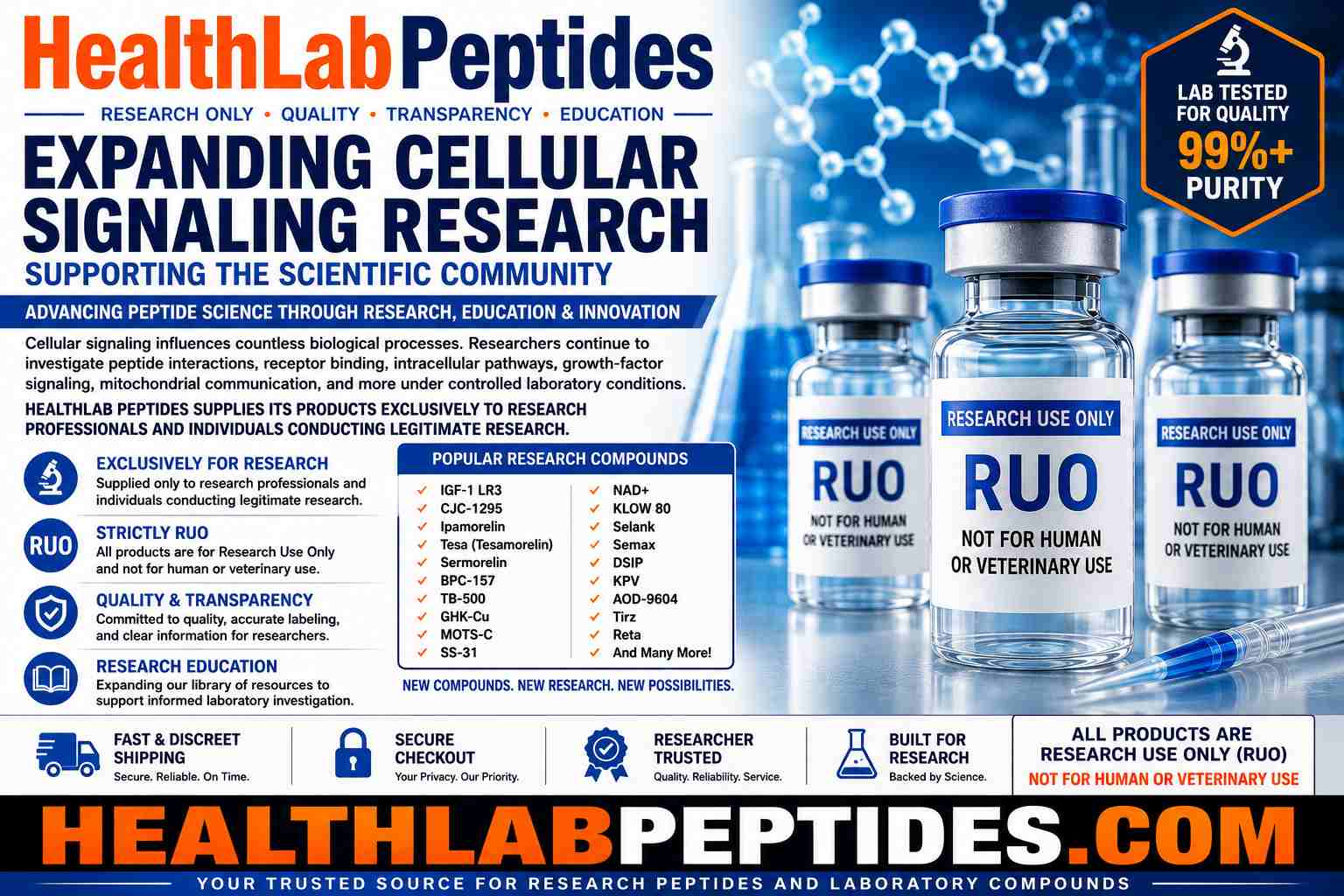
Research materials include BPC-157, TB-500, GHK-Cu, MOTS-C, SS-31, NAD+, IGF-1 LR3, CJC-1295, Ipamorelin, Tesa, Sermorelin, Selank, Semax, DSIP, KPV, AOD-9604, Tirz, Reta, and additional compounds.
As new areas of peptide science develop, the company expects its research catalog and educational resources to continue evolving.
The objective is to build a research-focused destination where qualified researchers can locate laboratory materials while also exploring educational information about the biological pathways and scientific questions associated with them.
Maintaining Clear Research-Only Standards
The growth of public interest in peptides makes clear product positioning increasingly important.
HealthLab Peptides supplies research compounds exclusively to research professionals and individuals conducting legitimate research.
Products are sold strictly for RUO and are not for human consumption, self-administration, veterinary use, or therapeutic use.
Information published through HealthLabPeptides.com discusses laboratory research, scientific literature, experimental mechanisms, and biological pathways for educational and research purposes.
It should not be interpreted as medical advice or a recommendation for human use.
Continuing to Build the HealthLab Peptides Research Library
HealthLab Peptides plans to continue expanding its educational coverage of cellular signaling and related areas of peptide science.
Future resources can explore receptor biology, mitochondrial communication, growth-factor signaling, metabolic pathways, neuropeptide research, and other developing areas of molecular science.
The company’s News & Press Releases section will continue providing updates about major research-library developments, catalog expansion, and company announcements.
As the scientific field develops, HealthLab Peptides intends to continue connecting its research-only catalog with an increasingly comprehensive educational resource for the research community.
About HealthLab Peptides
HealthLab Peptides is an online supplier specializing in research peptides and related laboratory compounds. The company maintains a growing research catalog alongside educational resources covering peptide science, cellular biology, mitochondrial research, molecular signaling, growth-factor research, and related areas of laboratory investigation.
HealthLab Peptides supplies products exclusively to research professionals and individuals conducting legitimate research. All products are strictly RUO and are not for human or veterinary use. Products and educational information are not intended to diagnose, treat, cure, or prevent any disease. HealthLab Peptides makes no medical or therapeutic claims, and its educational content does not constitute medical advice.