

Research suggests: GHK-Cu is studied not only for collagen-related measurements but also for its influence on enzymes and inhibitors involved in extracellular-matrix remodeling. A central experiment from 2000 examined matrix metalloproteinase-2 (MMP-2) in cultured dermal fibroblasts and reported that the copper-associated tripeptide changed both enzyme-related and inhibitor-associated measurements. Understanding that result requires more precision than saying a compound builds or repairs tissue. Matrix biology involves production, degradation, and reorganization, each measured differently. This review focuses on GHK-Cu, MMP-2, tissue inhibitors of metalloproteinases, fibroblast models, and the limitations of mechanistic conclusions. For molecular background, see GHK-Cu copper-binding chemistry and evidence limits. All discussion concerns laboratory research only.
The copper-associated GHK tripeptide
GHK refers to the amino-acid sequence glycyl-L-histidyl-L-lysine. GHK-Cu identifies an associated copper(II) complex, not a new protein assembled from hundreds of residues. Copper coordination is relevant because the metal can change chemical and biochemical interactions, and a test of copper-free GHK does not automatically answer the same question as a test of GHK-Cu. The precise form, experimental controls, and sample conditions must therefore be recorded. The distinction is especially important in experiments that compare a peptide complex with copper ions alone. Molecular identity is a necessary starting point; it does not establish any consumer or clinical effect.
Why extracellular matrix needs both synthesis and turnover
Extracellular matrix is a network of proteins and other molecules surrounding cells in tissues. Collagens, elastin, proteoglycans, and associated factors contribute different functions, but the network is dynamic. Fibroblasts can synthesize components, while proteolytic enzymes and regulatory proteins participate in turnover. Measuring increased collagen production does not establish that matrix organization improved. Similarly, finding more of a degradation-associated enzyme does not prove that intact tissue is being damaged. The direction and biological meaning of a marker depend on the model, other simultaneous signals, and whether the experiment directly measured enzymatic activity or only gene expression.
MMP-2 in matrix-associated research
MMP-2 is a matrix metalloproteinase studied for its ability to process certain extracellular-matrix proteins. It may be measured as messenger RNA, protein abundance, released enzyme, or active protease under a specific assay. Those endpoints are related but not interchangeable. Enzyme activity can be regulated after the protein has been produced, so a transcriptional change need not produce a proportional change in catalytic function. A scientific article should specify which observation is documented in the paper. Treating MMP-2 as a universal marker of either repair or harm oversimplifies its context-dependent biology.
A primary study of dermal fibroblast cultures
Siméon, Emonard, Hornebeck, and Maquart published an investigation in Life Sciences in 2000 (PMID 11045606; DOI 10.1016/S0024-3205(00)00803-1). They examined GHK-Cu in cultured dermal fibroblasts and measured MMP-2-associated responses. The investigators reported higher MMP-2 levels in conditioned culture medium and increased MMP-2 messenger RNA after exposure to the copper-associated complex. These are specific findings in fibroblast cultures, not a clinical demonstration of tissue improvement. They offer evidence for a laboratory signaling question and highlight how assay selection influences the interpretation.
The copper-ion control changes the conclusion
An especially informative aspect of the 2000 report is its comparison with individual components. The authors found that copper ions could reproduce the MMP-2-associated stimulation, whereas the GHK tripeptide alone did not reproduce that particular response. This means it would be inaccurate to credit the amino-acid sequence alone for the entire observed endpoint. The copper component and its chemical environment are experimentally relevant. However, a copper-ion result in one assay does not show that all GHK-Cu biology is reducible to free copper. Different endpoints and conditions may reveal different relationships, requiring direct comparison rather than speculation.
TIMP-1 and TIMP-2 belong in the same picture
The study also examined tissue inhibitors of metalloproteinases, including TIMP-1 and TIMP-2. Those proteins can regulate MMP-associated activity and help explain why enzyme abundance is not the same as net matrix degradation. The report described increased secretion of inhibitors in the same broad experimental system. This paired observation is an important reason not to reduce the paper to a single headline about MMP-2 being elevated. The tissue matrix is regulated through interacting production, inhibition, and degradation pathways. Laboratory summaries should keep those endpoints together while acknowledging that they do not reconstruct the full behavior of intact tissue.
What conditioned medium measures
Conditioned medium is the fluid collected from a cell culture after cells have spent time in it. Measuring a protein in that fluid can indicate secretion or release under the study conditions. Yet the amount in the medium may also be influenced by protein stability, binding, or degradation. It is not identical to directly imaging a three-dimensional matrix or measuring its strength. A fibroblast culture is informative because the system simplifies some variables, but the simplification also limits the conclusions. Results should be described as culture-associated molecular observations, not as validated tissue outcomes in people.
Gene transcription, protein release, and function
MMP-2 messenger RNA, released protein, and enzyme activity are three distinct stages in a biological process. Researchers may detect a transcriptional change without finding the same magnitude of protein change; protein can also exist in latent forms. Even an enzyme-activity assay does not by itself establish a whole-tissue phenotype. When comparing published GHK-Cu studies, the first question should be which stage was measured. The more clearly a report names its endpoint, the less likely it is to create a misleading impression that one marker proves a complete mechanistic chain.
Connection with earlier collagen studies
GHK-Cu research also includes an earlier fibroblast study by Maquart and colleagues (PMID 3169264), which investigated collagen synthesis in culture. That work and the later MMP-2 paper ask complementary but different questions. One deals with matrix-associated production measurements, while the other examines turnover-related regulators. Their findings cannot simply be added together into a claim that a peptide creates stronger tissue. A defensible synthesis explains why both formation and remodeling belong to extracellular-matrix biology, then identifies what neither study directly measured. The laboratory tissue-signaling overview
Interpreting a time-dependent matrix response
Cell signaling is dynamic. A measurement collected at one sampling interval may miss an earlier transcript change or a later regulatory response. The time at which conditioned medium is collected can affect observed protein abundance. Matrix biology also includes feedback between synthesis, proteolysis, and inhibitor release. Because of these factors, an experiment cannot be assumed to represent a universal permanent state. Scientific reports should state the selected time window, compare appropriate controls, and avoid claiming that an isolated response defines all future behavior in the tissue.
Why fibroblast culture findings cannot be marketed as healing
Dermal fibroblasts in culture are not equivalent to human skin, wound beds, or other intact tissues. A complex biological environment contains vasculature, immune cells, extracellular matrix structures, and multiple signaling gradients. An increase in MMP-2 or TIMP production under controlled conditions is a molecular finding. It does not prove faster healing, improved appearance, or reduced disease risk. Even when an original paper uses a clinical-sounding word to describe a hypothesis, the specific measurements and model remain the basis for a responsible conclusion. HealthLab research material is not offered for bodily administration.
Copper coordination and assay interference
Copper-containing reagents can influence both biological systems and some analytical methods. Investigators should distinguish actual changes in cellular output from potential interactions between the material and detection reagents. Appropriate controls for the metal-associated complex, the unbound peptide, and the relevant background conditions make mechanistic interpretation stronger. It may also be necessary to consider whether the test medium changes metal speciation. These are principles of scientific evidence assessment, not preparation instructions. Claims should be confined to the conditions examined in the cited studies.
What researchers should record when comparing studies
A useful comparison records the exact peptide form, cell origin, assay method, whether copper-free and copper-only controls were included, and whether the reported endpoint concerns messenger RNA, released protein, enzymatic activity, or matrix structure. Studies may use similar terminology while testing different components of the system. Results with distinct experimental methods should not be merged without qualification. This form of comparison is more scientifically informative than a simple list of purported peptide benefits. Negative and uncertain findings belong in the record alongside statistically supported observations.
The corresponding HealthLab research material
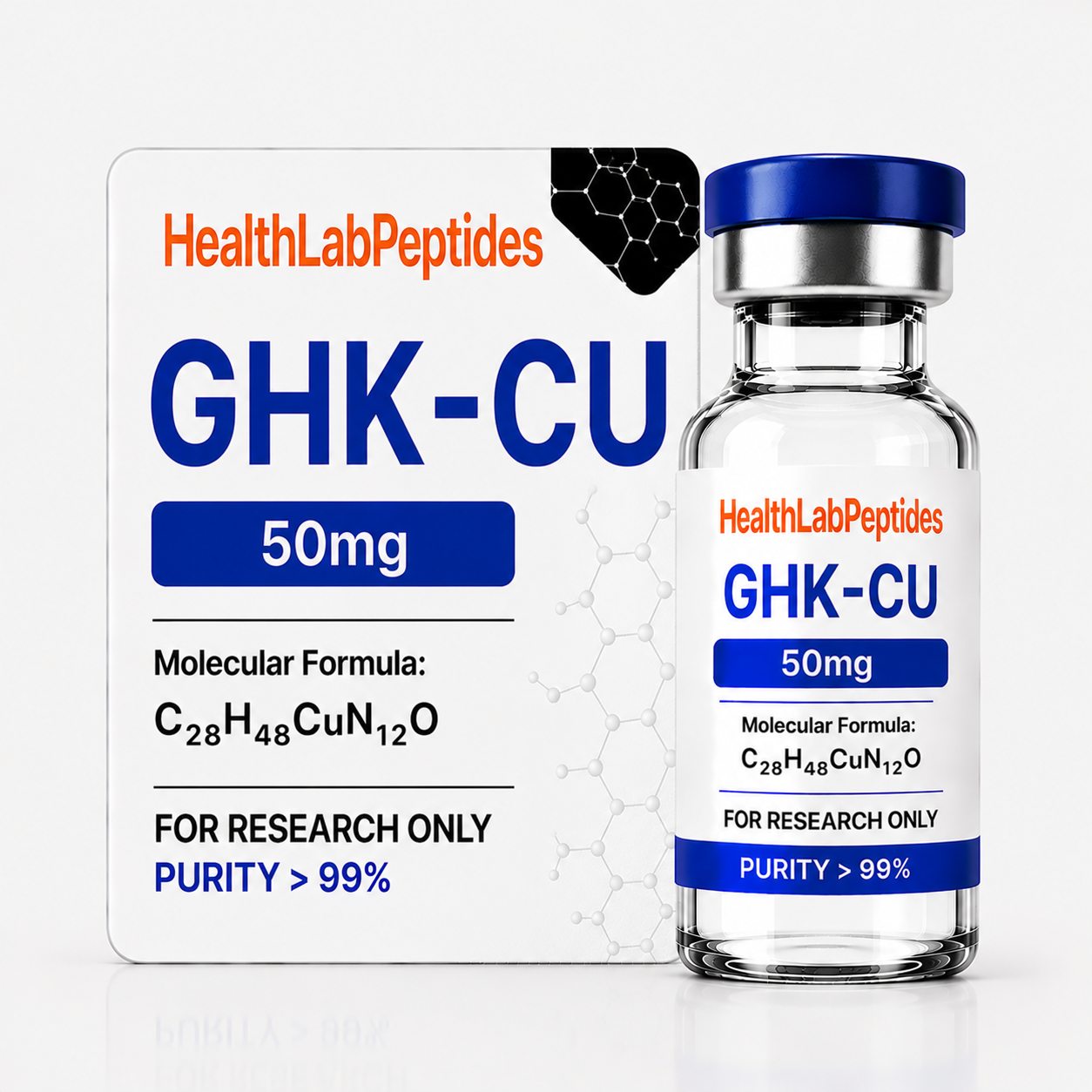
The GHK-Cu 50 mg laboratory research listing identifies the related catalog compound. The product name and labeled quantity help distinguish a specific material from the general scientific literature. They are not directions for use, and a research-material Certificate of Analysis does not establish clinical safety or regulatory approval. The scientific findings summarized here come from published studies and do not independently validate an untested commercial lot. Product identity and study evidence should remain separate.
Frequently asked research questions
Does MMP-2 expression mean more collagen has been degraded? Not necessarily; expression and enzymatic activity are different measures. Did the 2000 study examine inhibitor proteins? Yes, it also discussed TIMP-1 and TIMP-2. Was the copper-free GHK peptide equivalent to GHK-Cu in that assay? No; the investigators described different responses. Can a culture result be applied to people? No, direct clinical conclusions require separate evidence. Is a catalog vial an approved treatment? No.
Sources and limits of the evidence
Primary source: Siméon and colleagues, Life Sciences (2000), PMID 11045606, DOI 10.1016/S0024-3205(00)00803-1. Related historical fibroblast matrix-production research: Maquart and colleagues, FEBS Letters (1988), PMID 3169264. These studies provide useful mechanistic observations but differ in design and endpoints. The article does not claim that either study demonstrates human therapeutic, cosmetic, or veterinary use of HealthLab material.
Conclusion
GHK-Cu matrix research is more nuanced than a single claim about collagen. The published fibroblast work investigated MMP-2 alongside inhibitor proteins and used copper-containing and copper-free comparisons that materially affect interpretation. The most defensible finding is that selected laboratory measurements changed under defined experimental conditions. Understanding extracellular-matrix biology requires interpreting synthesis, proteolysis, and regulatory signals together without assuming clinical consequences. This article is intended to support that research understanding, not personal applications.
Research Use Only
Research Use Only / Not for human or veterinary use. This material and article are for lawful scientific, analytical, and in-vitro research. No dosing, administration, treatment, cosmetic-use, or other personal-use instructions are provided. The discussed research products are not represented as FDA-approved medicines.


