

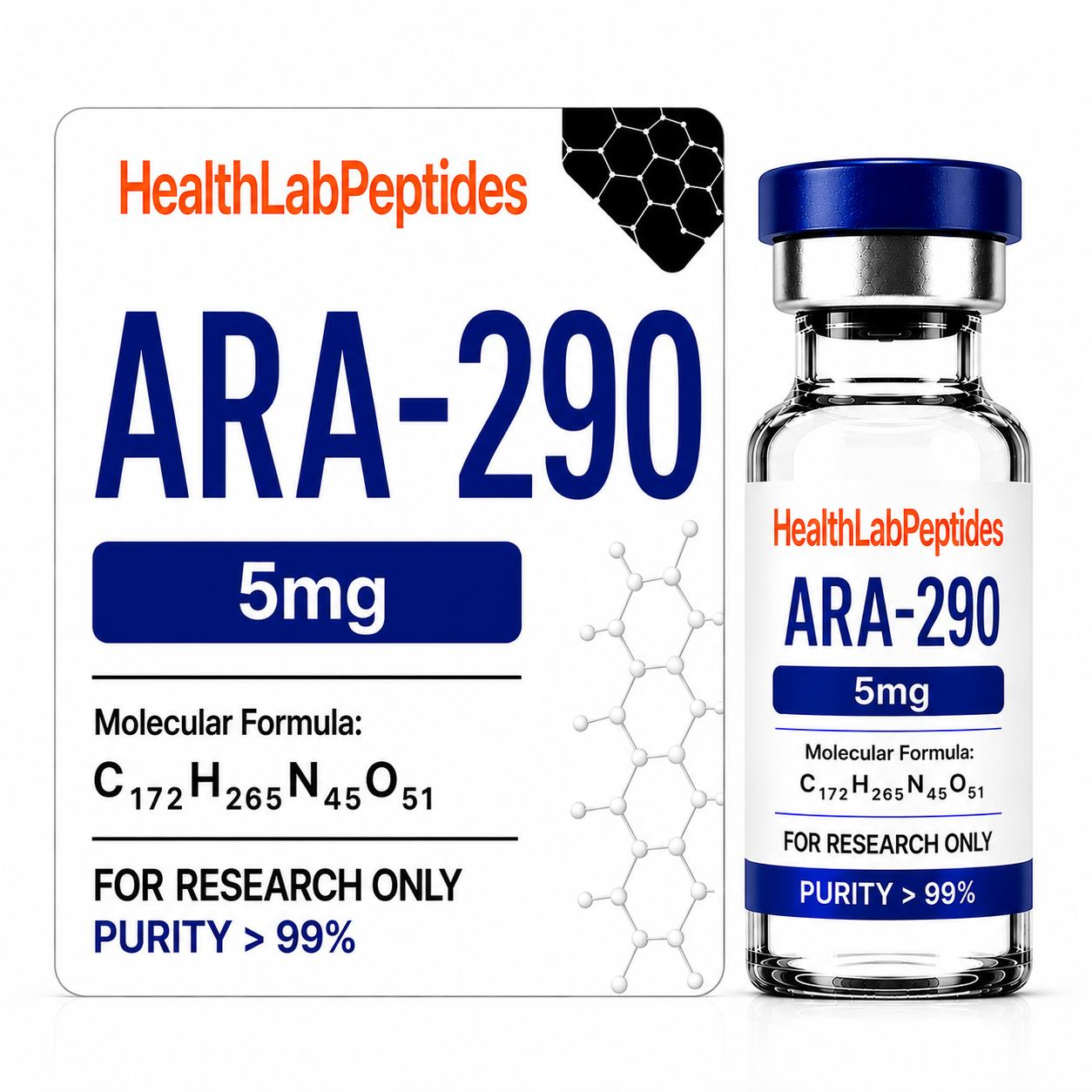
Research suggests: ARA-290, also known as cibinetide, is an EPO-inspired short peptide investigated in defined preclinical and regulated clinical research settings. This article critically examines ara-290 cibinetide research: lessons from a small phase 2 study with negative primary measures by distinguishing source evidence, model-dependent findings, and what the study did not establish. Begin with the corresponding HealthLab research overview for related chemical and biological context. All material is presented for lawful laboratory research education only.
A preliminary trial can have unconvincing outcomes
A small clinical study may record several biomarkers and patient-reported measures without reliably establishing a treatment effect. The distinction between the prespecified measures and exploratory outcomes is critical. A positive signal in a few individuals cannot overcome a negative group-level result through enthusiasm alone. An article about ARA-290 should present both the favorable and unfavorable observations, especially when primary clinical measures failed to show improvement. A commercial RUO vial cannot inherit a clinical indication merely because a molecule was investigated in patients.
The 2020 phase 2 investigation
A phase 2 study of the defined investigational cibinetide formulation in diabetic macular edema enrolled nine patients, of whom eight completed the reported study. The publication described several measured outcomes over a limited period, including visual function and retinal structure. The extremely small group limits confidence in both effectiveness and safety findings. The trial addresses a particular medical research question with oversight, not the use of independently marketed laboratory material. Details of eligibility, endpoints, and follow-up shape any valid interpretation.
The absence of improvement in several measures
The authors reported no improvement in group-level measures such as best-corrected visual acuity, central retinal thickness, central retinal sensitivity, and tear production over the reported study interval. These negative findings should appear prominently in a balanced research summary. It would be misleading to omit them and highlight only the positive direction of a questionnaire or selected individual responses. A rigorous interpretation recognizes that the main clinical measures did not demonstrate the hoped-for change in this small sample.
Exploratory signals are not a substitute for primary results
The publication also discussed improvements in some secondary or exploratory measures, including a vision-related questionnaire score and observations in individual participants. Such findings may help formulate hypotheses for future trials, but they cannot be treated as established clinical efficacy. Multiple outcomes in a tiny study create a risk of selecting favorable numbers by chance. A responsible article distinguishes hypothesis-generating observations from results that support a strong causal conclusion.
A useful comparison appears in the linked HealthLab scientific analysis, which explores another aspect of the experimental literature. Findings from different preparations, cohorts, assays, or source publications must not be combined without qualification. A shared keyword does not establish equivalent methods, and differing outcomes may reflect separate scientific questions rather than a true contradiction. The original studies should be checked before a conclusion is repeated.
What a safety statement can and cannot mean
The small trial reported no serious adverse events or detected antidrug antibodies under its observation conditions. That is a result, but the limited number of participants and follow-up mean uncommon or delayed risks could easily go undetected. The statement should not be restated as proof that the molecule is universally safe. The evidence supports what was observed in a specific regulated formulation and population, not a broad guarantee for commercial research vials.
EPO-derived peptide does not equal erythropoietin
ARA-290 was designed around a structural region of erythropoietin, but it is not identical to the larger glycoprotein hormone. Its receptor hypotheses and development program are distinct. The clinical study does not resolve every molecular question about CD131-associated signaling or demonstrate equivalence with other EPO-related compounds. Chemical ancestry alone cannot supply a mechanism or regulatory approval. The named research peptide must be evaluated through the direct studies that used it.
Why negative results make the scientific record stronger
Publishing null or disappointing outcomes helps prevent selective reporting. It also allows investigators to refine the population, assay, or mechanistic hypothesis for future experiments. A credible HealthLab article should not act as advertising for a research molecule; it should preserve what the paper actually reported. The 2020 investigation is a useful example of why careful study interpretation includes negative primary measures as well as uncertain exploratory findings.
Research methodology and evidence quality
Important references include Phase 2 cibinetide study (2020), PMID 32674280; Brines et al., Molecular Medicine (2015), PMID 25387363. The reader should examine the material used, comparison group, methodology, statistical treatment, and limits of the observation. A molecular signal is narrower than an organism-level outcome, and a clinical trial on a regulated formulation is different from chemical characterization of an RUO reagent. An isolated favorable result should be reported alongside any negative or uncertain findings. Reproducibility, independent evidence, and transparent controls determine the strength of the inference.
Why the experimental endpoint must be named
Scientific reports can measure transcript abundance, protein modification, receptor behavior, chemical identity, imaging results, or clinical endpoints. These measurements answer different questions, and one cannot substitute for another. Descriptions should state whether a result was directly observed or interpreted through a proposed mechanism. The subject’s commercial relevance is not evidence of biological efficacy. Where a direct causal chain is incomplete, the article should explain the uncertainty rather than imply that the most attractive interpretation is proven.
Related HealthLab research product and keywords
The ARA-290 5 mg research material listing corresponds to the laboratory compound discussed here. It identifies a catalog item and label quantity only, not a use regimen. Batch documentation such as a Certificate of Analysis can substantiate specified analytic characteristics to the extent tested, but cannot transfer clinical evidence from another preparation or establish FDA approval. Product keywords appear naturally to help readers locate the relevant molecular research while preserving the separation between scientific reporting and consumer-use claims.
What remains unestablished
The cited work does not demonstrate that any separately marketed HealthLab vial is safe for personal use or produces a predictable health, performance, cosmetic, or treatment effect. Cell and animal findings are model specific, and even regulated human studies are population- and product-specific. Scientific articles can responsibly discuss an investigational program while reporting adverse events and null results. A useful review identifies what further replication, characterization, or controlled investigation would be needed rather than asserting that outstanding questions have already been answered.
Reader questions and references
The key questions are whether the original study used the exact material being discussed, what model generated the evidence, what controls were included, and whether the outcome matched the article’s claim. Sources: Phase 2 cibinetide study (2020), PMID 32674280; Brines et al., Molecular Medicine (2015), PMID 25387363. The conclusion should remain proportional to that evidence. This research-only resource reports what investigators observed and where the limits lie, without providing administration instructions or making promises for the independent catalog product.
Research Use Only
Research Use Only / Not for human or veterinary use. No dosing, reconstitution, injection, treatment, administration, or other consumer-use instructions are included. HealthLab products are not represented as FDA-approved medicines.


