

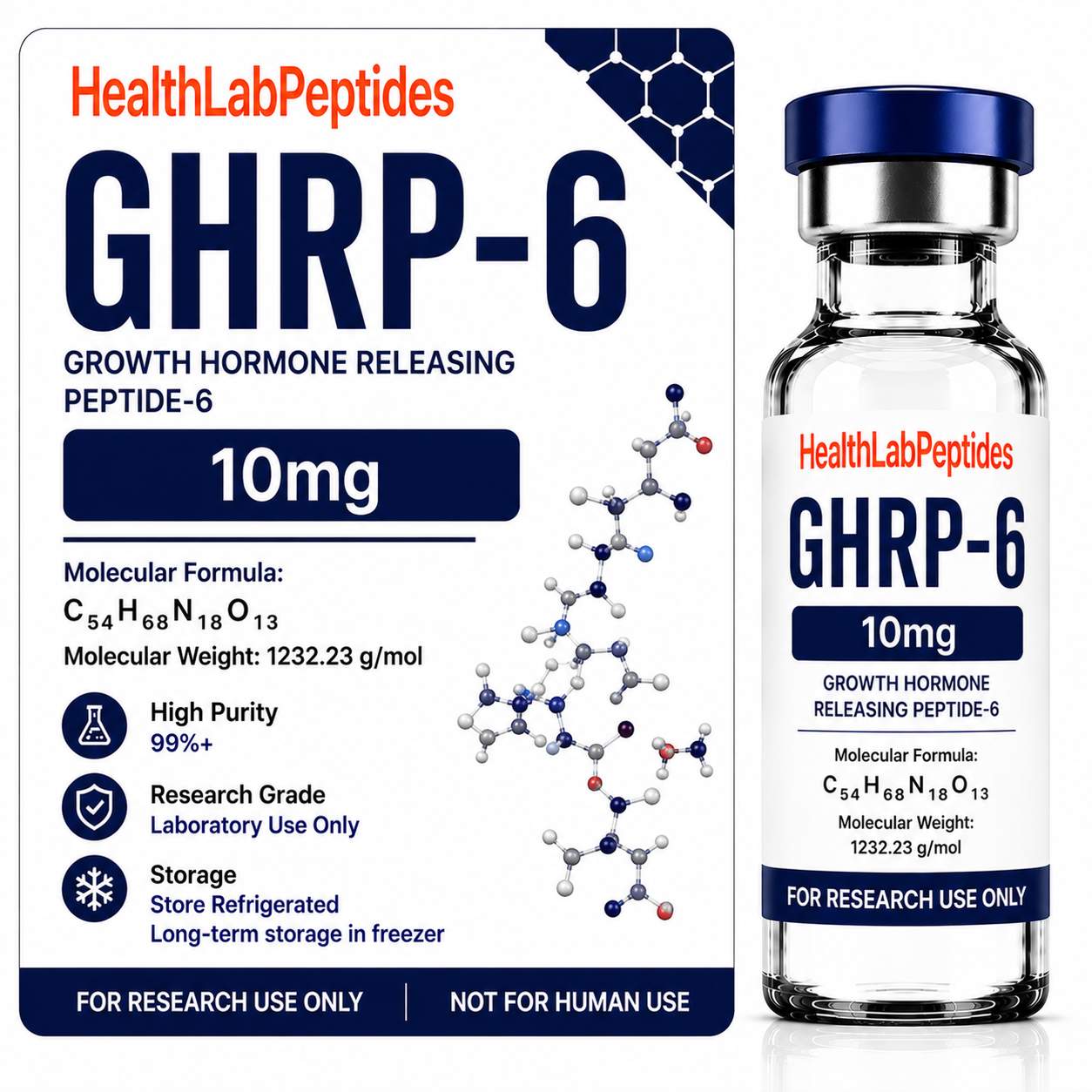
Research suggests: GHRP-6 is a synthetic hexapeptide studied at secretagogue-associated receptors, whereas ghrelin is an endogenous acylated peptide. Understanding ghrp-6 and ghrelin research: why a modified serine changes receptor biology requires separating the molecule, the model, and the endpoint. This article reviews the cited experiments and places their findings in the context of legitimate scientific investigation, including null results and uncertainty. For background, see the existing HealthLab research analysis. All information is provided for laboratory education and not human or veterinary use.
The receptor was investigated before its endogenous ligand was known
Synthetic growth hormone-releasing peptides provided experimental tools for identifying a receptor system distinct from the growth hormone-releasing hormone receptor. GHRP-6 belongs to this synthetic secretagogue class. The receptor historically called GHS-R was cloned before scientists identified ghrelin as a natural ligand. That sequence of discoveries matters because a synthetic receptor ligand and the endogenous hormone need not share chemical architecture. A receptor can recognize structurally different molecules, so a common downstream endocrine marker does not mean the molecules are identical.
The 1999 ghrelin discovery
Kojima and colleagues reported the isolation of ghrelin from rat stomach in Nature in 1999. They described a 28-residue peptide with an unusual fatty-acid modification on its third residue and investigated GHS-R-associated activity. The paper helped connect the previously identified synthetic-secretagogue receptor with an endogenous ligand. This is a biological discovery in a specific experimental setting, not a validation of a commercially supplied GHRP-6 vial. It also established an important chemical distinction: the natural ligand’s acylation plays a role in its activity.
Why serine-3 acylation matters
The original ghrelin work described an n-octanoyl modification of serine at position three. The researchers found that this modification mattered for the receptor-associated biological effects they measured. Ordinary amino-acid sequence alone was therefore insufficient to describe the active molecular species. An acylated and nonacylated form of the same peptide backbone can differ substantially. GHRP-6 does not reproduce ghrelin’s full sequence or modification pattern, and the ability of both to interact with the same receptor system does not make them pharmacologically identical.
GHRP-6 is a distinct synthetic ligand
A synthetic hexapeptide contains six residues and has a different structural arrangement from the longer endogenous ghrelin hormone. Its history as a receptor research tool predates the natural ligand’s identification. Comparing their experiments requires evaluating the same receptor, assay, concentration-response endpoints, and cellular background. A result concerning endogenous ghrelin release cannot automatically be assigned to GHRP-6. Structural differences also matter to processing and possible binding behavior.
A complementary HealthLab scientific comparison addresses a different dimension of the material. Comparing these sources can clarify whether a conclusion was established through molecular identification, binding, cell signaling, tissue measurements, or experimental physiology. Similar terminology is not enough to transfer a numerical result across distinct assays. Controls and model differences should be examined before treating findings as consistent or contradictory.
GHS-R1a versus GHRH receptor
The secretagogue receptor GHS-R1a and the GHRH receptor are different G-protein-coupled receptors. Some endocrine studies measure similar hormone-associated outcomes following activation of either system, but the upstream mechanisms differ. The 1998 ipamorelin comparison also included GHRP-6 and GHRP-2 as reference ligands. Such comparative evidence should be reported by receptor class and measured hormone rather than grouped under the phrase growth hormone peptide. Search keywords are not a substitute for receptor identity.
Receptor binding and pituitary responses
A receptor assay can reveal ligand interaction or downstream second-messenger signaling. A pituitary preparation adds another layer of biology, while an intact animal includes feedback loops. The presence of a synthetic secretagogue response in one system does not prove how the ligand behaves in every other preparation. A careful reader checks whether a publication investigated receptor affinity, G-protein coupling, hormone secretion, or animal physiology. Each level supports a different kind of conclusion.
No exercise or clinical inferences from receptor discovery
GHRP-6 is often associated online with muscle-building or athletic discussions, but those claims are outside the legitimate conclusions of the 1999 ghrelin discovery paper. The paper established a molecular relationship between ghrelin and its receptor, not medical approval of synthetic research vials. HealthLab’s product link is included only to identify the compound for laboratory study. It does not imply any personal use, outcome, or safe method of administration.
Evidence strength and study limitations
The main research source is Kojima et al., Nature (1999), PMID 10604470, DOI 10.1038/45230; Raun et al., European Journal of Endocrinology (1998), PMID 9849822. A mechanistic conclusion should be connected to its original preparations, comparison groups, sampling times, and analytic method. A measured difference is not always evidence of a direct causal molecular target; converging experiments and appropriate negative controls improve confidence. Any response detected in one laboratory model may differ in another model or species. A scientifically rigorous article reports those limitations alongside the positive results, rather than treating a promising abstract as a complete evidence base.
How a careful reader evaluates the methods
A useful review starts by checking the exact chemical form and naming convention. It then identifies which receptor, protein, metabolite, transcript, or assay signal was measured. A binding constant is not a clinical endpoint; a reporter gene is not the same as protein function; and a selected endocrine marker does not establish all endocrine effects. When the source reports multiple outcomes, each deserves its own explanation. Independent replication, well-described controls, and clear statistical uncertainty are more useful than a simplified claim of potency.
Research product keywords and catalog identification
HealthLab lists GHRP-6 10 mg laboratory research material. The product keyword and labeled quantity identify an item in a research catalog; they do not describe an experimental or consumer regimen. A Certificate of Analysis documents only the measurements recorded for a particular batch. It does not establish suitability for administration, FDA approval, or equivalence to a medicinal formulation mentioned in the literature. Scientific findings from a publication apply to its specific material and experimental system, not automatically to another supplier’s lot.
What can and cannot be concluded
The strongest defensible statement is the specific observation from the study’s model. A molecular interaction can inform a pathway hypothesis while leaving questions about target specificity, assay interference, and organism-level biology unresolved. Even if an author discusses possible medical relevance, that is not proof of an approved clinical use. A research-only supplier should avoid transforming measured markers into promises concerning health, mood, cognition, performance, muscle, body composition, or treatment. Negative evidence and scientific uncertainty remain part of the story.
Questions and source references
Readers can ask: was the exact molecule characterized; was the evidence generated in cells, animals, people, or a chemical system; what controls support the finding; and could another mechanism explain the response? Primary references: Kojima et al., Nature (1999), PMID 10604470, DOI 10.1038/45230; Raun et al., European Journal of Endocrinology (1998), PMID 9849822. Those details help readers verify the original result and identify where additional research is needed. The article’s purpose is to make the underlying study interpretable and to avoid inferring a human or veterinary outcome from a laboratory observation.
Research Use Only
Research Use Only / Not for human or veterinary use. The content provides no dosing, administration, injection, reconstitution, treatment, or other personal-use advice. HealthLab research material is not represented as an FDA-approved medicine.


