

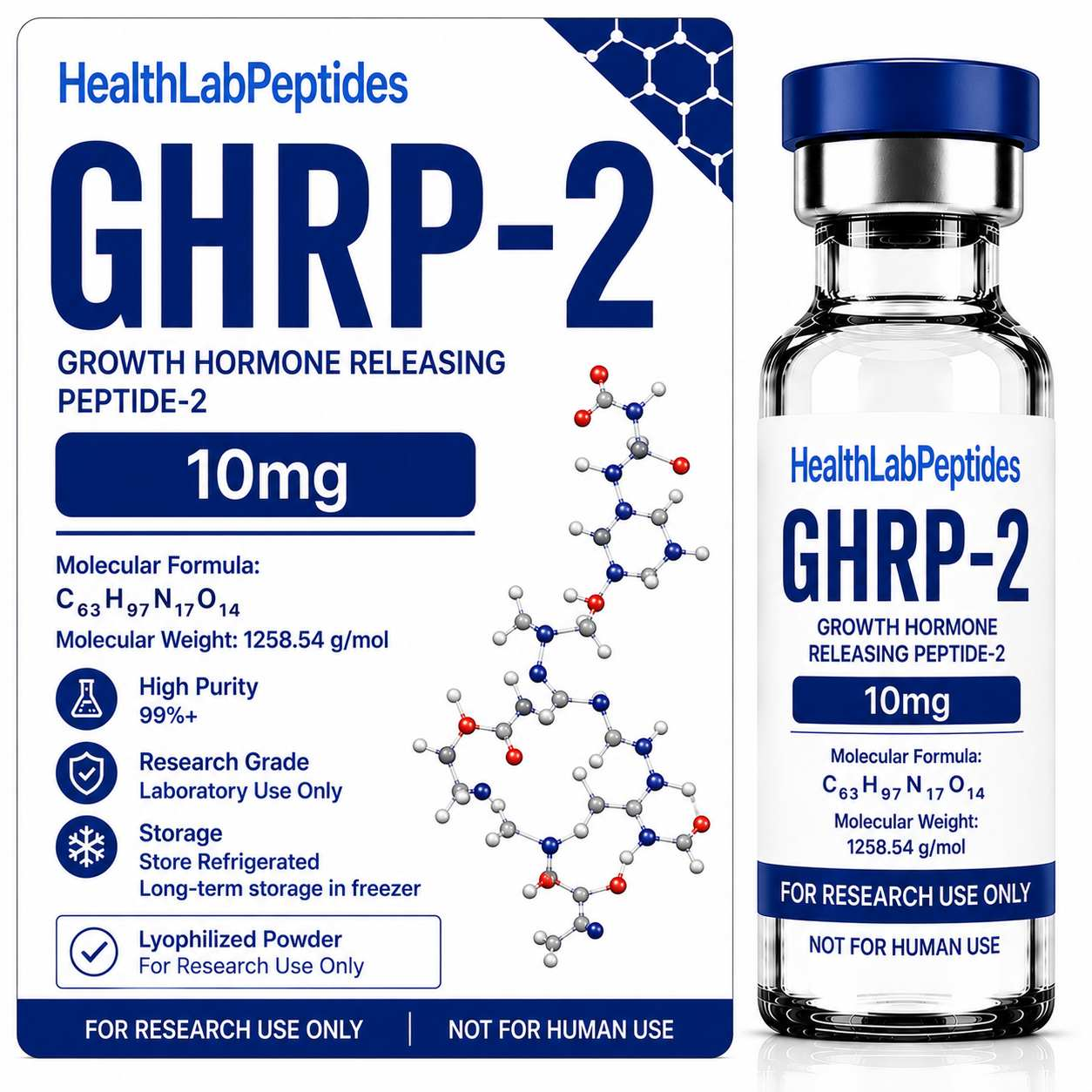
Research suggests that growth hormone-releasing peptide-2 (GHRP-2) and hexarelin are useful comparative ligands in research on the growth hormone secretagogue receptor family, but their published data should not be reduced to a ranking of which peptide is “stronger.” A historical study by Arvat and colleagues compared selected hormone-associated measurements in small groups of volunteers, while later structure–activity research examined how synthetic secretagogue sequences interact with receptor-related assays. These publications answer different questions and have different limitations. This article focuses on peptide sequence, receptor-class terminology, model-specific evidence, and the distinction between laboratory pharmacology and unsupported consumer claims. For broader context, see the GHRP-6 pituitary cell-signaling research guide.
What is GHRP-2?
GHRP-2 is a synthetic growth hormone-releasing peptide commonly described as a six-residue compound containing nonstandard amino-acid features. It belongs to a class of experimental growth hormone secretagogues, which are distinct from the hypothalamic peptide growth hormone-releasing hormone. Because the molecules differ in sequence and receptor interactions, studies of GHRH do not automatically apply to GHRP-2. Exact nomenclature matters when reviewing scientific papers and catalog materials. A short peptide name should be accompanied by a verified molecular identity and appropriate analytical records, rather than treated as a general indication of biological effect.
What is hexarelin?
Hexarelin is another synthetic hexapeptide investigated in secretagogue-related pharmacology. Its sequence is related to, but different from, GHRP-2 and GHRP-6. Differences in amino-acid identity and stereochemistry can influence binding-associated measurements and responses in defined biological systems. Two compounds with the same residue count need not have the same experimental profile. A scientifically useful comparison explains the structural distinction and reports the exact endpoints evaluated. It should not imply that a similar number of amino acids makes one material interchangeable with another.
GHS-R1a versus GHRH receptor
GHS-R1a, also called the growth hormone secretagogue receptor, is related to ghrelin signaling. GHRH receptor signaling is a different molecular pathway. Papers may compare ligands from the two systems because both can be associated with endocrine outcomes in defined models. However, a similar downstream hormone measurement does not demonstrate identical receptor binding or intracellular mechanisms. The hexarelin GHS-R1a research article
A 1997 comparative pharmacology paper
Arvat and colleagues published “Effects of GHRP-2 and hexarelin, two synthetic GH-releasing peptides” in Peptides in 1997, PMID 9285939, DOI 10.1016/S0196-9781(97)00016-8. The paper compared defined hormonal endpoints in small groups of younger and older volunteers under a controlled research setting. Its purpose was comparative pharmacology, not commercial product approval. The study’s sample sizes and measured endpoints substantially limit what can be generalized. It cannot establish safety or effectiveness of independent research vials or justify any personal-use instructions.
Why the measured hormones should be reported separately
The 1997 study evaluated growth hormone alongside prolactin, ACTH, and cortisol under different experimental comparisons. Those markers have different physiological roles. A finding that two ligands produce similar responses in one measured hormone does not establish that every other downstream pathway is identical. The study also found that the peptides were not fully specific for only one hormone-related response. That illustrates why the word selective must be defined according to the measurements actually performed. It would be misleading to describe GHRP-2 or hexarelin as producing only one endocrine signal in all contexts.
Age-group differences are model findings, not consumer guidance
Comparative endocrine studies sometimes include more than one age group to examine whether measured hormonal responses differ under controlled conditions. The 1997 paper evaluated younger and older participant groups, but its small design does not establish what an unrelated individual should expect from any research material. Age-related physiology is complex, and a brief hormone measurement is not equivalent to an outcome about well-being, performance, or treatment. Scientific articles should report the groups and endpoints accurately without turning them into age-related use claims or marketing promises.
Comparing GHRP-2 with GHRP-6
GHRP-2 and GHRP-6 belong to a related synthetic secretagogue research class, but they have distinct sequences. The compound name GHRP should not be treated as sufficient evidence of identical receptor affinity, metabolite behavior, or hormone-associated responses. A meaningful study comparison requires information about the exact ligand and experimental system. Differences can arise from the receptor assay, cell type, species, or analytical conditions. The important educational point is that structural similarity helps formulate a question for research but does not answer that question by itself.
Structure–activity research from 2016
A 2016 paper indexed under PMID 26811125 investigated structure–activity relationships for several peptidic growth hormone secretagogues, including GHRP-2, GHRP-6, hexarelin, and ipamorelin. The authors examined receptor-binding-associated activity and the influence of structural modifications. Their work illustrates how even a small sequence change can alter a molecular assay response. A receptor assay cannot establish every endocrine or organism-level consequence, and the behavior of metabolites may differ from that of an intact parent compound. These findings are useful for chemical and analytical research, not for constructing consumer treatment or performance plans.
What a radioreceptor assay measures
A radioreceptor assay can detect interaction with a receptor preparation by using a measured binding-related signal. It may be useful for comparing compounds or detecting receptor-active molecular species in analytical research. But receptor affinity, downstream signaling, and a physiological endocrine result are distinct outcomes. A positive binding result does not tell a researcher everything about how long a ligand persists, which tissues it affects, or whether it produces any desirable whole-organism change. Assay-specific controls and identification of the measured material remain essential.
Why metabolites complicate interpretation
Experimental peptides may be processed into shorter fragments or other products in a biological system. Such metabolites can have different analytical signatures and sometimes different receptor-associated behavior. The 2016 structure–activity literature considered the relationship between molecular changes and detectable receptor binding. A finding about a metabolite should not be assigned to the intact parent peptide without supporting evidence. Likewise, product descriptions should not assume that an outcome observed with a defined research preparation applies to every other chemical form. Understanding chemical identity is a prerequisite for reliable interpretation.
Receptor binding and pituitary-cell assays are not equivalent
A receptor-binding experiment is designed to evaluate interaction with a molecular target. A pituitary-cell model can measure a downstream biological response within a cellular environment containing additional signaling machinery. An intact organism includes further feedback loops and tissue-level processes. These methods can provide complementary information but do not support identical conclusions. A scientific comparison must describe which of these levels generated each reported observation. It should not collect positive findings from different models and combine them into an unsupported claim about general effectiveness or performance.
GHRP-2 compared with ipamorelin
Ipamorelin appears alongside GHRP-2 and hexarelin in certain comparative secretagogue publications. The compounds are structurally and pharmacologically distinct. The ipamorelin GHS-R1a research overview
Why endocrine changes do not establish a treatment
An altered hormone concentration measured over a defined interval is an experimental endpoint, not proof of medical usefulness. A clinical treatment claim would require a separate body of evidence concerning the precise formulation, studied indication, safety, and regulatory authorization. The existence of a peer-reviewed hormone-response study is not equivalent to FDA approval of a research product. It would also be scientifically incorrect to infer long-term organism-level effects from a brief biomarker measurement without additional studies. Keeping the claim at the level actually measured is central to responsible laboratory communication.
Design features of a meaningful comparison
Researchers comparing synthetic secretagogues should identify the relevant molecule, receptor assay, cellular system, controls, and statistical uncertainty. If the question concerns a time-dependent response, a single sampling point may not capture the whole pattern. Material identity should be verified rather than assumed from a supplier name, and observations across species require caution. Independent replication and transparent reporting of null or conflicting findings improve the evidence base. A review can be valuable even when the literature does not support a definite ranking of compounds or a consumer application.
Catalog identity for GHRP-2 and hexarelin
HealthLab provides a GHRP-2 10 mg laboratory research listing and a separate hexarelin research-material listing. These identify distinct catalog items rather than materials to combine or administer. Declared quantities are label specifications, not clinical or experimental protocols. A Certificate of Analysis may document selected batch properties within its test scope. It does not establish human or veterinary safety, clinical efficacy, or regulatory authorization. This page provides scientific context only.
Frequently asked questions
Are GHRP-2 and hexarelin the same peptide? No, they are separate synthetic compounds. Do they interact with the GHRH receptor? Their research class is primarily associated with the growth hormone secretagogue receptor system, which is distinct from GHRH receptor signaling. Does a similar hormone response mean identical pharmacology? No. Are receptor-binding and clinical studies interchangeable? No. Does a published human pharmacology study approve a catalog research vial? No. Is personal administration appropriate? No.
Selected research literature
Arvat and colleagues, Peptides (1997), PMID 9285939, DOI 10.1016/S0196-9781(97)00016-8; peptidic growth hormone secretagogue structure–activity research (2016), PMID 26811125. These studies address different aspects of the experimental pharmacology of GHRP-2 and related ligands. Their inclusion does not suggest that HealthLab research materials are intended for medical, veterinary, performance, or any other consumer application.
Conclusion: Similar class, different experimental evidence
GHRP-2 and hexarelin illustrate why structurally related peptide ligands require separate molecular identification and model-specific interpretation. The published literature includes comparative hormone-response measurements and structure–activity research, each with distinct limitations. Receptor interaction, cellular signaling, and whole-organism endocrine observations should not be presented as equivalent. Accurate naming, contextual internal links, and cautious scientific conclusions provide a stronger research resource than promotional comparisons based on informal claims.
For Research Use Only
For Research Use Only. Not for human consumption, medical, or veterinary use. No dosing, administration, injection, reconstitution, treatment, combination, or personal-use instructions are provided. These statements have not been evaluated by the FDA. This product is not intended to diagnose, treat, cure, or prevent any disease.


