
HealthLab Peptides Expands Growth-Factor and Peptide Signaling Research Resources
Research suggests that growth-factor and peptide signaling continue to represent important areas of laboratory investigation as researchers examine how molecular signals interact with receptors, cellular pathways, and biological communication systems. As these areas of peptide science develop, HealthLab Peptides is expanding its research-only catalog and educational library to provide research professionals with better access to both laboratory compounds and organized scientific information.
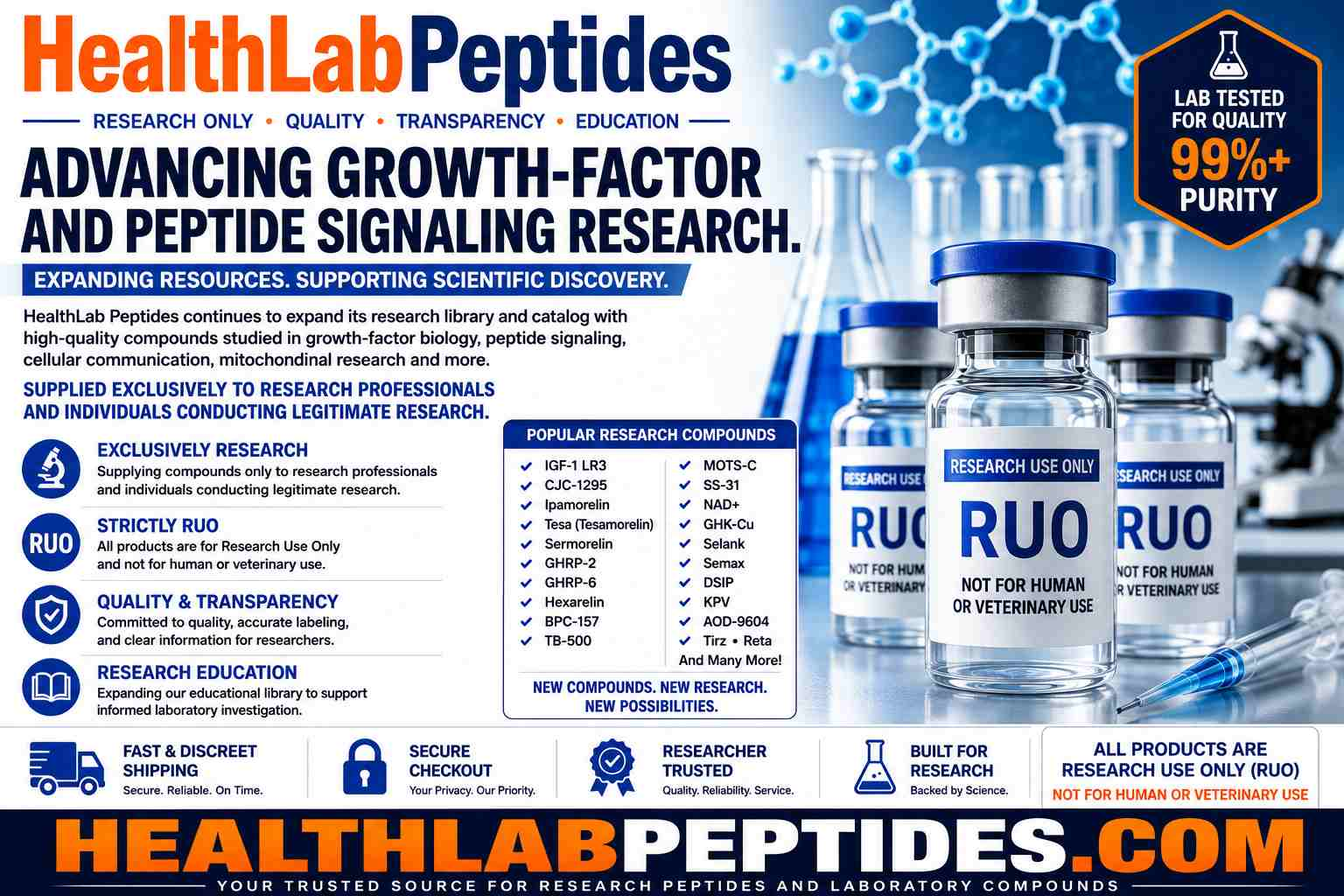
HealthLab Peptides supplies its products exclusively to research professionals and individuals conducting legitimate research. All products are sold strictly for RUO and are not for human or veterinary use.
Growth-Factor Signaling Remains an Active Area of Research
Growth factors are signaling molecules involved in complex biological communication systems. Laboratory researchers study these pathways to better understand receptor activity, intracellular signaling, molecular interactions, and the mechanisms through which cells respond to experimental conditions.
Peptide research frequently intersects with these investigations because certain research compounds are studied in relation to growth-factor pathways or associated signaling systems.
HealthLab Peptides continues organizing compounds and educational resources around these broader areas of scientific investigation.
Researchers can explore the wider selection through the HealthLab Peptides research catalog, which includes compounds associated with growth-factor research, peptide signaling, mitochondrial biology, cellular research, and other laboratory disciplines.
IGF-1 LR3 and Growth-Factor Research
IGF-1 LR3 is one compound frequently encountered in experimental discussions involving growth-factor biology.
Laboratory investigations involving IGF-related pathways may examine receptor interactions, signaling behavior, molecular mechanisms, and other controlled experimental variables.
HealthLab Peptides maintains IGF-1 LR3 research information for researchers interested in learning more about the scientific background surrounding this compound.
Researchers can also view the IGF-1 LR3 research product within the HealthLab Peptides catalog.
These resources are intended to connect individual research materials with broader information about the scientific pathways being investigated.
Peptide Signaling Extends Beyond a Single Research Pathway
Growth-factor research represents only one component of peptide signaling science.
Researchers also investigate compounds associated with endocrine signaling, receptor interactions, mitochondrial communication, cellular metabolism, neuroregulatory mechanisms, and other molecular systems.
CJC-1295, for example, is studied within a different signaling context than IGF-1 LR3. Researchers interested in this area can review the HealthLab Peptides CJC-1295 research guide.
Other research compounds associated with peptide-signaling investigations include Ipamorelin, Tesa, Sermorelin, GHRP-2, GHRP-6, Hexarelin, and additional laboratory materials.
Organizing these compounds around scientific pathways helps researchers distinguish between different areas of investigation rather than grouping all peptide research into a single category.
Building Connections Between Research Categories
One of the objectives of the expanding HealthLab Peptides educational library is to demonstrate how different areas of peptide science can intersect.
Growth-factor signaling may overlap with cellular biology. Cellular signaling can intersect with mitochondrial communication. Metabolic research can involve cellular-energy pathways, while neuroregulatory peptide research may examine entirely different receptor systems.
This interconnected structure is why HealthLab Peptides continues developing both individual compound resources and broader research categories.
A researcher studying one pathway can therefore move naturally toward related subjects without relying exclusively on individual product descriptions.
Researchers who are new to the field can begin with What Are Peptides? A Simple Research Overview before moving into more specialized areas of peptide science.
Research Into Cellular Communication Continues to Develop
Cellular communication involves networks of receptors, signaling molecules, enzymes, proteins, and intracellular processes.
Laboratory peptide research provides scientists with tools for investigating portions of these systems under controlled experimental conditions.
Different research compounds can therefore serve very different experimental purposes.
For example, BPC-157 and TB-500 are studied within different experimental contexts than IGF-1 LR3 or CJC-1295.
Mitochondrial research compounds such as MOTS-C and SS-31 represent still another area of investigation.
These differences reinforce the importance of presenting research compounds within their appropriate scientific context.
Expanding Educational Resources Alongside the Catalog
HealthLab Peptides is continuing to expand its educational library alongside its research-only product selection.
The objective is to create more than a conventional product catalog.
Researchers should be able to investigate a compound, learn about the broader research category surrounding it, discover related experimental subjects, and continue exploring relevant scientific information throughout the website.
HealthLab Peptides has already developed resources covering peptide mechanisms, mitochondrial research, growth-factor biology, cellular signaling, metabolic research, and numerous individual compounds.
The company’s broader article on peptide drug discovery and scientific development provides additional background on how peptide research has developed over time.
As the research library expands, these resources will continue to be connected through relevant internal references and scientific categories.
Clear Research-Only Standards Remain Essential
The growing public visibility of peptide science makes the distinction between research materials and products intended for personal use especially important.
HealthLab Peptides maintains a clear research-only business model.
Products are supplied exclusively to research professionals and individuals conducting legitimate research.
All compounds are sold strictly for RUO and are not intended for human consumption, self-administration, veterinary use, medical treatment, or therapeutic purposes.
This standard applies throughout the HealthLab Peptides catalog regardless of how a particular compound may be discussed elsewhere.
Educational information published by HealthLab Peptides is similarly intended to describe laboratory research, scientific literature, experimental mechanisms, and areas of investigation. It is not medical advice and should not be interpreted as a recommendation for human use.
Supporting Research Professionals With Better Organization
As a research catalog expands, finding relevant information can become increasingly difficult without a clear organizational structure.
HealthLab Peptides is addressing this by connecting individual compounds with larger research categories.
Researchers interested in growth-factor biology can locate IGF-related material. Those investigating mitochondrial biology can explore compounds associated with cellular-energy research. Researchers examining peptide signaling can move among resources involving receptor systems and related experimental compounds.
This structure is designed to help research professionals locate information more efficiently while also exposing relationships between different areas of laboratory science.
Continued Development Through 2026 and Beyond
HealthLab Peptides expects growth-factor and peptide-signaling research to remain important areas within its expanding scientific library.
Future educational resources will continue examining individual research compounds as well as broader subjects involving receptor biology, intracellular signaling, molecular communication, growth-factor pathways, mitochondrial research, and related areas.
The company’s News & Press Releases section will continue documenting major additions to the research library, catalog developments, and other HealthLab Peptides announcements.
As peptide science evolves, HealthLab Peptides intends to continue developing a research-focused platform that combines access to specialized laboratory compounds with organized educational resources for the research community.
About HealthLab Peptides
HealthLab Peptides is an online supplier specializing in research peptides and related laboratory compounds. The company maintains an expanding research-only catalog alongside educational resources covering peptide science, cellular signaling, mitochondrial biology, growth-factor research, molecular mechanisms, and other areas of laboratory investigation.
HealthLab Peptides supplies its products exclusively to research professionals and individuals conducting legitimate research. All products are strictly RUO and are not for human or veterinary use. Products and educational information are not intended to diagnose, treat, cure, or prevent any disease. HealthLab Peptides makes no medical or therapeutic claims, and its educational content does not constitute medical advice.