

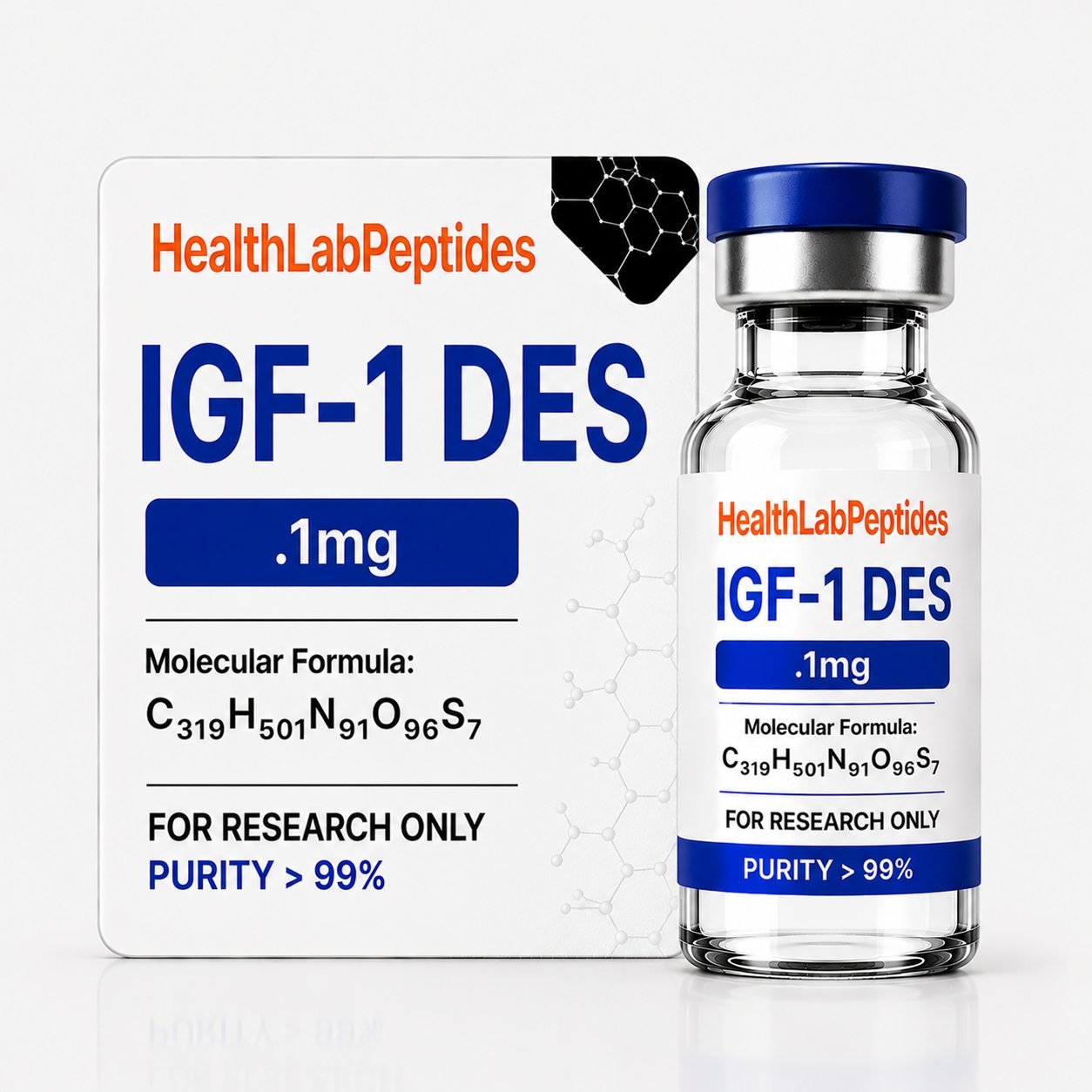
Research suggests that des(1–3)IGF-I, often called IGF-DES, is a shortened form of insulin-like growth factor I that can help scientists investigate how the amino terminus influences growth-factor binding and cellular responses. Unlike a generic IGF-I label, the name des(1–3) indicates a specific structural deletion: the first three amino-acid residues of mature IGF-I have been removed. This distinction matters because binding proteins, receptor recognition, and cell-culture measurements may respond differently to modified analogs. This article reviews the molecular definition, key historical experiments, and methodological limitations without implying any clinical or consumer use. For a starting point on peptide-length terminology, see the HealthLab peptides-versus-proteins guide.
What does des(1–3)IGF-I mean?
The prefix des refers to the removal of residues from an original protein sequence. Mature human IGF-I has 70 amino-acid residues; removing the N-terminal Gly-Pro-Glu tripeptide produces the 67-residue des(1–3) variant. That is not a casual spelling difference but a defined structural alteration with experimentally relevant consequences. The same fragment has been detected in biological materials, according to a 1996 biochemical overview, but the study of an endogenous cleavage product does not establish that every synthetic research sample behaves identically. Scientific comparisons should state the exact molecular form tested and how it was characterized.
Why amino-terminal residues affect growth-factor chemistry
A protein’s amino terminus can influence its interactions with other proteins even when much of the remaining chain is unchanged. In IGF-I, the removal of Gly-Pro-Glu changes a region associated with binding-protein recognition. Some studies have used a family of progressively truncated analogs to examine which part of the terminus matters for cellular assays. The relationship is not necessarily linear: removing another residue can produce a very different response. These comparisons illustrate how structure–activity research works, but they do not demonstrate a general benefit of a shortened molecule in an organism.
The 1988 N-terminal truncation experiment
A study in the Biochemical Journal investigated a series of IGF-I analogs lacking one to five N-terminal residues, with experiments in rat L6 myoblast cultures (PMCID PMC1138570). The paper reported that des(1–3)IGF-I produced a different protein-synthesis response from native IGF-I in that assay. Importantly, not every other truncation produced the same result. That observation supports the idea that sequence position matters, rather than a simplistic claim that shorter peptides always have stronger effects. The study also considered binding-related explanations. Its conclusions apply to the particular cultured cells, measured endpoints, and assay conditions.
Why cell-culture response is not receptor affinity
A cell-based endpoint such as protein synthesis reflects multiple processes, not only the interaction of one molecule with a receptor. Assay conditions may include endogenous binding proteins, receptor expression, growth media, and compensatory signaling. By contrast, a direct binding assay evaluates an interaction more narrowly. It is possible for two molecules to show similar receptor binding yet different apparent responses in a cellular experiment. That does not make either result invalid. It means the study questions are different. A rigorous article should name the endpoint and avoid treating all changes in cellular activity as identical manifestations of potency.
The IGF-binding-protein family
Insulin-like growth factor binding proteins, generally abbreviated IGFBPs, can influence how IGF ligands are presented or retained in biological environments. Their affinity for native IGF-I is not necessarily the same as for des(1–3)IGF-I. An experimental investigation in Biochemical and Biophysical Research Communications (1988; DOI 10.1016/S0006-291X(88)80032-9) compared binding-protein classes using IGF-related molecules. Such studies show why one needs to distinguish the binding protein from the signaling receptor. Lower affinity for a binding protein does not automatically indicate stronger receptor binding or prove a favorable effect in a living organism.
A 1996 overview of the truncated IGF variant
Ballard and colleagues published “Des(1–3)IGF-I: a truncated form of insulin-like growth factor-I” in the International Journal of Biochemistry & Cell Biology (1996; PMID 8930132, DOI 10.1016/1357-2725(96)00056-8). The article summarized evidence that removal of the first three residues reduces binding to several IGF-binding proteins and can alter growth-related responses in selected cultures. It also explained that truncated molecules may arise from post-translational processing. This remains an informative structural overview, not a demonstration of clinical effectiveness. Research results from the 1990s should be interpreted with attention to methods and subsequent independent investigations.
Direct binding studies with the IGF-1 receptor
Forbes and colleagues investigated binding of IGF-I and its analogs to the type 1 IGF receptor using BIAcore analysis in the European Journal of Biochemistry (2002; DOI 10.1046/j.0014-2956.2001.02735.x). The work included des(1–3)IGF-I and demonstrated that some modified analogs retained receptor-binding affinities broadly similar to native IGF-I under the tested assay. This is a useful contrast with literature emphasizing differences in cellular responses. It supports a more nuanced explanation: the observed activity of an analog can depend on binding proteins and the assay environment, not simply on stronger affinity for the signaling receptor itself.
What surface plasmon resonance contributes
Surface plasmon resonance techniques, including BIAcore methods, can examine molecular association and dissociation against immobilized binding partners. Such measurements may provide kinetic and affinity information, but their meaning depends on receptor preparation, immobilization, buffer composition, and fitting assumptions. They do not replicate every feature of a living cell membrane. When comparing published affinities, readers should consider whether full-length receptor, soluble receptor fragments, or other constructs were used. A direct binding result is a mechanistic measurement; it should not be converted into a claim about clinical strength, athletic outcomes, or personal use.
IGF-DES is not the same as IGF-1 LR3
A frequent catalog and search-engine confusion involves IGF-DES and IGF-1 LR3. IGF-DES is a shortened 67-residue variant lacking the first three residues of mature IGF-I. Long Arg3 IGF-I, by contrast, includes an N-terminal extension and a substitution at a specified position. Those modifications are not interchangeable. Both have appeared in binding-protein research, but they are distinct materials with different molecular definitions. The IGF-1 LR3 receptor-signaling article provides a separate research overview. An experiment using one analog cannot automatically be cited as proof of an effect for the other.
Protein synthesis in L6 myoblast models
L6 myoblasts are a rat-derived skeletal-muscle cell line frequently used in basic cell biology. They offer a controlled environment for measuring selected signaling and protein-synthesis endpoints. A result measured in those cells is meaningful for that experimental preparation, but cultured myoblasts do not reproduce the physiology of human muscle tissue in a living person. The cell line’s differentiation state, medium, and other growth factors can influence responses. It is therefore inappropriate to describe results from L6 culture experiments as established bodybuilding, recovery, or muscle-growth benefits. The correct language identifies the cell type and assay.
Why receptor expression varies between models
Different cell preparations may express different levels of IGF receptors, insulin receptors, or IGF-binding proteins. Consequently, an observed signal may not reproduce in another system even when the tested peptide is chemically identical. Comparing outcomes requires recognizing the molecular background and assay-specific controls. A binding-protein-rich medium, for example, poses a different experimental question from a highly purified receptor system. This is precisely why des(1–3)IGF-I is scientifically useful as a research analog: it helps separate otherwise entangled molecular variables. But it does not provide a simple hierarchy of products for personal use.
Interpreting numbers reported in historical studies
A published figure describing a relative change in a particular cell assay is a statement about that experiment. It should not be repeated without context or turned into an advertising multiplier. The 1996 overview discussed marked differences in some cultured-cell responses, while the 2002 direct receptor analysis offered a more specific view of receptor affinity. Both can be accurate because they measure different processes. Readers evaluating IGF-DES literature should ask whether a number refers to receptor-binding constants, protein-synthesis response, growth-related measurements, or another endpoint. Labels such as more potent are incomplete without that explanation.
Experimental controls and reproducibility
A robust molecular comparison should include verified material identity, suitable reference molecules, controls for the assay background, biological replicates, and documented statistical uncertainty. It may also need to distinguish the independent effects of receptor occupancy and IGF-binding-protein association. Negative or inconsistent findings can be just as important as a large positive change. An article that combines numbers from unrelated publications without matching endpoints risks misleading readers. Reliable research summaries describe the limits of cross-study comparisons rather than generating a consumer-facing ranking of analogs.
What the evidence cannot establish
IGF-DES publications can support conclusions about chemical identity, binding-protein recognition, receptor-binding properties, and responses in experimental cultures. They do not establish that HealthLab’s research material is safe or effective for human use, that it produces any specific whole-body outcome, or that an unapproved vial is equivalent to a regulated medicine. The existence of a naturally occurring fragment does not make a synthesized catalog sample suitable for administration. Discussions of exercise, growth, bodybuilding, or endocrine treatment must remain limited to scientific context and should never become instructions for personal use.
Laboratory catalog identity
The IGF-DES 0.1 mg research-material listing identifies the product offered in HealthLab’s catalog for lawful laboratory purposes. A listed quantity is part of the product’s identity, not a statement of effect or a suggested amount for a biological system. A Certificate of Analysis can document selected laboratory findings for a batch depending on the tests performed. Such documentation is not FDA approval and does not establish suitability for human or veterinary administration. For any experimental comparison, the intended molecule should match the material actually characterized.
Questions researchers commonly ask
What does des(1–3) mean? Removal of the first three amino-acid residues from IGF-I. How long is IGF-DES? The defined mature fragment has 67 amino-acid residues. Is it IGF-1 LR3? No; LR3 has different engineered changes. Why do binding proteins matter? Their interactions can influence observed responses in some assays. Does greater response in cultured cells imply a human benefit? No. Can a research vial be administered because a related fragment occurs naturally? No; natural occurrence is not regulatory authorization.
Selected research literature
N-terminal truncation and L6 myoblast comparison, Biochemical Journal, PMCID PMC1138570; Ballard and colleagues (1996), PMID 8930132, DOI 10.1016/1357-2725(96)00056-8; IGF-binding-protein comparison (1988), DOI 10.1016/S0006-291X(88)80032-9; and Forbes and colleagues, European Journal of Biochemistry (2002), DOI 10.1046/j.0014-2956.2001.02735.x. These references describe structural and laboratory research questions. The presence of published results does not indicate that a HealthLab research-only material has been approved for personal use.
Conclusion
IGF-DES provides a concrete example of how removal of just three amino-acid residues can change interactions with binding proteins and selected experimental readouts. Its literature is most informative when researchers separate receptor affinity, binding-protein behavior, and cell-specific responses. The compound is distinct from Long Arg3 IGF-I, and studies of either analog require their own controls and careful interpretation. This page presents the evidence as molecular research, not as a claim of medical, athletic, or consumer usefulness.
Research-use restriction
For Research Use Only. Not for human consumption, medical, or veterinary use. No dosing, administration, injection, reconstitution, treatment, or personal-use guidance is provided. These statements have not been evaluated by the FDA. This product is not intended to diagnose, treat, cure, or prevent any disease.


