

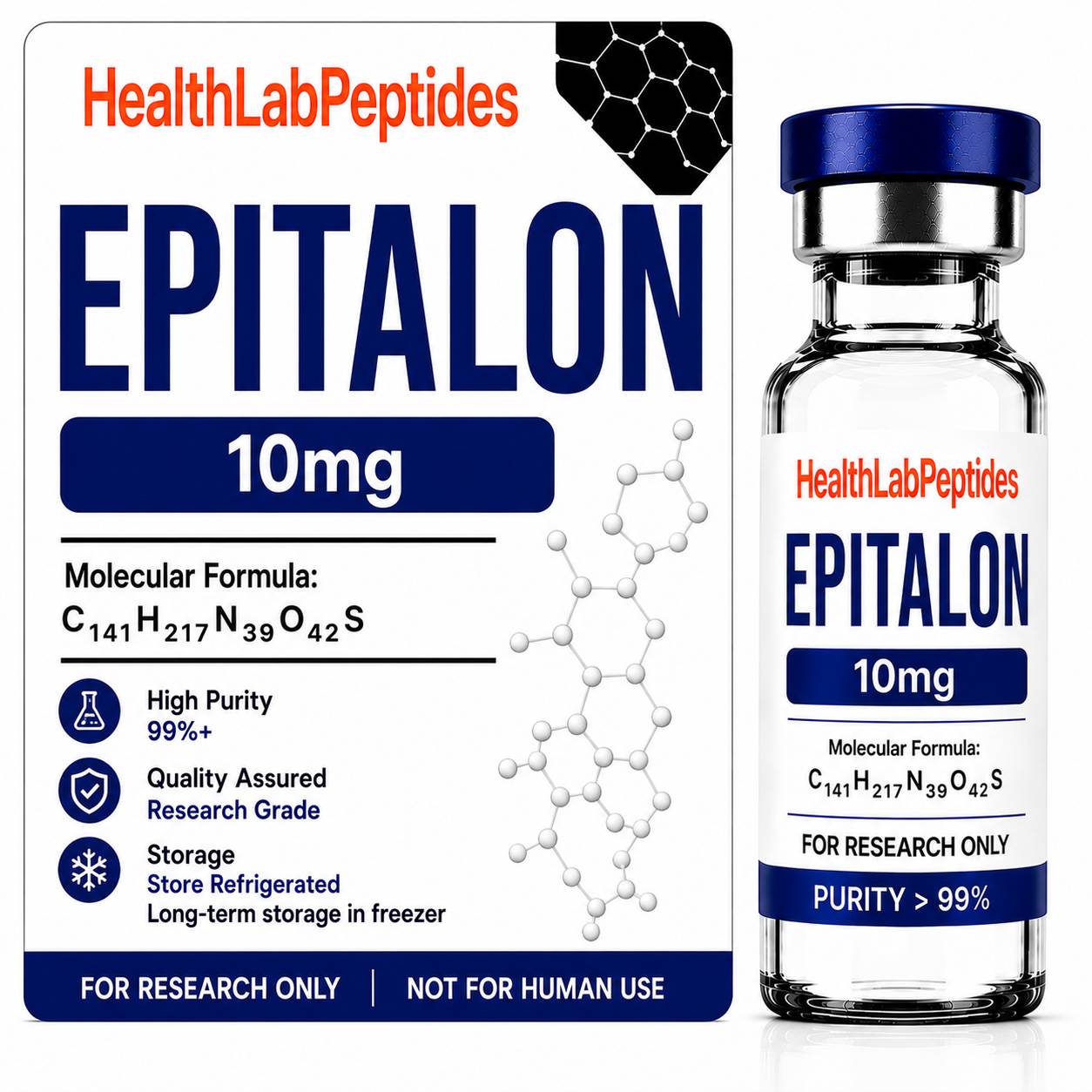
Research suggests that Epitalon, also spelled Epithalon, is a synthetic tetrapeptide that has been investigated in human cell-culture experiments involving telomerase expression, telomere length, and proliferative capacity. Its short sequence, Ala–Glu–Asp–Gly (AEDG), makes it a useful subject for questions about how defined peptides may influence laboratory readouts. Research on cultured cells does not establish that a compound prolongs human life, treats age-associated conditions, or is suitable for personal administration. This article reviews what the original investigators measured, how later cell-line work differed, which assays address different questions, and where uncertainty remains. For the underlying molecular terminology, see HealthLab’s introduction to peptide chemistry.
Epitalon structure and the meaning of AEDG
Epitalon consists of four amino-acid residues: alanine, glutamic acid, aspartic acid, and glycine. The shorthand AEDG records that sequence from the amino terminus to the carboxyl terminus. Because the molecule is a tetrapeptide, it should not be conflated with a full-length protein, hormone, or multi-component tissue extract. Exact sequence information matters when researchers compare results, because different peptides can share an informal nickname without having the same identity. Chemical synthesis, analytical characterization, and sequence confirmation address the question of what was studied; biological assays address a separate question about what happened under specific conditions. Neither category alone establishes a clinical use.
Where telomeres fit into cell biology
Telomeres are repeated DNA sequences and associated proteins located at chromosome ends. They help organize chromosome-end structures and are studied in relation to cell replication, DNA-damage responses, and cellular senescence. Telomere length can differ between cell types and may change over serial passages in culture. Yet length is not a complete or universal measure of an organism’s age, and a change in telomere measurements is not equivalent to an improvement in health. An article that uses the word longevity should explain whether the finding concerns a cultured cell population, a particular tissue, an animal, or humans. Epitalon research has historically emphasized the first of those categories.
What telomerase actually does
Telomerase is a ribonucleoprotein enzyme complex involved in telomeric DNA maintenance in certain cells. Its catalytic component is commonly described as telomerase reverse transcriptase, or TERT, while an RNA component contributes a template. Researchers can examine TERT messenger RNA, telomerase enzyme activity, and telomere length, but these are three distinct endpoints. Increased TERT transcription does not by itself prove that active telomerase has increased, and an enzyme-activity readout is not the same as directly measuring chromosome-end length. The strongest reports explain which endpoints were measured and whether they changed in the same experimental system.
The 2003 fibroblast study: What it reported
In 2003, Khavinson, Bondarev, and Butyugov published a report in the Bulletin of Experimental Biology and Medicine, PMID 12937682, DOI 10.1023/A:1025493705728. The investigators examined telomerase-negative human fetal fibroblast cultures and reported expression of the telomerase catalytic subunit, detectable enzyme activity, and increased telomere length following Epithalon exposure under their experimental conditions. This is a historically important starting point because it connects multiple laboratory endpoints in the same general line of investigation. It is not evidence that a commercial research vial produces clinically meaningful longevity effects in people. The study’s narrow model and replication history matter when evaluating the strength of a generalized claim.
The 2004 follow-up: Additional passages in cell culture
A 2004 paper from the same research group, PMID 15455129, DOI 10.1023/B:BEBM.0000038164.49947.8C, examined proliferative capacity in human fetal fibroblast cultures. The paper reported that treated cells continued through additional passages compared with the control cultures and described changes in telomere measurements. Passage number is a feature of that laboratory culture system, not a direct measurement of life expectancy. Replication from independent groups and different cellular models would be needed to establish how broadly such results apply. It is also important to ask whether changing a cell’s capacity to divide is necessarily desirable in every tissue or context; biology does not support that assumption.
Why a cell passage is not a human lifespan measurement
In a cell-culture experiment, a passage denotes a stage in which cultured cells are transferred to maintain a growing population. A change in passage number can reflect many experimental variables, including cell-line background, culture conditions, selection, and assay definitions. Although the relationship between telomeres and replicative senescence is scientifically interesting, extra cell divisions in a dish are not evidence that an organism lives longer. Biological aging involves interacting tissues, immunity, metabolism, accumulated molecular damage, and many processes that a two-dimensional cell culture does not reproduce. The correct claim stays within the measured cell system.
A later comparative study of normal and cancer cell lines
A 2025 paper available through PubMed Central, PMCID PMC12411320, investigated telomere-related responses in normal human cell preparations and breast cancer cell lines. Its experiments reported changes in telomere-length measures and TERT-associated transcription, with differences between normal and malignant cell models and their time courses. The authors also investigated alternative lengthening of telomeres, usually abbreviated ALT. These observations are especially relevant because they show that the result is not necessarily uniform across cell types. An observed response in a cancer cell line must not be interpreted as evidence of safety or benefit in a healthy organism. Cancer-cell findings can raise entirely different mechanistic questions.
Why cancer-cell observations require caution
Telomerase and alternative telomere-maintenance pathways are relevant to cancer biology because altered regulation can support continued cell proliferation. A laboratory report describing increased telomeric length in malignant cells is not an anti-aging endorsement; it is a reason to investigate the pathway carefully. Cell-line models differ from normal primary cultures in genomic background, proliferation programs, and checkpoint behavior. Findings in a transformed line may expose how a molecular intervention interacts with those differences rather than predicting a beneficial effect. A responsible summary must therefore avoid selectively quoting only the normal-cell results while overlooking the cancer-cell observations and the researchers’ stated model limitations.
Telomere-length assays are not all interchangeable
Telomere biology can be investigated through methods such as terminal restriction fragment analysis, quantitative PCR-based approaches, or fluorescence-based measurements. Each method reports a different aspect of the sample and has particular sensitivity and limitations. Bulk average telomere length may conceal variation among individual chromosomes or cells. Interpretation can also depend on culture heterogeneity, experimental replication, and the timing of sample collection. An article claiming that telomeres became longer should identify the study and its measurement approach rather than imply that every possible telomere-related endpoint was demonstrated. A robust research narrative acknowledges technical uncertainty.
TERT expression versus enzyme activity
Gene-expression analysis often uses reverse-transcription quantitative PCR to estimate the abundance of TERT transcripts. By contrast, telomerase activity assays examine an enzymatic process. Those methods provide related but different evidence. A result showing altered transcript abundance may motivate investigation of enzyme activity, while a finding in an activity assay may warrant independent validation and examination of the biological context. Cell type, baseline telomerase status, sample processing, and appropriate negative controls all matter. The presence of a significant result should not be expanded into claims about cellular rejuvenation or organism-level treatment.
Alternative lengthening of telomeres: What ALT means
ALT refers to telomere-maintenance mechanisms distinct from conventional telomerase activity. Some cancers use such pathways, and research on ALT is complex because different assays detect different associated features. A 2025 Epitalon study discussed ALT activity in its cancer-cell models, emphasizing the need to distinguish changes in telomere length from the particular mechanism responsible. Researchers should not infer ALT activity from a single length measure, and should not assume that a mechanism observed in a malignant line operates identically in a normal culture. These distinctions prevent the term telomere elongation from becoming an overgeneralized outcome claim.
Other experimental questions about short peptides
Epitalon belongs to the broader category of short synthetic regulatory peptides, but membership in that category does not establish a shared mechanism with another tetrapeptide or a distinct neuroactive compound. For comparison, Pinealon research involves a different short peptide and its own evidence questions. Structural length alone is a poor predictor of receptor interaction, transcriptional effect, or stability. The correct approach is to specify each sequence and evaluate its literature separately. Scientific classification can help organize topics but should not replace material-specific evidence.
Study replication and the limits of a small evidence base
A particularly important question for Epitalon is how findings from the early publications compare with studies conducted in other laboratories, cell types, and analytical systems. Reproduction of a specific molecular result across independent groups can increase confidence, while differences require explanation. Researchers should evaluate how many biological replicates were studied, whether appropriate control cultures were included, and whether the measures were prespecified. Even if a laboratory finding is reproducible, the conclusion remains attached to that experimental context. Clinical effectiveness and safety cannot be established by accumulating cell-culture papers alone.
Why telomere search terms can be misleading
Online searches often connect Epitalon with age reversal, longevity therapy, telomere repair, or anti-aging benefits. These phrases can be useful indicators of what readers are curious about, but they are not evidence that a research-only material has achieved the implied outcomes. The measured subjects in the cited early papers were cultured cells, not lifespan outcomes in humans. Similarly, claims about cancer prevention or treatment would require entirely different evidence and regulatory authorization. A research-focused article should answer the scientific question beneath the search term without converting an experimental result into consumer marketing.
Molecular identity and catalog documentation
Researchers comparing publications should match the intended amino-acid sequence and chemical form to the actual test material. A Certificate of Analysis may support batch traceability for particular identity or purity attributes, depending on which assays it reports. It cannot establish that an unapproved research sample is suitable for injection, supplementation, medical use, or another bodily application. The Epitalon 10 mg research-material listing identifies the corresponding HealthLab laboratory catalog item. The listing is for legitimate analytical and in-vitro investigation only, not a recommendation to administer a compound.
Frequently asked questions about Epitalon research
Is Epitalon the same as Epithalon? Both names commonly refer to the AEDG tetrapeptide in the literature. What did the earliest studies measure? Telomerase-related endpoints, telomere length, and replicative behavior in selected fibroblast cultures. Did those studies demonstrate longer human lifespan? No. Why are cancer cell lines discussed? Later work examined model-dependent telomere regulation, including mechanisms in malignant cells. Does a product’s research-only label mean it has an approved clinical use? No. Molecular identity, laboratory observations, and regulatory status are separate questions.
Selected scientific references
Khavinson, Bondarev, and Butyugov, Bulletin of Experimental Biology and Medicine (2003), PMID 12937682, DOI 10.1023/A:1025493705728; Khavinson and colleagues, Bulletin of Experimental Biology and Medicine (2004), PMID 15455129, DOI 10.1023/B:BEBM.0000038164.49947.8C; and the 2025 comparative human cell-line study, PMCID PMC12411320. These are experimental references, not endorsements of consumer or medical uses. Source identifiers are provided without outbound links so readers can distinguish the cited research from the catalog material.
Conclusion: What remains scientifically defensible
Epitalon is a defined tetrapeptide with a small but noteworthy body of laboratory work concerning telomerase-associated endpoints and cell replication. The most useful contribution of the literature is that it identifies measurable molecular questions and demonstrates why different cell models may yield different results. Neither historical observations in fetal fibroblasts nor later cancer-cell investigations prove lifespan extension, clinical safety, or suitability for use in a person. Clear descriptions of molecular identity, model, assay, and evidentiary limitations are more useful than claims based on the word longevity.
Research use restriction
For Research Use Only. Not for human consumption, medical, or veterinary use. This article does not provide dosing, administration, reconstitution, injection, treatment, or personal-use instructions. These statements have not been evaluated by the FDA. This product is not intended to diagnose, treat, cure, or prevent any disease.



 IGF-1 LR3 Research Material — 1mg