

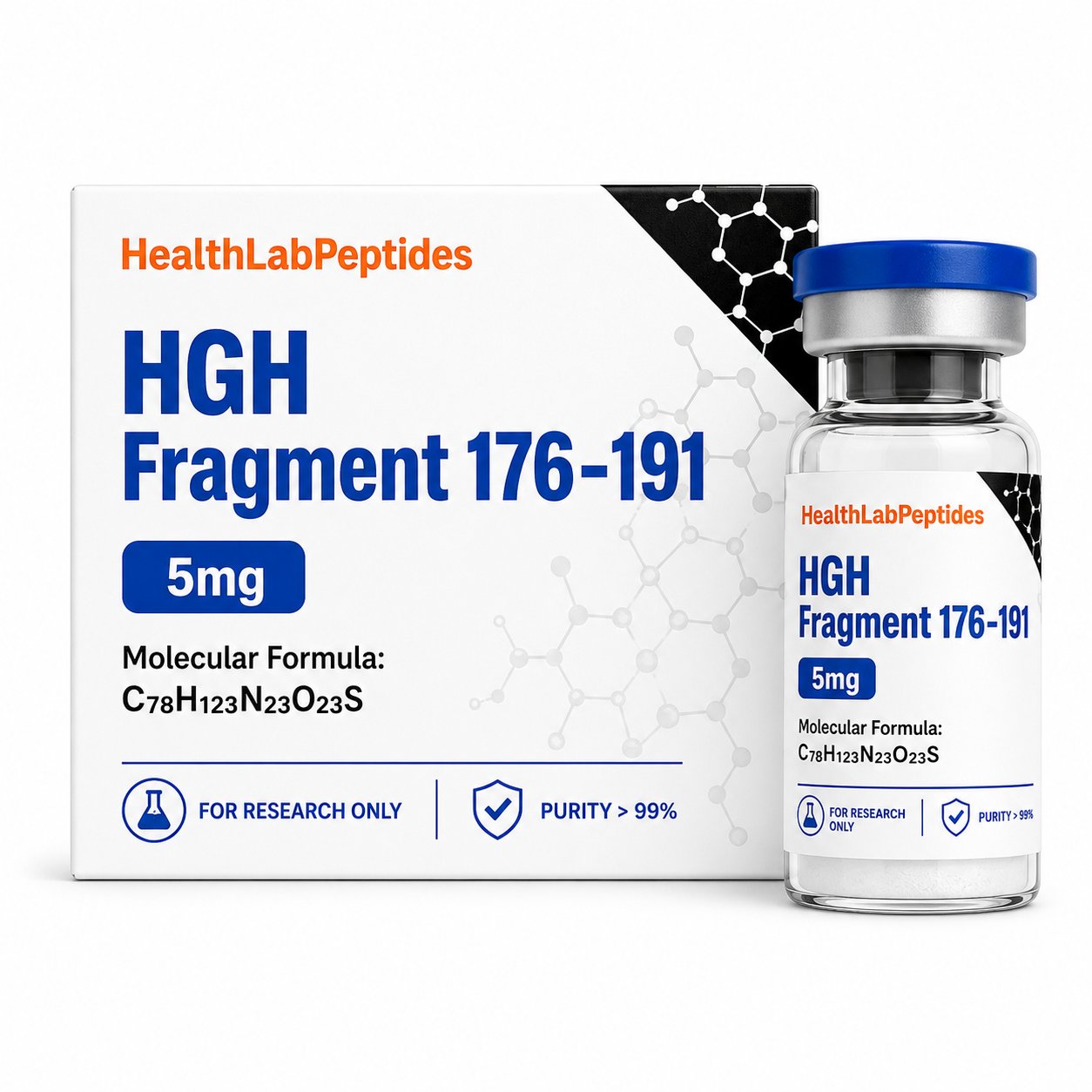
Research suggests that the C-terminal portion of human growth hormone is a useful subject for sequence-comparison research, because seemingly similar names can refer to chemically different fragments. “HGH fragment 176–191,” “hGH 177–191,” and “AOD-9604” are often grouped together in commercial discussions, but they should not be treated as interchangeable without verifying the actual amino-acid sequence. Historical studies investigated shortened growth-hormone peptides in animal and tissue models, while later studies examined a modified analog. Those experiments do not establish human-use suitability or clinical outcomes for a laboratory research material. This guide explains the sequence distinctions, historical findings, analytical challenges, and limits of interpretation. For a basic molecular overview, see the HealthLab peptide structure guide.
What is human growth hormone?
Human growth hormone, also called somatotropin, is a much larger peptide-based hormone than the short fragments described here. The mature protein contains 191 amino-acid residues, and different regions contribute to its structural and molecular interactions. Experimental fragments are shortened sequences selected from the parent molecule. They do not necessarily preserve all of the parent hormone’s receptor behavior or biological activity. Consequently, a paper investigating native growth hormone should not be cited automatically as a paper about a fragment. Equally, a result observed with a particular synthetic fragment does not establish the full hormone’s effects under every experimental condition.
Sequence numbering: Why residue 176 matters
When researchers describe hGH residues 176–191, they refer to a segment corresponding to the final 16 amino acids of the mature hormone. The native sequence begins with phenylalanine at residue 176. A fragment described as hGH 177–191 is one residue shorter and begins with leucine. These distinctions are more than typographical details: losing or changing an amino acid affects molecular mass and potentially biochemical behavior. An accurate catalog or study record should specify the complete sequence so the actual material can be compared with the source publication. Merely writing HGH fragment on a label is insufficient for precise molecular identification.
AOD-9604 is a modified analog, not the identical native fragment
AOD-9604 is commonly described as a synthetic sequence related to hGH residues 177–191 with an added or substituted N-terminal tyrosine, giving a 16-residue analog rather than the native 176–191 sequence. In a simplified one-letter comparison, the native hGH(176–191) starts with F while the AOD-9604 analog starts with Y. The rest of a reported sequence may overlap, but this difference has analytical significance. A paper studying AOD-9604 should not be presumed to have tested the unmodified native segment. Researchers should document any additional chemical features and verify the source’s actual molecule before attributing reported results.
Why sequence identity is a research and SEO issue
Search engines may display similarly titled pages for AOD-9604 and HGH fragment 176–191 even when the products are different. A scientifically reliable website should help readers recognize the exact distinction instead of combining both entities to capture traffic. Sequence-specific titles, descriptions, and internal links avoid confusing the customer and preserve a more useful research archive. The AOD-9604 research overview covers a related but distinct analog. Internal cross-references should explain that relationship clearly rather than implying the two labels are synonymous.
Early growth-hormone C-terminal fragment studies
Research on shortened growth-hormone sequences predates the development of AOD-9604. A 1979 synthesis paper by Wade and colleagues (PMID 429095, DOI 10.1111/j.1399-3011.1979.tb01868.x) examined several C-terminal fragments, including hGH 177–191, 178–191, and 179–191. Such studies were designed to explore which sequence regions contributed to activity under particular experimental systems. Their historical value is in comparing molecular structures and measured responses, not in demonstrating a product application. Findings from early fragment experiments should not be generalized to every modern material with a similar catalog label.
A 1978 comparison of several fragment boundaries
Ng and Bornstein reported animal experiments with synthetic growth-hormone C-terminal sequences in the American Journal of Physiology in 1978 (PMID 645904, DOI 10.1152/ajpendo.1978.234.5.E521). The study compared peptides corresponding to several ranges, including 176–191, 177–191, 178–191, and shorter segments. Responses varied with which residues were present. This is an example of why a few amino acids can change an assay outcome. It should not be used to claim that these fragments have desirable metabolic effects in people or that an experimental sequence is safe for human use. The model involved rats and specific endocrine-related observations.
What a 1993 tissue assay actually reported
Wu and Ng examined a synthetic hGH 177–191 fragment in Biochemistry and Molecular Biology International (1993; PMID 8358331). The work considered lipid synthesis and breakdown in rat adipose-related preparations. Its abstract reported an effect on antilipogenic measurements while noting no significant lipolytic effect in the chosen glycerol-release assay. That contrast matters because the words antilipogenic and lipolytic describe different biochemical processes. A headline claiming generalized fat loss from this study would go beyond its methods. Researchers must identify the model and endpoint rather than combining different lipid-metabolism terms into one consumer-facing conclusion.
Antilipogenesis is not the same as lipolysis
Lipogenesis refers to processes involved in synthesizing or storing lipids, whereas lipolysis concerns the breakdown of stored lipid molecules. A study may detect a response in one pathway but not another. In the original 1993 work, measurements were made under specific experimental conditions using rat preparations and did not amount to a demonstration of human body-composition outcomes. Similarly, rates of glycerol release and overall tissue changes are not interchangeable readouts. Scientific clarity requires describing what the assay actually measured and whether a difference was statistically supported. This distinction is particularly important when marketing language incorrectly condenses complex experiments into claims of fat burning.
The 2001 AOD-9604 mouse studies
Heffernan and colleagues studied AOD-9604 in mice in publications including an Endocrinology paper (2001; PMID 11713213, DOI 10.1210/endo.142.12.8522). The investigators considered metabolic-related outcomes in obese and other mouse models and compared some responses with those of full-length growth hormone. These are preclinical observations about a defined analog. They are not evidence that the native 176–191 fragment necessarily behaves the same way, nor do they establish that either research material produces meaningful human weight-management effects. Species, test molecule, model, and endpoint must all be kept in view when the literature is summarized.
Why the growth-hormone receptor question matters
Growth hormone receptor signaling involves the interaction of the full-length hormone with its defined receptor system. Some analog-development work investigated whether shortened peptides preserve particular metabolic-associated readouts without the same receptor-linked actions. That can be an interesting pharmacological research question, but it should not be simplified into a claim that every fragment is receptor independent or inherently safer. The answer depends on the exact sequence and the assays used. Direct receptor binding, downstream signal detection, and animal physiological observations are distinct levels of evidence requiring separate interpretation.
Cysteine residues and structural chemistry
The C-terminal segment of mature growth hormone includes cysteine residues that can influence the peptide’s possible conformations and chemical behavior. Investigators should confirm whether a research material is described as reduced, oxidized, cyclized, or otherwise modified, rather than assume that a residue sequence alone captures every structural property. Analytical methods may be needed to distinguish chemical forms that share a general name. A peptide’s measured activity in a published assay may be sensitive to such details. These are laboratory identity questions and do not translate into guidance for preparation or personal application.
Why comparisons between studies can be misleading
A report describing a synthetic sequence in rats and a later paper examining AOD-9604 in mice have different materials, experimental environments, and endpoints. Even when both papers discuss lipid biology, the numerical results cannot be combined into a universal potency ranking. Differences in metabolism between species add another limitation. Strong research writing compares the exact study design before attempting to infer any common pathway. If the experiments disagree, the answer is to examine those differences rather than choose the result that sounds most favorable for a commercial product.
Fragment names and product identification
A label stating HGH fragment 176–191 should correspond to the sequence that the supplier actually identifies as the research material. Researchers should examine any available sequence documentation and Certificate of Analysis in light of the assays performed. An analysis may demonstrate selected molecular characteristics, but it does not prove medical-grade status, safety, or suitability for injection. The HealthLab HGH Fragment 176–191 research listing provides catalog context for a laboratory material. Because historical and modern fragment naming conventions differ, the correct scientific approach is to verify the actual molecule, not infer it from a short headline.
Why the clinical-evidence boundary is important
Preclinical reports about AOD-9604 do not establish clinical efficacy for HGH fragment 176–191. Clinical-development discussions surrounding AOD-9604 have included programs that did not demonstrate meaningful success on the intended primary weight-related endpoint. Those reports should not be converted into a claim about the related native fragment in either direction without direct evidence. A product offered for research is not an approved medicine simply because an analog appeared in trials. For HealthLab, the relevant purpose is controlled laboratory investigation of molecular identity and scientifically documented mechanisms, not medical or personal use.
What an analytical laboratory can ask
A defensible research question might concern the identity of a C-terminal sequence, whether a source describes native hGH(176–191) or a modified analog, or how a particular published assay defined its experimental endpoint. A study comparison may record residue numbering, species, model type, control group, and result. Those steps improve scientific reproducibility and help readers avoid misunderstandings. They do not require making predictions about a person’s body, determining an administration route, or constructing an unsupported consumer-use protocol. Strong information architecture can support science without transforming a research catalog into a treatment site.
Frequently asked questions
Is hGH 176–191 a full growth-hormone molecule? No, it is a short C-terminal segment. Is AOD-9604 exactly the same? No; it is generally described as a modified analog with a distinct N-terminal residue. Do both have the same evidence? No; experiments must be attributed to the exact material tested. Does a mouse metabolic result prove human fat loss? No. Should a laboratory reader rely on a product name alone? No; sequence and analytical identity are essential. Are research samples approved for human use? No.
Selected research identifiers
Ng and Bornstein (1978), American Journal of Physiology, PMID 645904, DOI 10.1152/ajpendo.1978.234.5.E521; Wade and colleagues (1979), International Journal of Peptide and Protein Research, PMID 429095; Wu and Ng (1993), Biochemistry and Molecular Biology International, PMID 8358331; Heffernan and colleagues (2001), Endocrinology, PMID 11713213, DOI 10.1210/endo.142.12.8522. These identify different compounds and experiments and are provided to support accurate distinctions, not claims of consumer efficacy.
Conclusion
Human growth-hormone C-terminal fragment research has a history that includes native-sequence fragments and later modified analogs. The critical scientific question is which exact molecule an experiment tested and what the reported assay could establish. Keeping hGH(176–191), hGH(177–191), and AOD-9604 distinct helps prevent errors in both laboratory interpretation and scientific SEO. The evidence summarized here concerns controlled experiments and does not establish clinical use, treatment, or consumer benefit for HealthLab’s research material.
Research-use restriction
For Research Use Only. Not for human consumption, medical, or veterinary use. No dosing, injection, administration, reconstitution, treatment, or personal-use guidance is provided. These statements have not been evaluated by the FDA. This product is not intended to diagnose, treat, cure, or prevent any disease.


