

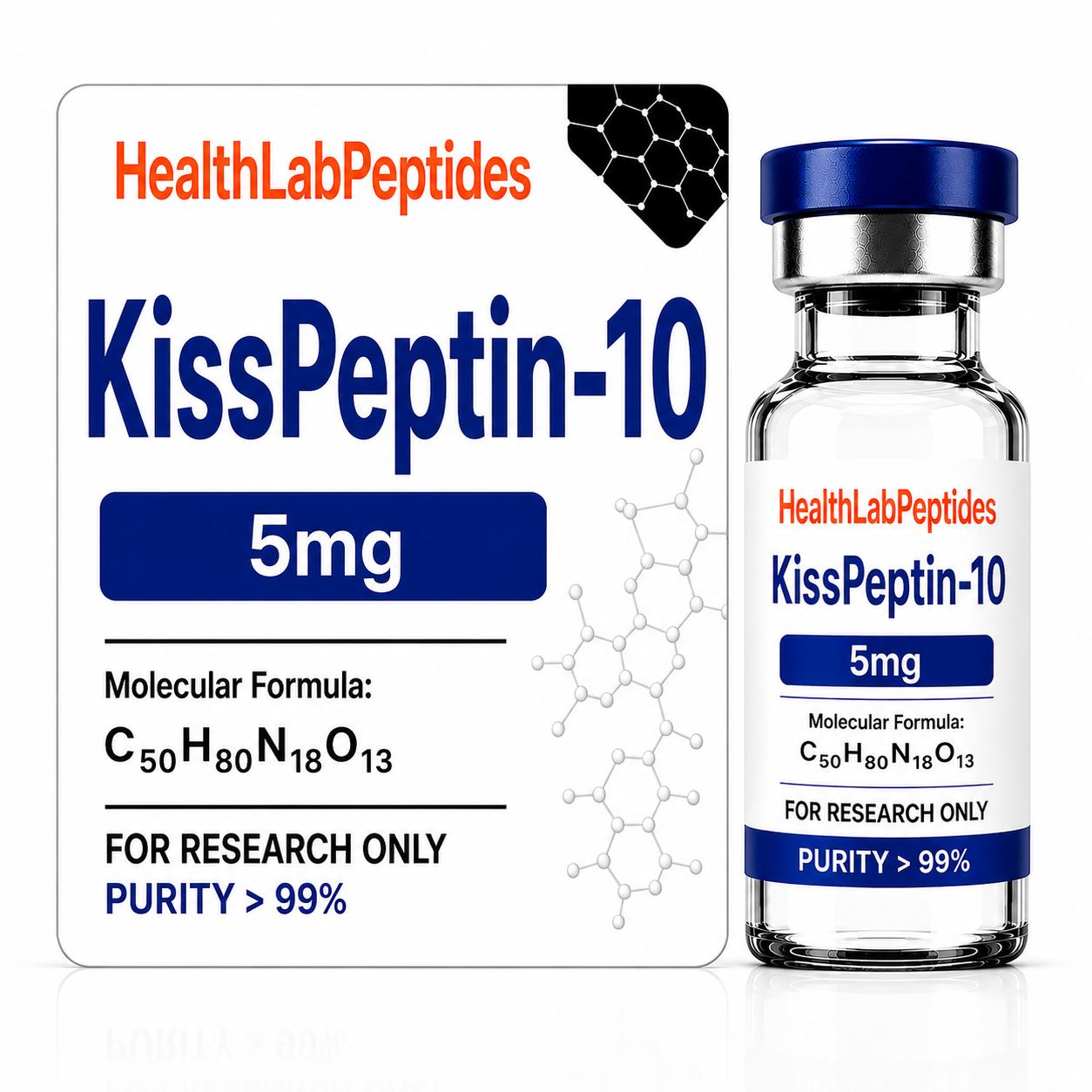
Research suggests that Kisspeptin-10 is a useful experimental ligand for studying the kisspeptin receptor KISS1R, also known in older literature as GPR54. Beyond the initial receptor-associated calcium response, investigators have examined an important molecular question: how can signaling continue when the receptor is being internalized and recycled? A series of cell-line and neuronal investigations describes dynamic receptor trafficking, differences between short and sustained signals, and the importance of extracellular calcium in those models. This article focuses on receptor movement and the interpretation of signaling experiments rather than repeating a generic overview of hormone pathways. It does not endorse administration or any medical use of research material. For the broader receptor framework, read peptide hormone-receptor communication in research.
What is Kisspeptin-10?
Kisspeptin-10 is a ten-amino-acid fragment within the larger kisspeptin peptide family. Its name identifies peptide length, not an amount or a personal-use recommendation. Kisspeptins are ligands for the receptor KISS1R, a G-protein-coupled receptor studied in reproductive neuroendocrinology. The names KISS1R and GPR54 refer to the receptor in related publications, so readers should recognize both when comparing studies. A peptide fragment and its full-length precursor are not necessarily interchangeable in every experimental context. Sequence identity and the model tested matter whenever a paper describes kisspeptin-induced cellular behavior.
KISS1R is a seven-transmembrane signaling receptor
KISS1R belongs to the family of receptors that span the cell membrane multiple times and connect extracellular ligands to intracellular signaling machinery. Research on this receptor frequently focuses on Gq/11-related pathways and the resulting cellular responses. Describing KISS1R as a receptor is more precise than treating kisspeptin as a general hormone booster. The receptor’s expression and regulation can vary across engineered cell lines, neuronal preparations, and organismal tissues. Therefore a particular reporter or calcium measurement should be interpreted in the context of the cells and receptor constructs used. Receptor activation is not synonymous with clinical efficacy.
The phospholipase C pathway
When KISS1R engages its relevant intracellular signaling machinery, phospholipase C can participate in the hydrolysis of membrane-associated phosphoinositides. This produces messenger molecules involved in downstream signaling, including inositol trisphosphate and diacylglycerol. Protein kinase C and intracellular calcium responses are common experimental readouts of this signaling cascade. But these markers do not all report the same process: one can measure a second messenger, an enzyme-associated response, or a broader downstream cellular change. A rigorous research comparison should identify the actual measured event rather than claim that every marker proves a single biological outcome.
Initial calcium release and prolonged signaling are different questions
A cell can display a relatively rapid increase in intracellular calcium after receptor stimulation, followed by a longer-lasting pattern under certain conditions. The mechanisms supporting the first phase may differ from those maintaining the second. This distinction is central to KISS1R research because a sustained response may depend on extracellular calcium and receptor trafficking rather than simply on an unrecovered pool of internal calcium. An experiment that collects only one early measurement cannot fully characterize later dynamics. Scientists therefore interpret temporal changes in relation to the specific model and the source of the measured signal.
The 2008 GnRH neuron-explant experiment
A study published in the Journal of Neuroscience, PMID 18948403, PMCID PMC2654742, examined Kisspeptin-10 in mouse nasal explant cultures containing gonadotropin-releasing hormone neurons. The investigators reported changes in intracellular calcium oscillations associated with activation of the native receptor and discussed phospholipase C-related mechanisms. This is a valuable contrast to experiments in engineered cell lines because the system involved a neuronal preparation. However, it remained a laboratory model, not evidence that a commercial research peptide has a predictable or safe effect in a person. The experimental measurements were neuronal calcium signals, not clinical treatment outcomes.
What a calcium oscillator means in a neuron model
A calcium oscillator describes repeated changes in intracellular calcium over time. In the 2008 explant work, the investigators observed differences in the frequency and pattern of signals among the neuronal preparations studied. Such oscillations may be influenced by membrane activity, channel properties, and second-messenger systems. A signal’s pattern can contain information that a single average calcium measurement would miss. Yet the occurrence of a particular waveform in a developmental mouse neuron model cannot be generalized to adult human endocrine physiology without additional research. Model identity and experimental timing are fundamental to the conclusion.
The 2012 single-cell analysis
Babwah and colleagues published a study in Endocrinology in 2012, PMID 23070548, PMCID PMC3512071, DOI 10.1210/en.2012-1747. Using single-cell methods, the investigators examined sustained KISS1R signaling and the contribution of extracellular calcium. Their models included engineered HEK293 cells as well as GT1-7 neuronal and CHO cell preparations. The reported results linked the persistence of some responses to extracellular calcium rather than solely to intracellular calcium stores. This finding illustrates why receptor research cannot be summarized simply as kisspeptin increases calcium. The source and timing of the signal are part of the mechanism.
Why extracellular calcium matters in sustained responses
Calcium can be mobilized from intracellular stores, enter through plasma-membrane channels, or participate in coupled processes. An early response in a cell may depend on one source, while a prolonged response draws on another. In the 2012 KISS1R research, investigators distinguished acute second-messenger activation from later responses that depended on extracellular calcium. This distinction complicates any attempt to rank experimental peptides by a single maximum fluorescence value. The molecular question concerns signal origin, timing, and persistence, not a general claim about reproductive function or medical use.
What receptor internalization means
After ligand engagement, some G-protein-coupled receptors move from the cell surface into intracellular compartments. This process is called internalization. It can influence which signaling machinery the receptor encounters and whether the surface remains responsive to ligand. Importantly, internalization does not necessarily mean immediate and permanent destruction of the receptor. Some receptors can return to the plasma membrane through recycling. Understanding these paths requires experiments that distinguish surface-associated and intracellular receptor populations. Observing fluorescence inside a cell is not enough on its own to establish the entire trafficking route.
The 2014 KISS1R trafficking study
A Molecular Endocrinology article published in 2014, DOI 10.1210/me.2013-1165, PMID 24295737, examined receptor internalization, recycling, and degradation in KISS1R-expressing cell models. The investigators reported a rapid acute calcium response followed by a more sustained second phase. Removing kisspeptin from the medium abolished the later phase, and interfering with trafficking reduced it. The study therefore linked continued ligand presence and dynamic receptor movement with the longer calcium response in the tested cells. This is a mechanistic finding in defined preparations; it does not establish an administration method or a clinical intervention.
Ligand processing and receptor fate can differ
The 2014 paper also investigated what happened to internalized ligand and receptor. The investigators found evidence that much of the internalized kisspeptin was processed relatively rapidly, while receptor-associated protein could persist and recycle differently. This demonstrates why the fate of a peptide ligand should not be assumed to match that of the receptor it activates. A statement that the receptor internalizes tells only part of the story. The scientific details include ligand degradation, receptor recycling, and the maintenance of a surface population capable of responding in the experimental setting.
Recycling versus degradation
Internalized receptors may follow different intracellular routes: some return to the cell surface, while others are processed through degradation pathways. The balance can influence the receptor population available during a prolonged experiment. A 2011 investigation of KISS1R trafficking and degradation, PMID 21285314, examined wild-type receptor and a disease-associated Arg386Pro variant, reporting differences relevant to receptor turnover and recycling. Such genetic studies are valuable for understanding receptor biology, but a mutation-associated phenotype does not establish that a particular research peptide should be used therapeutically. The experiments concern receptor regulation in defined models.
What mutation studies tell researchers
Comparing a wild-type receptor with a defined variant can help separate the contributions of receptor expression, trafficking, and degradation. An altered receptor may exhibit prolonged responsiveness because of changes in protein turnover rather than a fundamentally different ligand-binding event. The 2011 work on Arg386Pro illustrates why studies of receptor regulation require careful distinction between surface abundance, internalization, recycling, and intracellular degradation. These processes have different measurement methods and may change independently. Evidence from genetic variants should not be simplified into a claim that prolonged signaling is always desirable.
Why engineered cell lines cannot replace neuronal experiments
HEK293 and CHO cells provide useful systems for studying introduced receptors under relatively controlled conditions. But those cells have different backgrounds from GnRH neurons, including signaling proteins, membrane channels, and regulatory pathways. GT1-7 cells are also a specific neuronal model rather than a universal proxy for human neuroendocrine tissue. Repeating a result across several cell types can strengthen confidence in a mechanism, but it does not erase the differences among them. A well-written research article reports which model produced the result rather than presenting all calcium traces as if they came from the same biological context.
How receptor trafficking is measured
A published trafficking study may use surface labeling, microscopy, ligand-binding experiments, biotinylation, or biochemical analysis to distinguish receptor populations. These approaches can measure different aspects of internalization and recycling, and each has limitations. For example, fluorescence localization can show where labeled material accumulates, while a surface-binding assay may provide a different estimate of accessible receptors. Interpretation depends on construct design and whether the tag itself changes receptor behavior. Strong conclusions generally integrate more than one type of measurement with suitable controls. These are analytical principles, not instructions for consumer preparation of a material.
Why continuous ligand presence changes the interpretation
When an experiment reports sustained calcium activity, it matters whether the ligand remained present in the culture medium and whether the receptor population changed during the observation. The 2014 KISS1R study specifically tested ligand removal and trafficking-related disruptions. Such controls help distinguish continuous receptor-associated activity from a signal that would otherwise decay. An isolated peak value omits that dynamic information. It is inaccurate to describe sustained signaling without noting the conditions that supported it. This principle is broadly relevant to other G-protein-coupled receptors, although the specific findings cannot simply be transferred to unrelated peptides.
Kisspeptin receptor research compared with endocrine outcomes
Kisspeptin and KISS1R are investigated in relation to reproductive neuroendocrinology, but receptor trafficking experiments address a narrower molecular question. A calcium trace in cultured cells is not the same endpoint as circulating hormone levels, reproductive physiology, or a clinical outcome. The existing Kisspeptin-10 calcium-signaling research overview provides broader context on the receptor, while this page focuses on trafficking and sustained signal regulation. Internal links should clarify the distinction between two research questions rather than make unsupported statements about products.
Study limitations and replicability
The relevant experiments involve particular receptor constructs, cultured cells, neuronal preparations, signaling reporters, and time points. Results may be sensitive to background receptor expression, the method used to measure calcium, the presence of ligand, or cell-specific trafficking machinery. Independent replication and converging evidence from different assays increase confidence but do not create clinical proof. Readers should resist extrapolating a mechanistic result to health claims about fertility, testosterone, mood, performance, or other human outcomes. Strong scientific SEO distinguishes what is known from what remains a research question.
Laboratory material identity
HealthLab’s Kisspeptin-10 5 mg research-material listing identifies a catalog item for lawful laboratory investigation. The name Kisspeptin-10 specifies peptide fragment length, while the quantity on the listing describes a labeled amount, not a protocol or recommendation. Certificates of Analysis may document selected properties depending on the tests actually performed. Such documents do not confer FDA approval, establish human-use safety, or establish equivalence to a material studied under a regulated clinical program. The research-only designation must remain consistent with the entire article’s claims.
Frequently asked questions about KISS1R trafficking
Is GPR54 the same receptor as KISS1R? These names are used for the same receptor in the scientific literature. Does internalization necessarily end signaling? No; recycling and other processes can affect response patterns. Why is extracellular calcium discussed? It was experimentally important for sustained responses in particular cell models. Did the cited experiments test a HealthLab vial in humans? No. Does longer calcium signaling mean a better clinical outcome? No; the endpoint was molecular and model-specific. Does a product listing authorize administration? No.
Research literature
Kisspeptin-10 in GnRH neuron-explant calcium studies, Journal of Neuroscience (2008), PMID 18948403, PMCID PMC2654742; Babwah and colleagues, Endocrinology (2012), PMID 23070548, DOI 10.1210/en.2012-1747; “Dynamic Kisspeptin Receptor Trafficking Modulates Kisspeptin-Mediated Calcium Signaling,” Molecular Endocrinology (2014), PMID 24295737, DOI 10.1210/me.2013-1165; KISS1R trafficking and Arg386Pro research (2011), PMID 21285314. These are study-specific references that do not establish consumer efficacy or authorize nonlaboratory use.
Conclusion
Kisspeptin-10 research demonstrates why the persistence of a receptor-associated signal cannot be explained by a single calcium measurement. Experiments have connected KISS1R trafficking, receptor recycling, extracellular calcium availability, and time-dependent responses in defined cell and neuronal models. Those observations are valuable for understanding G-protein-coupled receptor regulation, while leaving many organism-level questions unanswered. This article’s aim is to explain the molecular evidence accurately, distinguish it from adjacent topics in the HealthLab library, and avoid claiming medical or personal-use outcomes.
Research-use restriction
For Research Use Only. Not for human consumption, medical, or veterinary use. No dosing, injection, administration, reconstitution, treatment, or personal-use guidance is provided. These statements have not been evaluated by the FDA. This product is not intended to diagnose, treat, cure, or prevent any disease.



 Selank Research Material — 5mg
 Sema Research Material — 20mg
 Ipamorelin Research Material — 10mg
 Tirz Research Material — 20mg