

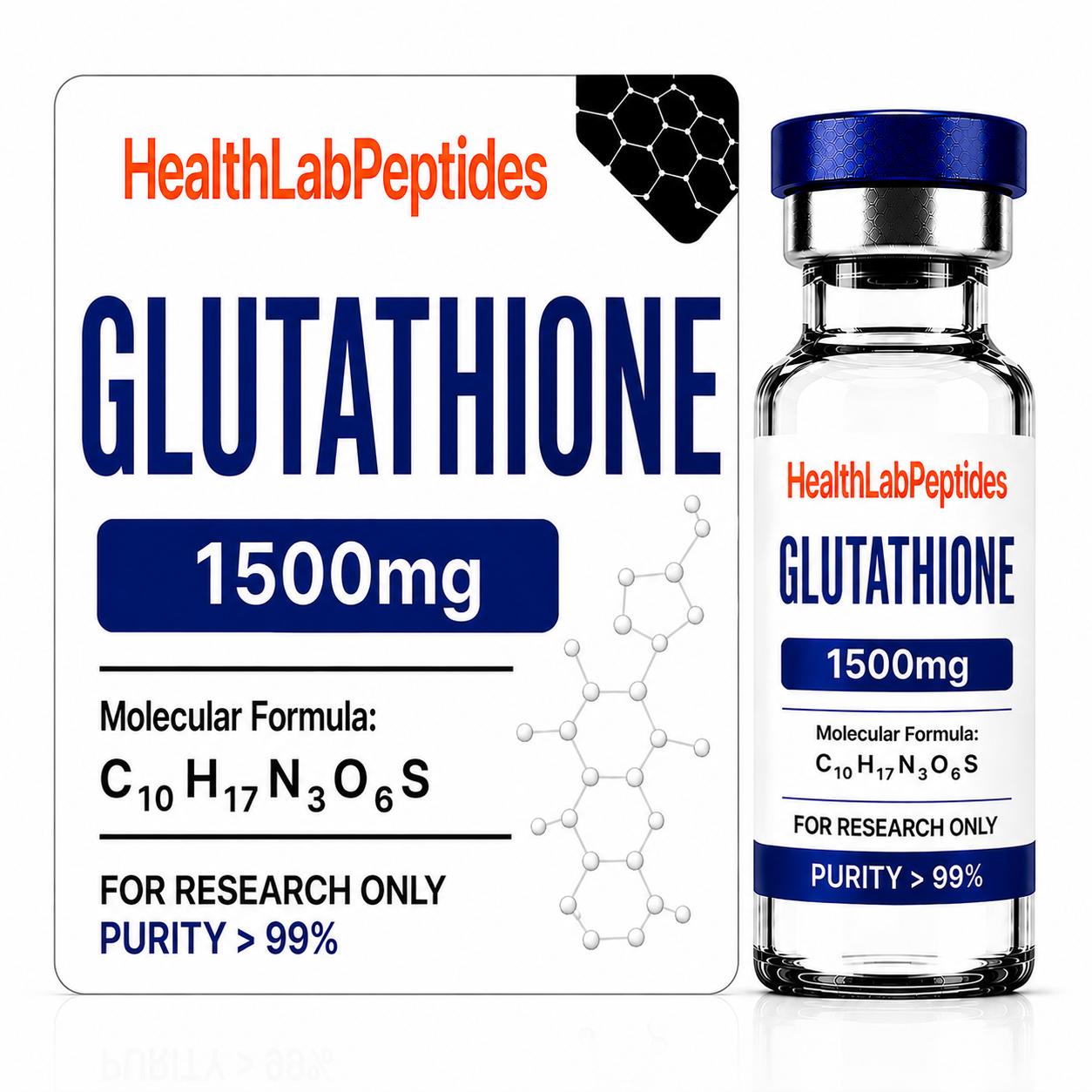
Research suggests that glutathione and nicotinamide adenine dinucleotide (NAD) participate in distinct but connected biochemical systems relevant to cellular redox measurements. One common source of confusion is the assumption that NAD+, NADH, NADP+, NADPH, reduced glutathione (GSH), and oxidized glutathione (GSSG) are interchangeable markers of a single antioxidant pathway. They are not. Each has a specific molecular role, and different experimental assays measure different parts of the system. This research explainer compares the chemistry, enzyme-associated reactions, and analytical limitations that matter when studying these molecules in cells. It does not describe a health or medical application for laboratory materials. For a broad introduction to molecular classes, see the HealthLab peptide and amino-acid research overview.
What glutathione actually is
Glutathione is a tripeptide built from glutamate, cysteine, and glycine. Its chemical structure includes an unusual gamma-glutamyl linkage, and the cysteine residue contributes a sulfur-containing group important in many redox reactions. The reduced form is abbreviated GSH. Under certain reactions, two glutathione units form the oxidized disulfide form, GSSG. Researchers may measure the amounts or ratio of these species to investigate the biochemical state of a cell or preparation. Such measurements do not constitute a simple diagnosis or prove that supplying a research material will change an organism’s health.
What NAD+ and NADH mean
NAD stands for nicotinamide adenine dinucleotide, a nucleotide-derived cofactor rather than a peptide. NAD+ is an oxidized form, while NADH is a reduced form that carries electrons in many biochemical pathways. The ratio between them matters to particular metabolic reactions, but the total concentration and compartment can also influence interpretation. The terms are not synonyms for glutathione, and neither molecule is properly classified as a peptide merely because it appears in a peptide-research catalog. Using accurate chemical classifications improves both laboratory documentation and the clarity of an educational article.
NADP+ and NADPH are not the same pair as NAD+/NADH
NADP+ and NADPH contain an additional phosphate group and participate in many biosynthetic and redox-associated processes. Although structurally related to NAD+ and NADH, they should be tracked separately. A biochemical reaction dependent on NADPH cannot automatically be described as dependent on NAD+ without demonstrating how the relevant cofactors are interconverted or supplied. The difference is especially important when discussing glutathione reductase, which uses NADPH to reduce GSSG back to GSH. A statement that NAD+ directly recharges glutathione would therefore be a misleading simplification of the enzyme system.
The glutathione redox cycle in laboratory biochemistry
Glutathione peroxidases can use GSH in reactions involving peroxide substrates. In the process, reduced glutathione is converted to the oxidized disulfide form. Glutathione reductase can then regenerate GSH from GSSG, with NADPH serving as the reducing cofactor. This biochemical cycle is described in major reviews of glutathione and cellular redox biology, including work indexed under PMID 36707132. It is a measurable reaction network, not a general promise of detoxification or improved well-being. Assays should distinguish enzyme activity, substrate concentrations, and the actual form of glutathione detected.
Why NADPH is central to the regeneration step
In the glutathione reductase reaction, NADPH supplies reducing equivalents. This role belongs to the NADP(H) cofactor pair, which is related to but distinct from the NAD(H) pair. The connection helps explain why a paper on NAD metabolism may discuss glutathione without claiming that all NAD-related molecules act interchangeably. Investigators should be careful with abbreviations: omitting the letter P can change the meaning of an enzyme reaction. Good figures and table labels distinguish NAD+, NADH, NADP+, NADPH, GSH, and GSSG rather than folding everything into a general antioxidant label.
The pentose phosphate pathway and cellular NADPH
The oxidative pentose phosphate pathway is one source of NADPH in cells. A 2023 review in Nature Metabolism, DOI 10.1038/s42255-023-00863-2, explains how this pathway participates in NADPH generation and other metabolic processes. NADPH supports both reductive biosynthetic chemistry and certain redox-regulating systems. It can also be used by enzymes that deliberately generate reactive species for signaling. Thus, more NADPH is not automatically synonymous with a universally favorable cellular outcome. The meaning of a measured level depends on cell type, compartment, metabolic state, and what the research question asks.
A major review of NAD redox couples
A review titled “NAD(H) and NADP(H) Redox Couples and Cellular Energy Metabolism,” PMCID PMC5737637, describes how the two pyridine-nucleotide systems connect to energetic and redox processes. It identifies the NADP(H)-dependent role of glutathione reductase alongside other redox enzymes, while discussing why oxidative and reductive stresses are both biologically relevant. This is valuable background for an evidence-based comparison of NAD and glutathione. The review does not establish that a laboratory material can be administered to produce a particular effect. It also emphasizes that the biochemical role of a redox species depends on the surrounding metabolic network.
GSH to GSSG ratio: Useful but not a complete story
The ratio of reduced to oxidized glutathione may provide information about the redox state of an experimental preparation. However, a bulk measurement does not necessarily reveal the separate conditions within cytosol, mitochondria, or other compartments. Sample handling and analytical oxidation can also affect the measured distribution. A result should therefore report the method, cell model, and limitations rather than treat one number as a universal antioxidant score. The ratio is one biomarker among many, and it cannot by itself establish that a research material produces improved health or clinical protection.
Enzyme activity versus concentration measurements
Researchers can measure glutathione concentration, glutathione reductase activity, glutathione peroxidase activity, or metabolites in a particular compartment. These are not interchangeable endpoints. A change in enzyme activity can occur without a proportional change in bulk glutathione level, and a change in GSH may reflect multiple interacting pathways. In the NAD-related systems, total cofactor amounts may also differ from redox ratios. When an article says that a pathway increased, it should identify what was actually measured and whether direct evidence supports the pathway-level inference. That distinction protects readers from exaggerated molecular conclusions.
Reactive oxygen species are not one uniform measurement
Reactive oxygen species, often abbreviated ROS, is a broad term covering several chemically distinct reactive species. These molecules may contribute to regulated signaling as well as cellular damage, depending on context. A single fluorescent probe or generic oxidative-stress assay may be sensitive to more than one reaction and can be affected by experimental conditions. Consequently, the presence of a ROS signal does not identify a complete molecular mechanism. An accurate research review should distinguish direct chemical detection from proxy signals, and avoid assuming that suppressing every measured reactive species is universally desirable.
Why glutathione and NAD+ should not be combined into a benefit claim
A common marketing mistake is to present two well-studied molecules as automatically complementary because both appear in cellular metabolism. Biochemical relationships do not establish a beneficial interaction when two research materials are combined. A direct combination experiment would need defined materials, appropriate controls, a meaningful endpoint, and evidence that its results differ from independent component responses. Even then, the interpretation would be limited to the experiment. Scientific plausibility is not a substitute for testing. The strongest educational comparison explains the pathways rather than suggesting a consumer stack or synergy.
Cellular compartment matters
Metabolic redox systems operate in distinct cellular compartments with different transport mechanisms, protein populations, and local substrate availability. A result in whole-cell lysate may reflect an average over compartments rather than a specific mitochondrial or cytosolic condition. Mitochondrial NAD pools and glutathione-related systems can be investigated with specialized methods, but those methods introduce their own assumptions. Readers should examine whether a study directly measured compartment-specific species or inferred their behavior from a whole-cell signal. The biological interpretation changes with that distinction.
Glutathione and protein-thiol research
Beyond serving as a substrate in peroxide-associated reactions, glutathione participates in redox regulation involving protein cysteine residues. Reversible modifications such as S-glutathionylation are studied as part of cellular signaling and protein function. A 2023 review indexed under PMID 36707132 discusses these processes together with other biochemical roles. The topic illustrates why simple antioxidant language is inadequate: glutathione participates in signaling regulation, not only in the removal of unwanted chemicals. An observed modification should be described in terms of the specific protein and experimental model.
How to choose a meaningful research question
One scientific question is whether a test condition changes NADH relative to NAD+ in a particular cell system. Another asks whether glutathione reductase maintains a defined GSH/GSSG balance in a model preparation. A third considers how pentose-phosphate-pathway activity supports NADPH availability. All three involve related metabolic biology, but they require different assays and controls. A well-structured study describes the measured molecular species, sampling time, biological replication, and uncertainty. Combining unrelated endpoints into a broad statement that cellular health improved would not be justified by the measurements alone.
Catalog identity and laboratory restrictions
HealthLab provides separate catalog listings for glutathione research material and NAD+ research material. These listings identify different molecular entities; neither is a medical treatment or a recommendation to use the materials together. The declared label quantity should not be interpreted as a suggested use level. A Certificate of Analysis may document selected properties of a particular batch, but its existence does not establish clinical safety or regulatory approval. Laboratory documentation should preserve the distinct chemical identities and should not describe NAD+ as a peptide.
Frequently asked laboratory questions
Is glutathione a peptide? Yes, it is a tripeptide with a distinctive linkage. Is NAD+ a peptide? No, it is a nucleotide-derived cofactor. Does glutathione reductase use NAD+ directly? The established reductase reaction depends on NADPH. Is GSH the same as GSSG? No, they represent reduced and oxidized glutathione species. Do higher measurements always mean better biology? No, values require model-specific interpretation. Do these biochemical relationships justify personal administration? No.
Selected literature identifiers
Glutathione biochemistry review, PMID 36707132; glutathione and cellular processes review, PMID 36386929; “NAD(H) and NADP(H) Redox Couples and Cellular Energy Metabolism,” PMCID PMC5737637; and “The Pentose Phosphate Pathway in Health and Disease,” Nature Metabolism (2023), DOI 10.1038/s42255-023-00863-2. These sources establish molecular terminology and the context of experimental reactions. They do not validate the administration or use of catalog materials in humans or animals.
Conclusion: Related pathways, different molecules
Glutathione and NAD-related cofactors belong to connected biochemical networks, but they have separate structures and functions. Reduced glutathione, oxidized glutathione, NAD+, NADH, NADP+, and NADPH must be named accurately for a research result to be interpreted. The most defensible educational approach is to explain the reactions, identify the assays, and state their limits. Molecular relationships may generate valuable hypotheses, but they are not evidence of consumer benefits or approved medical applications. This distinction keeps laboratory research content useful and accurate.
Research use restriction
For Research Use Only. Not for human consumption, medical, or veterinary use. This article provides no dosing, injection, administration, supplementation, or personal-use guidance. These statements have not been evaluated by the FDA. The materials discussed are not intended to diagnose, treat, cure, or prevent any disease.


